Last updated: October 2026
Quick answer: The cookware worth investing in this fall is a small set of durable, versatile pieces: an enamelled cast iron Dutch oven, a cast iron skillet, a heavy stainless steel sauté pan, a large stockpot, a carbon steel pan, and rimmed baking sheets, bought one at a time.
There is a moment every autumn when cooking shifts up a gear. Summer’s quick salads and grilled bits give way to slow braises, bubbling stews, crusty loaves, and roasts that fill the house with warmth. And it is exactly at that moment that your cookware either rises to the occasion — or lets you down. The thin pan with the wobbly handle, the pot that scorches everything, the lid that never quite fits: fall cooking exposes every weakness in the cupboard.
The good news is that you do not need a kitchen full of expensive equipment to cook beautifully. What you need is a small number of genuinely good pieces — the work horses that handle most autumn cooking and last for decades if you treat them well. In our experience, a well-chosen collection built slowly beats a matching set bought in a day, and your cooking will tell you what you actually need next.
What Does “Worth Investing In” Actually Mean?
Investment cookware is not about price tags. It means pieces made from lasting materials, versatile enough for dozens of jobs, and repairable or re-conditionable, so they earn their place in your kitchen year after year.
Before we get to the pieces, a word on what makes cookware worth investing in — because it is not about price tags. A well-made cast iron skillet that you use three times a week for thirty years costs you very little per use. A cheap non-stick pan that warps and flakes within two years is the expensive one, whatever the receipt says. Investment cookware is defined by longevity, versatility, and how much pleasure it gives you to use.
The pieces worth your money share three traits:
- Lasting materials: cast iron, carbon steel, stainless steel, enamelled cast iron, and copper improve with age or at least do not degrade quickly.
- Versatility: the best pieces handle dozens of jobs, which is why a Dutch oven beats a single-purpose gadget every time.
- Repairability: a cast iron pan can be re-seasoned, a stainless steel pot can be scrubbed back to life, and a good knife can be sharpened.
One more principle: buy once, buy well, and buy in the right order. You do not need all nine pieces on this list tomorrow. Start with the piece that fills the biggest gap in your cooking, use it until you love it, then add the next.
1. The Enamelled Cast Iron Dutch Oven
An enamelled cast iron Dutch oven is the single most versatile piece on this list, handling braises, stews, soups, bread, and roasts from hob to oven to table with ease.
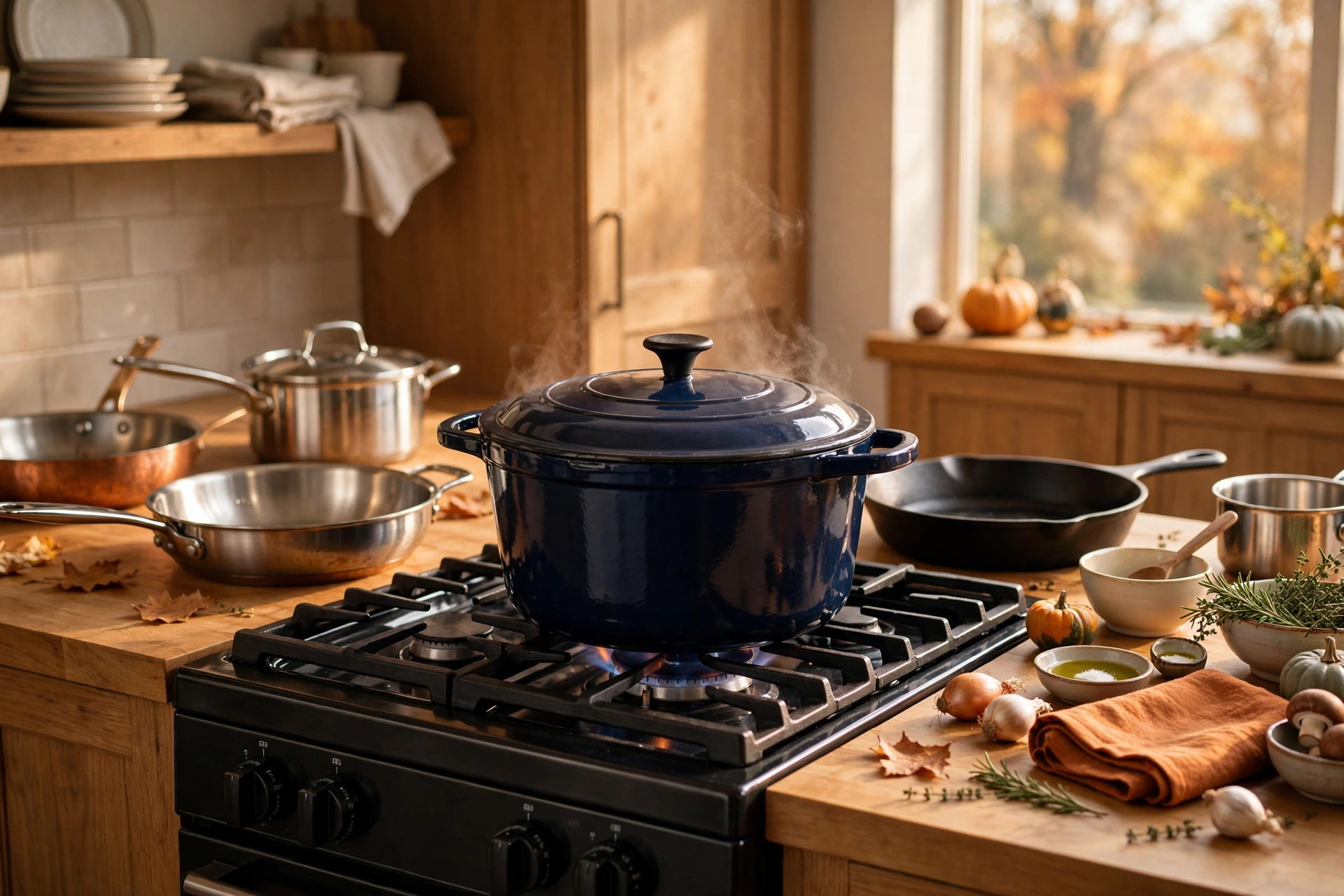
If you buy one piece from this entire list, make it this one. The enamelled cast iron Dutch oven — the heavy, lidded pot in cheerful colours — is the single most versatile piece of cookware ever made, and autumn is its season. It braises, stews, bakes bread, roasts a chicken, simmers soup, fries, and goes from hob to oven to table without a second thought. There is almost nothing in fall cooking it cannot do.
What to look for:
- A heavy, even-casting body with a tight-fitting lid — the lid traps steam and bastes your food as it cooks.
- A light-coloured enamel interior, which lets you see browning properly.
- A 5 to 6 litre size for most households: big enough for a batch of stew or a loaf of bread, not so big it is unwieldy.
The well-known premium brands are superb, but mid-range options perform remarkably well — the design is simple enough that you are not paying purely for the name. Care is easy: no seasoning needed, hand wash with warm soapy water, avoid thermal shock like plunging a hot pot into cold water, and use wooden or silicone utensils to protect the enamel. With that minimal care, a good Dutch oven will cook for you for the rest of your life — and then for someone else’s. It is the definition of an heirloom purchase.
2. The Cast Iron Skillet
A cast iron skillet sears, roasts, and bakes better than almost any other pan, and its simple care routine — wash, dry thoroughly, and oil lightly — keeps it improving with every use.
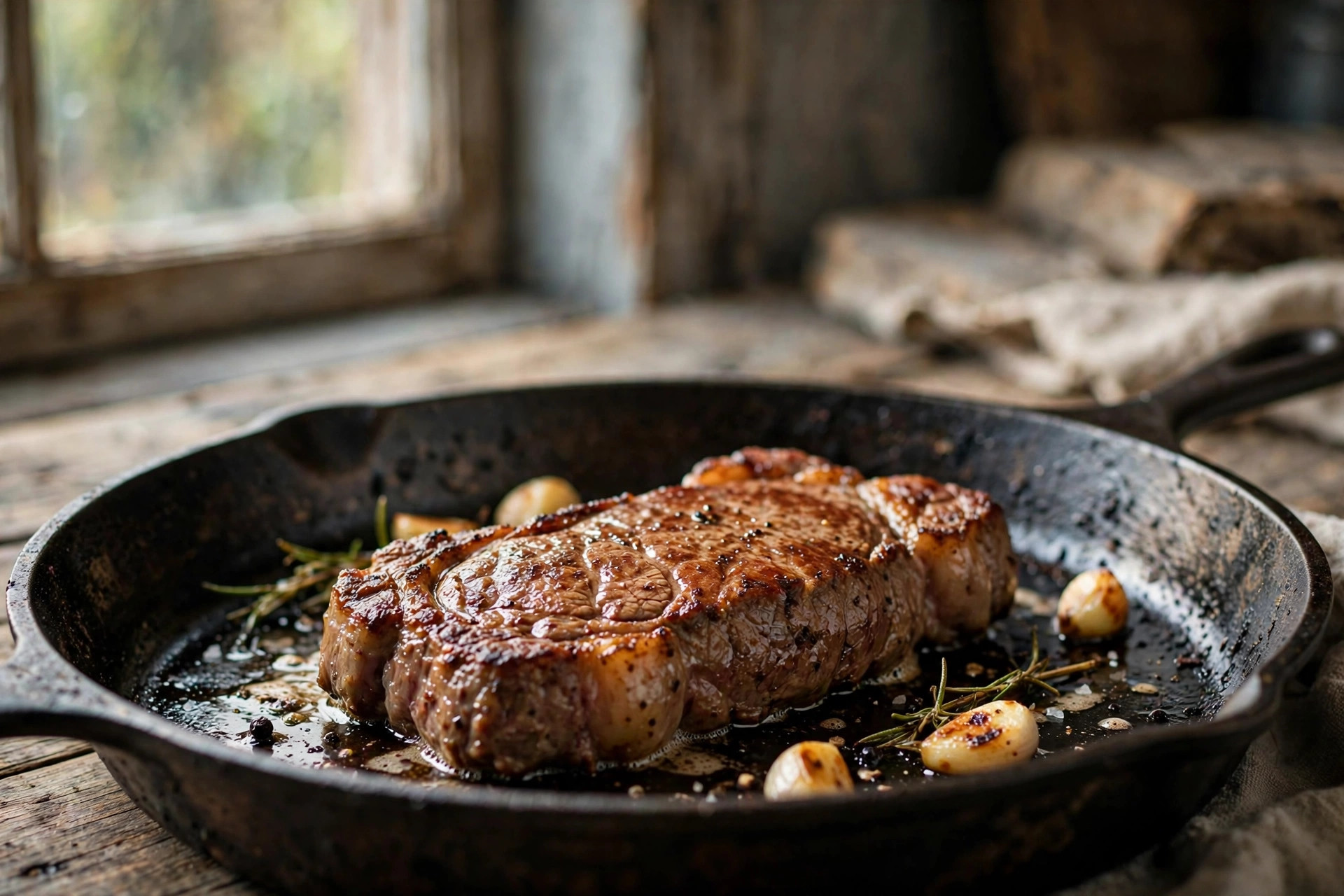
The cast iron skillet is the Dutch oven’s scrappy sibling: cheaper, lighter on features, heavier on character. It sears steaks better than any other pan in your kitchen, roasts vegetables to caramelised perfection, bakes cornbread with an unbeatable crust, and goes from stovetop to oven to campfire. Every serious home cook should own one, and autumn — roast season, sear season, cornbread season — is the time to start.
What to look for:
- A pre-seasoned skillet from a reputable foundry, with a smooth-ish cooking surface and a comfortable handle.
- A 26 to 30 centimetre size, the sweet spot for most cooking — big enough for four chicken thighs or a proper frittata.
- The classic round shape, not gimmicky shapes: it is classic because it does everything.
Here is the open secret of cast iron: the affordable, workhorse brands perform essentially as well as the expensive heritage ones. Cast iron is cast iron. Care is where cast iron’s reputation gets dramatic, but the reality is simple. Wash with hot water and a brush — a little soap is fine despite the old myths — dry it thoroughly on a warm hob, and rub in a whisper-thin layer of oil while it is still warm. That is it. The seasoning builds with use: the more you cook, the better it gets. Avoid long soaks and the dishwasher, and never let it air-dry wet.
3. A Heavy Stainless Steel Sauté Pan
A heavy, fully clad stainless steel sauté pan is your everyday responsive pan for sauces, sautés, one-pan pasta, and deglazing, offering the precise heat control cast iron cannot and making weeknight cooking noticeably easier.
Cast iron gets the romance, but stainless steel does the everyday work. A heavy, tri-ply stainless steel sauté pan — straight sides, a lid, around 28 centimetres — is the pan you will reach for constantly: sauces, sautés, one-pan pasta dishes, reheating, deglazing. Where cast iron is slow to heat and slow to cool, stainless steel is responsive, which makes it better for anything needing precise heat control.
What to look for:
- “Tri-ply” or “fully clad” construction, meaning aluminium or copper sandwiched through the base and up the sides — this eliminates hot spots.
- A weighty feel, with a comfortable handle that stays cool and a lid that fits snugly.
- Solid mid-range quality: the cheapest thin stainless steel pans warp and scorch, while a solid mid-range pan performs beautifully for decades.
Care is gloriously low-maintenance. Stainless steel is dishwasher safe, scouring-pad tolerant, and nearly indestructible. For stuck-on food, deglaze the hot pan with water or simmer a little water with baking soda. A suitable stainless steel polish brings back the shine when it dulls. The rainbow discolouration that appears with heat is harmless and cosmetic.
4. A Large, Good-Quality Stockpot
A large 8 to 10 litre stockpot with a thick, heavy base is indispensable for soup, stock, and batch cooking, heating big volumes of liquid evenly without scorching, throughout the colder months.
Autumn is soup season, stock season, and batch-cooking season, and all of them need one thing: a big pot. A 8 to 10 litre stockpot handles everything from chicken stock to a triple batch of chilli to blanching vegetables to cooking pasta for a crowd. It is deeply unglamorous and utterly indispensable.
What to look for:
- A thick, heavy base for even heat — thin stockpots scorch on the bottom, which ruins stocks and soups.
- Stainless steel: non-reactive, easy to clean, and durable.
- A pasta insert or steamer basket as a genuinely useful extra.
Do not overspend here; a solid, heavy-based pot from a mid-range brand does the job perfectly. One tip that elevates every stockpot: learn to make stock in it. A chicken carcass, vegetable trimmings, water, and a few hours of the gentlest simmer produce a stock that transforms every soup, stew, and risotto you make afterwards. Freeze it in portions and you have liquid gold on demand all winter.
Safety note: the USDA Food Safety and Inspection Service safe temperature chart lists 165°F as the safe minimum internal temperature for all poultry, and 160°F for ground meats. The USDA also advises refrigerating leftovers within 2 hours of cooking, according to its leftovers and food safety guidance.
5. A Carbon Steel Frying Pan
A carbon steel frying pan seasons like cast iron but is lighter and more responsive, making it ideal for stir-fries, omelettes, sautéed greens, and fried eggs with crisp edges, for busy weeknight cooking.
Carbon steel is cast iron’s lighter, nimbler cousin — the pan of professional kitchens and crêpe masters. It seasons like cast iron, sears beautifully, and is significantly lighter, which makes it a joy for anything involving tossing or flipping: stir-fries, omelettes, sautéed greens, fried eggs with lacy crisp edges. If you love your cast iron but wish it were less of a workout, carbon steel is your answer.
What to look for:
- A long handle (it gets hot — that is what oven gloves are for), a smooth interior, and a thickness that feels substantial without being exhausting.
- The classic French-style shape, which is refreshingly affordable and the benchmark for this kind of pan.
- A pan you will use often, since it arrives needing seasoning and improves with every use, heating and cooling faster than cast iron for more control.
Care mirrors cast iron: hand wash, dry thoroughly, light oiling. Carbon steel is more prone to rust than cast iron if neglected, so the dry-it-properly rule matters even more. But used regularly — which it will be, because it is such a pleasure — it stays in beautiful condition with almost no effort.
6. A Rimmed Baking Sheet (or Three)
Heavy-gauge rimmed aluminium baking sheets stay flat in a hot oven, conduct heat evenly, and handle roasting, traybakes, biscuits, and sheet-pan dinners better than thin, warping alternatives, for reliable everyday autumn cooking.
The humble sheet pan is the hardest-working piece in autumn cooking, and most kitchens are under-equipped. Roasted root vegetables, traybakes, sheet-pan dinners, biscuits, roasted chicken parts, granola — the rimmed baking sheet does all of it. The reason to invest rather than make do: cheap thin sheets warp in a hot oven with an alarming bang, buckling your food into a sad, uneven pile. Heavy-gauge sheets stay flat and conduct heat evenly.
What to look for:
- Heavy-gauge aluminium, rimmed on all four sides, in the standard half-sheet size.
- At least two sheets — one for roasting while the other holds prep, or both in the oven at once for big batch sessions.
- Individual sheets are inexpensive, so this is the easiest upgrade on the list with one of the biggest daily impacts.
Care: hand wash to preserve them, though they tolerate the dishwasher. Line with baking parchment or a silicone mat for easy cleanup and to protect the surface. Darkened, seasoned sheets are not dirty — they are well-loved, and many bakers swear older sheets perform better. Replace them only when they warp or the coating fails, which with heavy-gauge pans takes years.
7, 8 and 9: What About the Supporting Cast?
The final three pieces round out a complete autumn kitchen: a small lidded saucepan for daily jobs, a braiser for slow covered cooking, and an oven thermometer that reveals whether your oven truly runs at the set temperature.
The final three pieces round out a complete autumn kitchen without any single-purpose clutter.
| Piece | Best for | Why it earns its place |
|---|---|---|
| 7. A 2 to 3 litre saucepan with a lid | Grains, sauces, reheating, melting, blanching | Heavy-based stainless steel; the small daily jobs you do most often |
| 8. A cast iron or enamelled braiser | Short ribs, chicken thighs, slow covered braises | Wide searing surface plus a heavy lid, built for autumn cooking |
| 9. An oven thermometer | Baking and roasting accurately | Most home ovens run hot or cold, which sabotages results people blame on recipes |
If your Dutch oven is the all-rounder, the braiser is the specialist that earns its place every single week from October to March. Many cooks find it becomes their most-used pot. And the oven thermometer is the cheapest item on this list and quietly one of the most transformative: it tells you the truth about your oven, and adjusting accordingly improves everything that comes out of it. It is not glamorous; it is just correct.
What Should You Skip for Now?
Skip single-purpose gadgets, enormous matching sets, high-maintenance copper, and yearly non-stick replacements, choosing instead the good version of the tools you genuinely love and reach for, season after season in your own kitchen.
A word on what not to buy, because restraint is part of smart investing:
- Skip single-purpose gadgets: the unitaskers that clutter cupboards and rarely earn their space.
- Skip the enormous matching set: you will use four pieces constantly and the rest will gather dust.
- Skip copper unless you are an enthusiast: it is beautiful and performs wonderfully, but it demands polishing and costs a fortune for gains most home cooks will never notice.
- Skip replacing non-stick every year: a non-stick pan has a place — eggs, delicate fish — but treat it as a consumable, not an investment. Buy a decent affordable one, use it gently, and replace it when the coating wears.
- Skip anything you will not enjoy maintaining: the best cookware investment is the one you actually reach for, season after season.
How Should You Build Your Collection This Fall?
Start with the piece that fixes your biggest cooking frustration, use it until you love it, then add the next one — within a couple of autumns you will own a collection that makes every cold-weather meal easier.
Start where your cooking hurts most. If your stews scorch, get the Dutch oven. If your steaks never sear, get the cast iron skillet. If your roasts cook unevenly, get the heavy sheet pans and the oven thermometer. One piece, used and loved, then the next. Within a couple of autumns you will have a collection that makes every cold-weather meal easier and better.
Good cookware is one of the few purchases that genuinely pays you back — in better dinners, in the pleasure of tools that work properly, and in decades of service. This fall, invest in the pieces that earn their place. Your future self, stirring a perfect stew in a pot that will outlive you both, says thank you.
Leave a Reply