
Last updated: October 2026
Quick answer: A calm Christmas routine is a set of daily habits that keeps the holiday season soft instead of stressful: quiet mornings, honest boundaries, simple gift-giving, and peaceful evenings. It is not a strict schedule. Pick three things that matter, leave white space in your calendar, and close each day gently.
December has a way of speeding up without asking you first. One day you are sipping tea in November, and the next your calendar is full of parties, shopping lists, and family plans. If the holidays usually leave you tired instead of happy, you are not alone. The good news is that Christmas does not have to feel like a race. A calm Christmas routine is a small set of gentle habits that keeps the season soft, slow, and enjoyable. No perfect tree, no endless parties, no pressure to do it all. Just quiet mornings, honest boundaries, and evenings that end peacefully. This guide will help you build your own calm Christmas routine, one small step at a time.
What is a calm Christmas routine?
Quick answer: A calm Christmas routine is a handful of daily habits that protect your peace during a busy season: one quiet morning moment, one kind boundary, and an evening that belongs to you. Everyone’s version looks different. What matters is choosing your season on purpose instead of letting it choose you.
A calm Christmas routine is not a strict schedule. It is a soft rhythm underneath the holidays, built on three daily pillars:
- One quiet morning moment. A few minutes that belong to you before the day begins.
- One kind boundary. A clear, warm limit that protects your time or energy.
- One peaceful evening. A gentle close to the day, instead of more noise.
You are far from alone in wanting this. In a 2023 American Psychological Association poll of 2,061 U.S. adults, 89% said something causes them stress during the holiday season, and 41% said their stress increases during the holidays compared with other times of year (APA, 2023).
How do I slow down December before it speeds up?
Quick answer: December speeds up because we say yes too quickly. To slow it down, review your calendar honestly in early December, pick three non-negotiable events, leave free days between plans, shop in small weekly batches, and lower one standard you do not truly need.
December fills up fast because we say yes too quickly. Before the month begins, sit down with your calendar and look at it honestly: which events actually sound lovely, and which ones make your stomach tighten?
Try these small steps in early December:
- Pick your three non-negotiables. Three things that truly matter to you this Christmas. Everything else is optional.
- Leave white space. For every planned day, keep one day free. Empty days are where calm lives.
- Shop early, in small batches. One short trip a week beats a frantic last-minute rush.
- Lower one standard. Store-bought cookies are fine. A smaller tree is fine. Nobody is grading you.
The difference is easier to see side by side:
| Rushed December | Calm December | |
|---|---|---|
| Calendar | Every evening booked | Free days between plans |
| Shopping | One frantic last-minute rush | Small batches, one short trip a week |
| Gifts | Bought under pressure | Decided early, wrapped slowly |
| Standards | Perfect tree, perfect table | One lowered standard is fine |
| Evenings | Scrolling and more planning | Tree lights, tea, and early bed |
Slowing down is not laziness. It is how you make room for the parts of Christmas you actually love.
How does a calm Christmas routine start each morning?
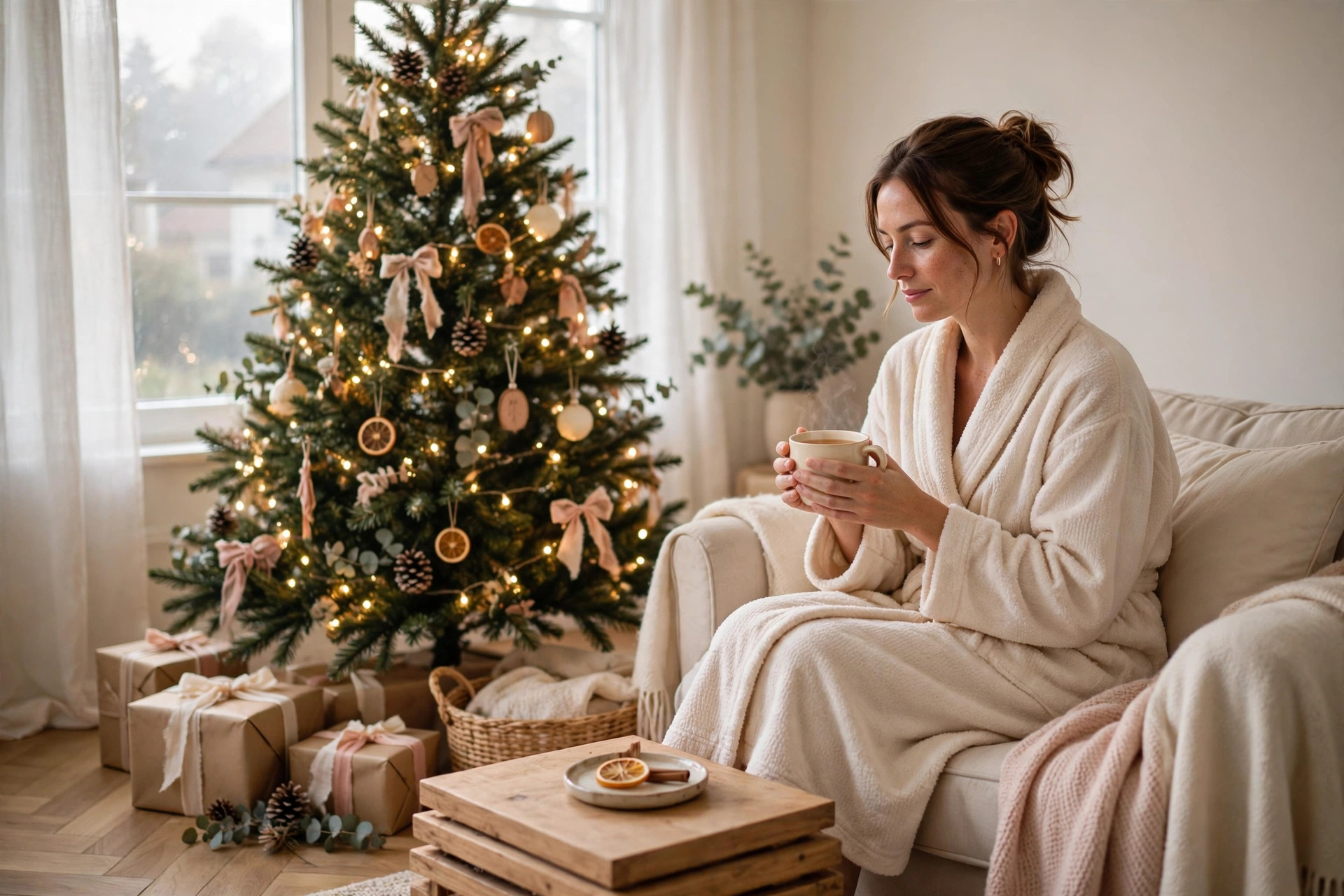
Quick answer: A calm Christmas morning protects the first twenty minutes of your day. Wake a little earlier, make a warm drink, sit by the tree for a minute, write one line about today, and pick your single most important plan. On the busiest days, shrink the ritual instead of skipping it.
Protect the first twenty minutes of the day with these simple steps:
- Wake a little earlier. Even fifteen minutes before the house wakes up is enough.
- Make something warm. Tea, coffee, or warm milk with cinnamon. Hold the cup and breathe before touching your phone.
- Look at the tree. Sit near it for a minute. The soft lights in a quiet room are their own kind of meditation.
- Write one line. One thing you are looking forward to today. That is all.
- Check the day lightly. Glance at your plans, pick the one thing that matters most, and let the rest be flexible.
On the busiest days, shrink the ritual instead of skipping it. One warm drink and three slow breaths still count.
How can I give Christmas gifts without the stress?
Quick answer: Stress-free gift-giving comes down to deciding early and keeping it simple. Set one total budget and write it down, list each person with a single gift idea, choose thoughtful over expensive, wrap a little each evening, and give yourself permission to go simple with gift cards or homemade treats.
Gifts cause more Christmas stress than almost anything else: the money, the crowds, the fear of choosing wrong. In the American Psychological Association’s 2023 holiday poll, 58% of U.S. adults said spending too much or not having enough money causes them stress, and 40% said finding the right gifts does (APA, 2023). Deciding your budget once, early, removes the biggest source of that pressure.
- Set a simple budget early. Decide the total once, write it down, and stop thinking about it.
- Make a short list. Write each person’s name and one idea. When the list is done, the shopping is done.
- Choose thoughtful over expensive. A handwritten letter with a small gift often means more than something costly.
- Wrap slowly. Put on soft music and wrap one evening at a time. Rushing ruins the fun.
- Give yourself permission to go simple. Gift cards, baked treats, and donations in someone’s name are all perfectly lovely.
Remember: the people who love you want your presence more than your presents. A calm giver gives better gifts anyway.
How do I set kind boundaries with family at Christmas?

Quick answer: Kind boundaries are clear, warm statements about what you need, made before the gathering starts. Decide your limits on time, topics, and alcohol in advance. Repeat a gentle no without new explanations, build in an exit, and protect one small tradition that is just yours.
Family is the heart of Christmas, and sometimes the hardest part. A calm Christmas routine includes boundaries said with love, not guilt.
Boundaries are not walls. They are clear, kind statements about what you need. “We would love to come for dinner, and we will head home by nine so the kids can sleep.” Honest, warm, and specific.
- Decide before you arrive. Know your limits on time, topics, and alcohol before the gathering starts.
- Use the broken record. Repeat your kind no without new explanations. “That does not work for us this year” is a complete sentence.
- Build in an exit. Drive separately or plan a reason to leave. Knowing you can go makes staying easier.
- Protect one tradition of your own. Keep one small ritual that is just yours, even during family days.
People may be surprised the first time you set a boundary. Most of them adjust. And you will enjoy the gathering far more when you are not running on empty.
How can I end busy December evenings softly?

Quick answer: End busy December evenings softly. Dim the lights and keep the tree on, put your phone away for one screen-free hour, drink something warm, and spend ten quiet minutes journaling or stretching. A calm Christmas routine also means a decent bedtime, since tired and festive do not mix well.
Try an evening wind-down that fits the season:
- Dim the lights, keep the tree on. Let the tree lights be the evening glow while you unwind.
- One screen-free hour. Put the phone away after dinner. The sales will still be there tomorrow.
- Something warm to drink. Herbal tea or warm milk. The ritual tells your body the day is done.
- Ten quiet minutes. Sit, stretch, or write a few lines in a journal. No agenda.
- Bed at a decent hour. Tired and festive do not mix well. Sleep is a holiday gift to yourself.
That last point matters more than most people realize. The U.S. Centers for Disease Control and Prevention recommends that adults sleep at least 7 hours each night, yet more than a third of American adults regularly get less (CDC). In our experience, protecting a real bedtime through December is one of the simplest ways to keep the whole season feeling calm.
Evenings like these are what you will remember in January, not the extra errands.
How do I say no to holiday plans without feeling guilty?

Quick answer: A kind no follows a simple pattern: thank the person warmly, decline clearly, and do not over-explain. You can offer an alternative when you want to, like a quiet coffee in January. Measure every invitation against your three non-negotiables, and let the rest go.
Saying no gets easier with practice: decline one optional event this week and notice how much lighter you feel.
- Thank, then decline. “Thank you so much for thinking of me. I cannot make it this year.” Warm and final.
- Offer an alternative when you want to. “I cannot do the party, but I would love a quiet coffee in January.”
- Do not over-explain. Long excuses invite negotiation. Short kindness closes the door gently.
- Remember your three non-negotiables. If it is not one of them, it is a safe no.
A kind no protects your yes. Every party you skip makes the ones you attend more joyful.
How do I reset gently after Christmas and before the New Year?

Quick answer: A gentle post-Christmas reset means resting before you resolve anything. Tidy one small space, take a quiet winter walk, write a short gratitude list, and give yourself three slow days before thinking about the new year. Carry your favorite calm Christmas habit into January.
The days between Christmas and New Year are a gift most of us waste by rushing into resolutions. A calm Christmas routine ends with a gentle reset, not a dramatic overhaul.
- Tidy one small space. A drawer, a shelf, your nightstand. Small order calms a busy mind.
- Take a quiet walk. Fresh winter air clears the leftover holiday buzz better than anything.
- Write a short gratitude list. Five good things from this Christmas. Keep it somewhere you will find next December.
- Rest before you resolve. Give yourself three slow days before thinking about the new year at all.
- Keep one ritual going. Pick your favorite calm Christmas habit and carry it into January. Peace should not expire on December 26.
The walk is worth protecting on purpose. The World Health Organization recommends at least 150 minutes of moderate-intensity activity per week for adults aged 18–64, and notes that any amount of movement is better than none, with more bringing greater benefits (WHO). A short stroll between Christmas and New Year counts, and it clears the holiday buzz beautifully.
End the season the way you lived it: gently.
Frequently Asked Questions About a Calm Christmas Routine
Quick answer: These are the questions we hear most about keeping Christmas calm, from stressful family gatherings to handling the holidays alone or with young kids. The answers are short and practical, and every one of them works with the calm Christmas routine described above.
How do I stay calm when my family is stressful?
Decide your boundaries before you arrive, keep visits shorter than you think you should, and give yourself permission to step outside for air. You cannot control how others behave, but you can control how long you stay and how you respond.
What if I cannot afford many gifts?
Set your budget early and stick to it without shame. Thoughtful, simple gifts, like a letter, baked treats, or time together, often mean more than expensive ones. The people who matter will understand.
How do I handle Christmas alone?
Build your own rituals: a special meal, a walk to see the lights, a favorite film, a call with someone you love. Being alone at Christmas can be peaceful when you plan it with care instead of dreading it.
Can a calm Christmas routine work with young kids?
Yes, and kids often love it. Fewer events, earlier bedtimes, simple traditions repeated each year. Children remember the feeling of Christmas far more than the number of presents.
A calm Christmas routine is not about doing less for the sake of it. It is about making room for what matters: warmth, rest, and the people you love. Start with one small habit this week, a quiet morning or a kind no, and let the calm grow from there. Save this guide, share it with a friend who needs a softer December, and give yourself the gift of a peaceful holiday.
Leave a Reply