
Last updated: October 2026
Quick answer: A cosmic reset is a gentle 20- to 40-minute wind-down built from dim light, one point of focus and a closing gesture. Look at the moon, light a candle, write a few lines or walk outside — a rhythm that marks the day as done and helps you ease into rest.
Some evenings, the day clings to you — the inbox, the noise, the mental to-do list still scrolling at 10pm. The “cosmic reset” is a gentle answer to that feeling: a collection of slow, starlit evening rituals inspired by the night sky, moon phases and quiet reflection, designed to help you consciously close the day and slip into rest. It’s one of Pinterest’s fastest-rising hobby trends, and its appeal is obvious — who doesn’t want their evenings to feel a little more magical?
Let’s be clear about what this is and isn’t. A cosmic reset isn’t a belief system, a spiritual practice you must commit to, or a promise of any particular outcome. Think of it instead as an aesthetic and a rhythm: dim the lights, look up at the sky, do something slow and intentional, and let your body get the message that the day is done. Whether you find the moon romantic, the stars awe-inspiring, or candlelight simply cosy, there’s a version of this ritual with your name on it.
What Does a Cosmic Reset Actually Look Like?
At its simplest, a cosmic reset is a 20- to 40-minute wind-down with three ingredients: dimness, a single point of focus, and a small closing gesture. Light a candle and write three lines before blowing it out, or step outside and look at the moon for two full minutes.
At its simplest, a cosmic reset is a 20 to 40-minute evening wind-down with three ingredients: darkness (or at least dimness), a single point of focus, and a small closing gesture that marks the end of the day. That might be lighting a candle and writing three lines in a journal before blowing it out. It might be stepping outside to look at the moon for two full minutes. The “cosmic” part is really about perspective — remembering, as you stare at something billions of years old, that today’s small stresses are genuinely small.
Looking at something vast — a starry sky, the sea, a mountain view — can quiet self-focused thoughts and leave people feeling calmer and more connected, a feeling sometimes described as a miniature “overview effect”. You don’t need a telescope or any special knowledge. You just need to look up, regularly, on purpose. The ritual part matters too: humans find comfort in repeated small ceremonies, and an evening ritual signals to your body that rest is coming, which can genuinely help you fall asleep more easily.
Start tonight with the simplest possible version: lights low, phone in another room, one candle lit, five slow breaths by the window. That’s a cosmic reset. Everything below is just lovely ways to elaborate on it.
How Can Moon Phases Shape Your Evening Wind-Downs?
Following the moon’s monthly cycle gives your resets a natural rhythm and a reason to vary them. Try a quiet “blank page” ritual at new moon, a celebratory gratitude moment at full moon, and shorter, earlier rituals as the moon wanes.
Following the moon’s monthly cycle gives your resets a natural rhythm — and a reason to vary them so they never go stale. Around the new moon, when the sky is at its darkest, try a “blank page” ritual: write down one thing you’d like to release (a worry, a grudge, a bad habit of doomscrolling) and one small intention for the weeks ahead. Tuck the paper into a drawer. The act of naming things can reduce their emotional charge — no mysticism required.
At the full moon, make it celebratory. Step outside — even onto a balcony or doorstep — and spend a few minutes simply looking at it. Notice its colour, its craters, how it silver-washes everything. Many women pair this with a gratitude practice: three good things from the past month, spoken aloud or written down. During the waning weeks in between, use the shrinking moon as a visual metaphor for winding down: shorter rituals, earlier lights-out, a general permission to do less.
You don’t need to track anything precisely; a free moon-phase calendar or your phone’s weather app will tell you what’s overhead. The point isn’t astronomical accuracy — it’s having a monthly excuse to pause and reflect, which most of us otherwise never schedule.
The rhythm itself is real: NASA Space Place explains that the moon moves through eight phases, from new moon to full moon and back, in a cycle of about 29.5 days. In our experience, borrowing that monthly rhythm makes an evening ritual much easier to keep.
How Do You Create a Calm Corner That Feels Like Night Sky?
Choose one chair, window seat or bedroom corner and style it for evening: a soft throw, a candle or two, a few beautiful objects and a journal. Keep the overhead light off, use the same spot nightly, and the place itself will start to cue calm.

Environment shapes mood more than we admit, and a dedicated calm corner makes your reset ritual almost automatic. Choose a chair, a window seat or a corner of your bedroom, and style it for evening: a soft throw, a candle or two (real or flameless — safety first, especially with fabrics nearby), and a few objects you simply find beautiful. Tumbled stones and crystals are popular here purely as decor — amethyst’s violet, rose quartz’s blush, labradorite’s blue flash — chosen for colour and the pleasure of holding something cool and smooth, not for any claimed properties.
Add layers that engage the senses gently: a sprig of dried lavender for scent, a small speaker playing ambient “space” soundscapes or soft piano, a journal and pen that feel nice to use. Keep the overhead light off. Our bodies associate dim, warm light with evening, and making this shift deliberately each night strengthens the wind-down cue far more than you’d expect.
The real trick is consistency of place. When you sit in the same spot, light the same candle and do the same small sequence, your brain starts to relax before you’ve even begun — the ritual becomes a shortcut to calm. After a fortnight, just lighting that candle can make your shoulders drop.
What Makes Stargazing Pauses and Moonlit Walks So Restorative?
Going outside and looking up costs nothing and takes five minutes, yet even a handful of visible stars can shift your perspective. A slow moonlit walk adds gentle movement, so stick to routes you know well, keep your phone on silent for safety, and invite a friend if you like.
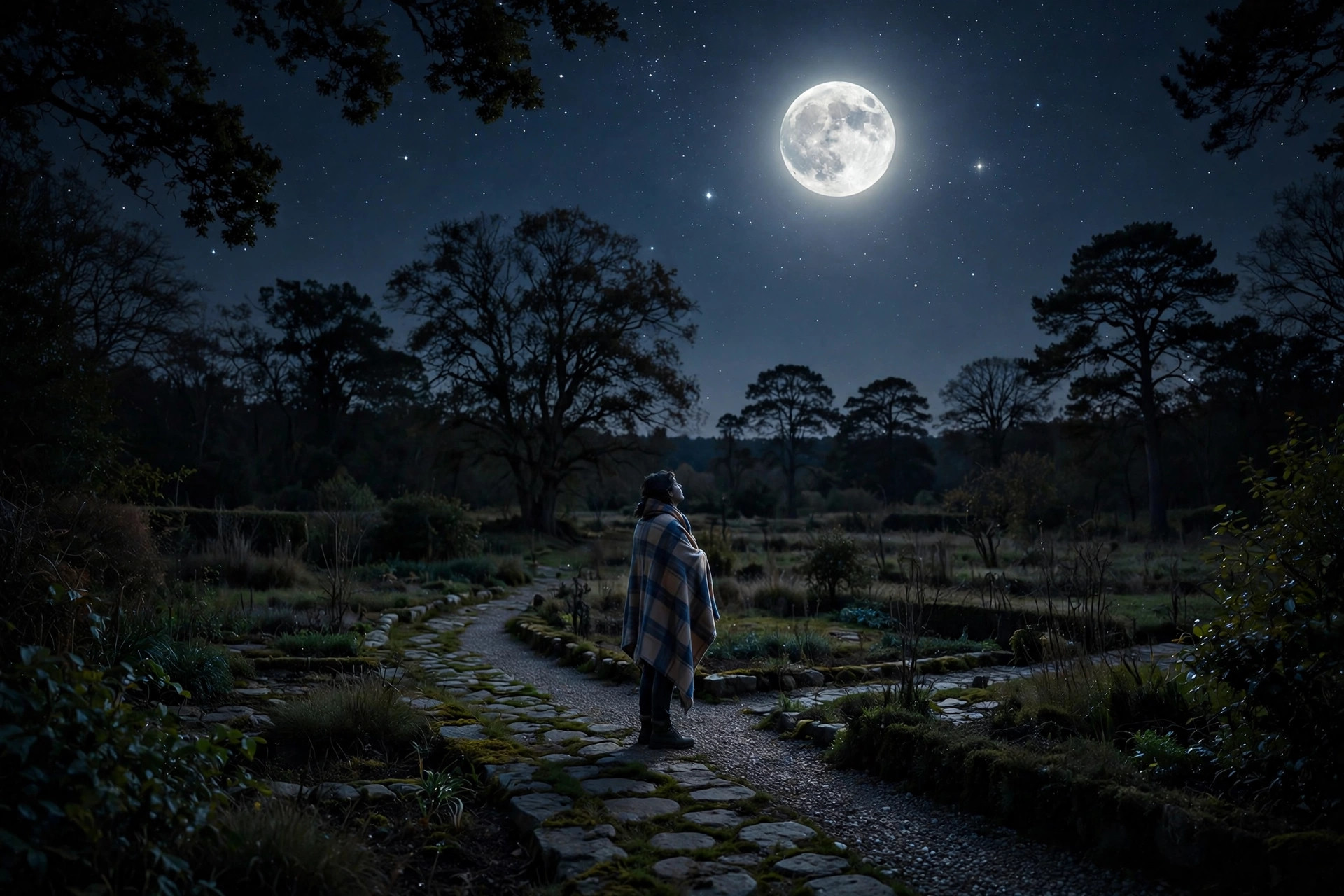
The single most powerful cosmic reset costs nothing and takes five minutes: go outside and look up. Light pollution means most of us rarely see a truly dark sky, but even a handful of visible stars can trigger that perspective-shifting awe. Wrap up warm — autumn nights are perfect for this, crisp and clear — and give your eyes a few minutes to adjust. Try to find one constellation; the Plough (part of Ursa Major) is visible most autumn evenings in the northern sky and is easy to spot once you know its saucepan shape.
A short moonlit walk is the more active version. Leave the earbuds at home, walk slowly, and let your attention drift between the sky and your footsteps. Walking is one of the most reliable mood-lifters there is, and doing it under moonlight adds a layer of quiet wonder that a daytime stroll doesn’t have. Stick to routes you know well and feel safe on, take your phone for safety (on silent, in a pocket), and consider inviting a friend — shared stargazing is a lovely, low-effort way to connect.
If clouds or city lights hide the stars, a planetarium app or a short stargazing video can still deliver a dose of cosmic perspective from the sofa. The feeling of vastness is what matters, however you reach it.
Which Night-Sky Journal Prompts Help Quiet Reflection?
Write just a few lines per prompt — this is reflection, not homework. Connect three small moments like a constellation, ask what you have been orbiting, name your current phase, notice what is drowning out your quiet signal, and write two encouraging sentences to tomorrow’s you.
Journaling is the backbone of many cosmic resets, and a few sky-themed prompts can make the practice feel fresh. Try these, writing just a few lines each — this is reflection, not homework:
- The constellation of your day: Connect three small moments from today like stars in a constellation. What picture do they make together?
- What are you orbiting? What’s been pulling most of your energy lately — and is it something you actually want at your centre?
- Phases: Like the moon, what phase are you in right now — waxing and full of plans, or waning and needing rest?
- Light pollution: What’s been drowning out your own quiet signal lately? One small thing you could dim.
- A letter to tomorrow: Write two sentences of encouragement to the person you’ll be in the morning.
Some people enjoy pulling a single tarot or oracle card purely as a creative writing prompt — treating the imagery as a mirror for reflection, the way you might respond to a painting in a gallery. If that appeals, keep it light and playful: ask “what deserves my attention tonight?” and free-write for five minutes about whatever the card’s picture suggests to you. It’s storytelling with yourself, nothing more arcane than that — and if it doesn’t appeal, skip it entirely; the stars and the journal are plenty.
NASA lists the eight moon phases in order — new moon, waxing crescent, first quarter, waxing gibbous, full moon, waning gibbous, third quarter and waning crescent — which makes a handy reference if you want to match a prompt to the night sky above you.
How Do You Build Your Own Cosmic Reset Routine?
Pick one element from each layer: a setting, a focus and a closing gesture. Twenty minutes is plenty and ten is fine on busy nights, and the closing gesture matters most — it is the full stop that tells your mind the day is officially over.
Now assemble your personal version. Pick one element from each layer: a setting (your calm corner, the garden, a moonlit walk), a focus (candle flame, stars, journal page), and a closing gesture (blowing out the candle, three slow breaths, writing “done” at the bottom of the page). Twenty minutes is plenty; ten is fine on busy nights. The closing gesture matters most — it’s the full stop that tells your mind the day is officially over.
| Layer | Pick one |
|---|---|
| Setting | Calm corner, garden, moonlit walk |
| Focus | Candle flame, stars, journal page |
| Closing gesture | Blowing out the candle, three slow breaths, writing “done” |
Consider pairing your reset with existing sleep hygiene: a warm shower beforehand, herbal tea, screens off. The cosmic framing makes these familiar habits feel special rather than dutiful, which is half the battle with any routine. And be honest with yourself about what this is for: these rituals are wonderful for everyday stress and busy minds, but they’re not treatment. If anxiety, low mood or sleeplessness is significantly affecting your life, please speak to your GP or a qualified mental health professional — the stars are a lovely support act, not the main event.
Tonight, when the sky darkens, give yourself the gift of looking up. Light one candle, find the moon, breathe slowly, and let the vast quiet above remind you: the day is done, you did enough, and rest is waiting. That’s the whole cosmos of it.
Leave a Reply