Last updated: October 2026
Quick answer: Crystals are naturally occurring minerals admired for their colour and beauty, and in self-care they are used as mindfulness anchors — objects that prompt you to pause, breathe, and set an intention. Their traditional meanings are stories, not scientific facts, and they are never a substitute for medical care.
Walk into any beautiful homeware shop or scroll through a self-care feed, and you will see them: little bowls of polished stones in soft pinks, purples, and milky whites, catching the light on windowsills and desks. Crystals have quietly become one of the most loved tools in modern self-care — not because of any grand promise, but because they are beautiful, tactile, and surprisingly good at reminding us to slow down.
If you are curious but unsure where to start, you are in exactly the right place. This guide is written for the complete beginner: no prior knowledge, no special beliefs required, no expensive purchases necessary. We will look at what crystals actually are, how to choose your first few stones without feeling overwhelmed, and the traditional meanings of ten beginner-friendly crystals.
Please note: crystals are personal and spiritual mindfulness objects, not medical advice. Their traditional meanings are not scientifically proven, and crystals cannot heal illness or replace professional care. If you are dealing with health concerns, please see a doctor or therapist.
What Are Crystals — and What Are They Not?
Crystals are naturally occurring minerals formed over thousands or millions of years, used in self-care as anchors that help you focus your attention — the calm comes from the pausing and breathing, not from any proven power in the stone.
Let us start with the simple facts. Crystals are naturally occurring minerals — stones formed over thousands or millions of years as minerals cooled and hardened into structured, often beautiful shapes. Amethyst is quartz with a trace of iron that gives it its purple colour. Rose quartz gets its blush from tiny mineral inclusions. People have admired them for their beauty for as long as humans have been picking up interesting stones, which is to say: forever.
The science backs up the basics: according to Britannica, quartz is the second most abundant mineral in Earth’s crust, and amethyst is a variety of quartz whose violet colour experts believe arises from its iron content (Britannica: amethyst). These are geological facts — and they are separate from the symbolic meanings people attach to the stones.
In self-care and mindfulness practice, crystals are used as anchors — physical objects that help you focus your attention. This is the same principle behind holding a warm mug during a difficult conversation, or keeping a smooth pebble from a favourite beach in your pocket. The object itself does not do anything magical; it gives your wandering mind somewhere gentle to land. When you hold a crystal and take three slow breaths, the calm you feel comes from the breathing and the pausing — the crystal just helped you get there.
Over centuries, different cultures have attached symbolic meanings to different stones: rose quartz with love and kindness, amethyst with calm, citrine with warmth and optimism. These associations are traditions and stories, not scientific facts, and it is perfectly fine to enjoy them as stories. Many people choose stones by meaning, others simply by which colours make them happy. Both approaches are completely valid. The only “wrong” way to use a crystal is to expect it to do the work of a doctor, a therapist, or a good night’s sleep.
How Do You Choose Your First Crystals?
Start with three to five stones chosen by eye, favour affordable tumbled stones from reputable sellers, and let traditional meanings be a bonus rather than a rule — the stone you love looking at is the right one for you.
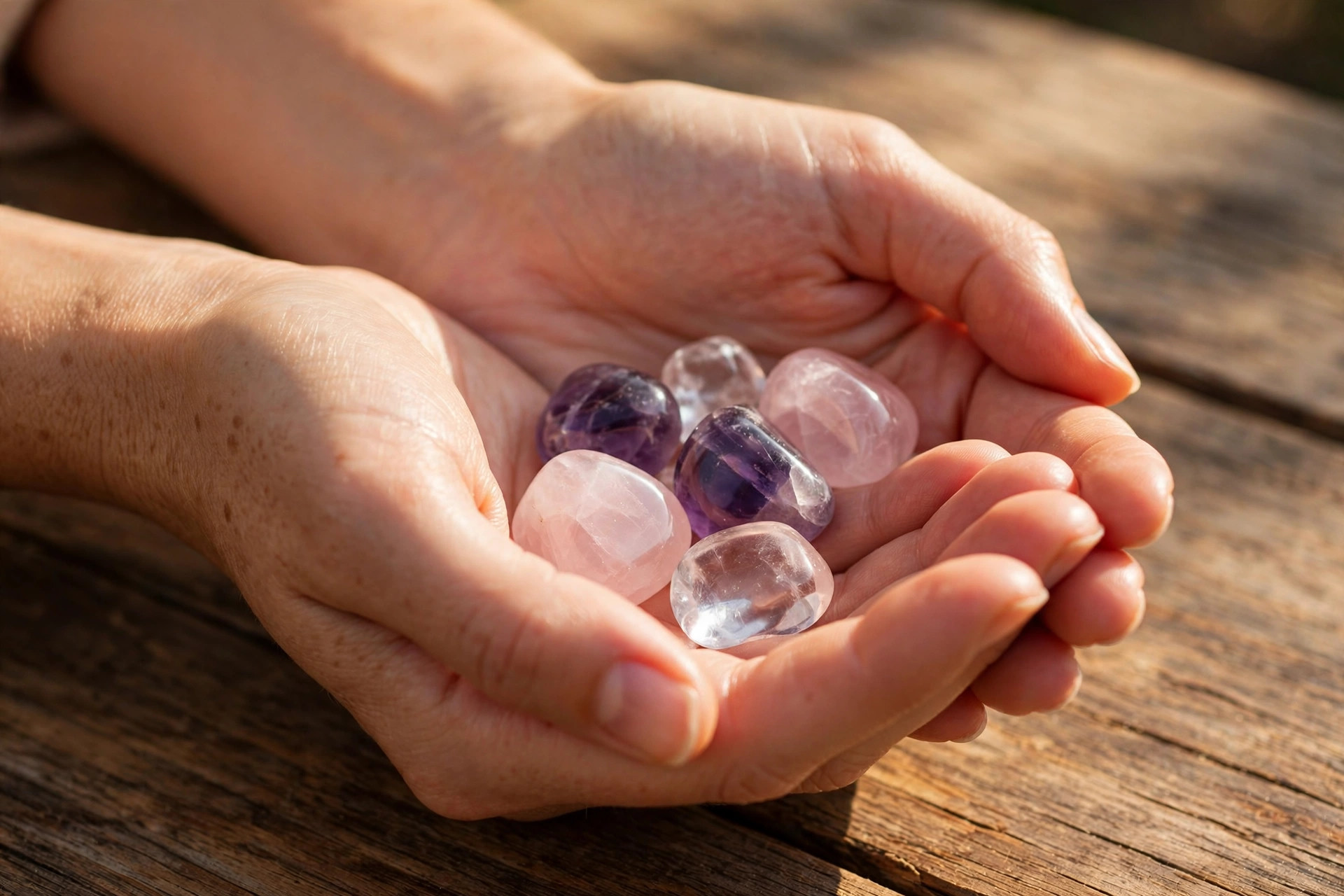
- Go with your eyes first. In a shop or online, notice which stones you keep looking at. The one you find beautiful is the right one for you right now. Attraction is a perfectly good selection method — you will actually use and enjoy the stones you love looking at.
- Start with tumbled stones. These are the smooth, polished pebble-shaped crystals, usually inexpensive and comfortable to hold. They are ideal for beginners: no sharp edges, easy to carry in a pocket or bag, and very affordable.
- Buy from reputable sellers. Choose established crystal shops, well-reviewed online sellers, or local markets rather than suspiciously cheap bulk listings. Real stones have natural variations in colour and pattern; perfectly uniform, garishly bright “crystals” are often dyed glass. A good seller will tell you exactly what each stone is.
- You do not need the rare ones. Beginners sometimes feel they need expensive or unusual specimens. You do not. The classic starter stones — clear quartz, amethyst, rose quartz — are popular precisely because they are beautiful, affordable, and widely available. Start simple.
- Let meaning be a bonus, not a rule. If you are drawn to a stone and later learn it traditionally symbolises calm, that is a lovely coincidence to enjoy. But do not talk yourself out of a stone you love because its “meaning” does not match your mood. Your connection to it matters more than any list.
Aim for three to five stones for your first collection. That is enough to play with, arrange, and carry — and small enough that each one stays special.
Which 10 Crystals Are Best for Beginners?
These ten starter stones are affordable, widely available, and easy to enjoy — read their meanings as traditional stories to enjoy, and choose the ones whose stories resonate with you, or simply the ones you think are pretty.
| Crystal | Traditional meaning | Why beginners love it |
|---|---|---|
| Clear quartz | Clarity and fresh starts | The classic all-rounder; clean, icy look goes with everything |
| Amethyst | Calm and rest | Deep violet colour alone makes a room feel more serene |
| Rose quartz | Kindness and love | Soft pink; a reminder to be gentle with yourself |
| Citrine | Warmth and optimism | Sunny colour; a small pocket of sunshine for your desk |
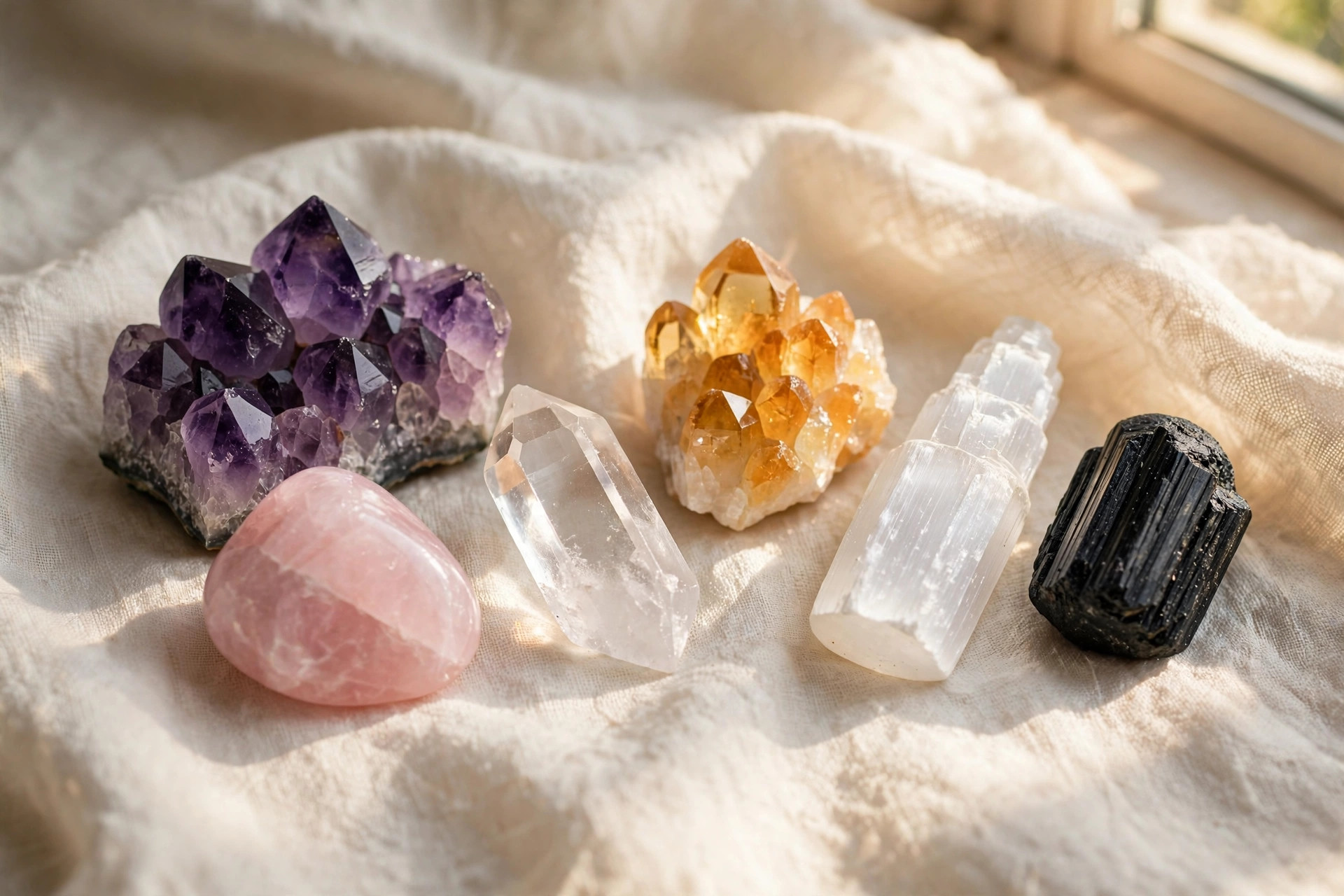
| Black tourmaline | Grounding and protection | Deep black anchor stone for a door or workspace |
| Selenite | Peace and tidiness | Soft, milky-white wands and towers; keep dry, admire rather than carry |
| Carnelian | Motivation and warmth | Rich orange-red; a nudge to begin on slow days |
| Moonstone | Intuition and cycles | Pearly shimmer; a natural partner for moon-water rituals |
| Green aventurine | Luck and new opportunities | Gentle green; restful to look at whatever you believe |
| Lapis lazuli | Wisdom and honesty | Deep blue with golden flecks; treasured since ancient Egypt |
Remember: these meanings are traditional associations — stories humans have told about stones for generations. Enjoy them as stories. The real value of your crystal is the pause it gives you, whatever its name.
How Do You Care for Your Crystals?
Crystals ask for very little: a soft dry cloth for cleaning (water suits most stones but not soft ones like selenite), gentle storage where they will not chip, and keeping small stones away from very small children and pets.
Keep them clean with a soft, dry cloth or a gentle rinse in plain water — but check first, because not all stones like water. Selenite, for example, is soft and can be damaged by soaking, so it is strictly a dry-cloth stone. When in doubt, a dry cloth is always safe. Dry them thoroughly after any rinse.
Many crystal lovers enjoy “cleansing” their stones as a ritual — not because the stones get dirty in any energetic sense, but because the act of caring for them is calming in itself. Simple methods include placing them in moonlight overnight (a lovely pairing with moon-water night), wafting them through incense smoke, or simply holding each one for a moment and setting a fresh intention. Choose whichever feels pleasant; the ritual is for you, not the stone.
Store them somewhere they will not get knocked about — a small pouch, a dish, a lined box. Tumbled stones are hardy, but points and clusters can chip. And keep them out of reach of very small children and pets: some stones are small enough to be a choking hazard, and a few mineral types should not be mouthed. A beautiful dish on a high shelf is both safe and decorative.
How Can You Work Crystals Into Your Day?
The best crystal habit is the one you will actually keep, so start small: a pocket stone, a desk companion, a bedside stone, a one-minute holding pause, or a nightly gratitude moment — none of them takes more than a minute or two.
- The pocket stone. Choose one tumbled stone to carry in your pocket or bag. When you notice it during the day — reaching for your keys, waiting in a queue — let it be a cue to take one slow breath. It is a tiny mindfulness bell you carry with you.
- The desk companion. Place a stone or two where you work. When your eyes need a rest from the screen, look at the stone instead: notice its colour, its patterns, the way light moves through it. Thirty seconds of this is a genuine micro-break.
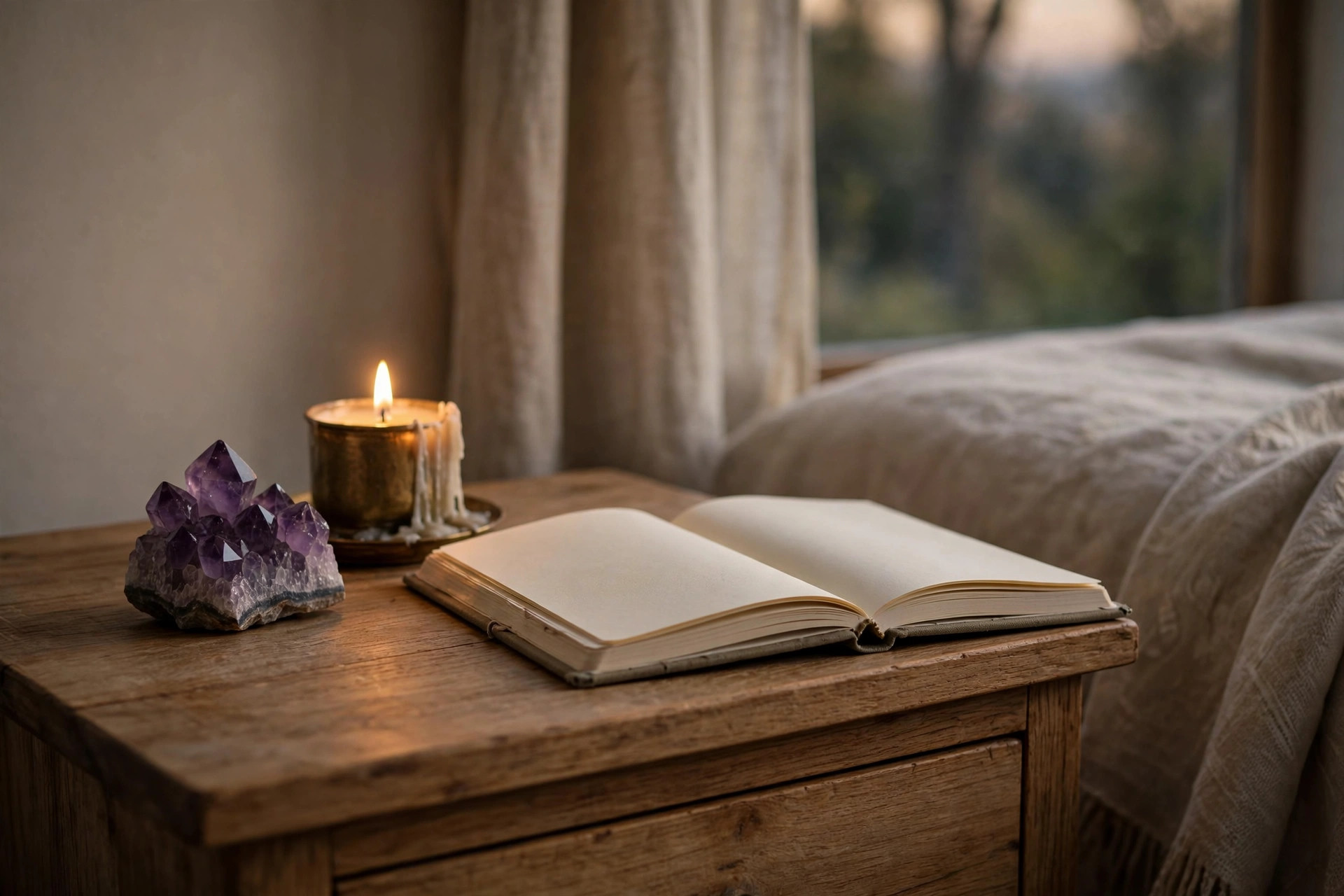
- The bedside cluster. Keep an amethyst or other calming stone on your nightstand as part of your wind-down. Seeing it there each evening can become a visual cue that the day is ending and rest is coming.
- The holding meditation. Hold a smooth stone in your palm, close your eyes, and notice its temperature, weight, and texture for one minute. That is it. This simple sensory exercise is a classic mindfulness technique, and the stone just gives your hand something to do.
- The gratitude stone. Each evening, hold your stone and name three good things from the day — out loud or silently. Pairing gratitude practice with a physical object helps the habit stick, because the stone reminds you to do it.
None of these take more than a minute or two. That is rather the point: crystals work best as small invitations to pause, scattered through an ordinary day.
How Do You Set an Intention With a Crystal?
Hold your chosen crystal, take three slow breaths, choose one word for how you would like to feel — calm, brave, patient, kind — and place the stone where you will see it, so it reminds you of that word through the day.
If you would like a slightly more deliberate practice, try this simple intention-setting ritual. It takes about five minutes and needs nothing but your stone and a quiet corner.
Sit comfortably and hold your chosen crystal in both hands. Close your eyes and take three slow breaths, feeling the stone’s weight and temperature. Then think of one word for how you would like to feel today or this week — calm, brave, patient, kind. Say the word quietly to yourself, and imagine placing it into the stone, like tucking a note into a pocket. Open your eyes, place the stone somewhere you will see it, and go about your day.
When you see the stone later, it will remind you of your word. That reminder is the entire mechanism — not magic, just a well-placed nudge toward the mindset you chose. In our experience, this kind of physical cue genuinely helps intentions stick. Your crystal is simply a beautiful version of a sticky note.
You can repeat this whenever you like: weekly, monthly, or whenever life shifts and you need a new word. Some people like to do it on the new moon, pairing it with a fresh start. Others do it on Monday mornings with their coffee. Make it yours.
When Are Crystals Not Enough?
Crystals cannot treat anxiety, depression, insomnia, chronic pain, or any medical condition, and they cannot replace medication, therapy, or medical advice — if a seller ever suggests skipping professional care in favour of stones, walk away.
This matters, so let us say it plainly: there are things crystals cannot do, and it is important to know the difference. Crystals cannot treat anxiety, depression, insomnia, chronic pain, or any medical condition. They cannot replace medication, therapy, or medical advice. If a crystal seller ever suggests you can skip professional care in favour of stones, walk away — that is not self-care, it is misinformation.
Think of crystals the way you think of a favourite candle or a comforting playlist: lovely supports for everyday wellbeing, not treatments. If you are struggling — sleeping badly for weeks, feeling persistently low, dealing with pain or illness — please reach out to a doctor, a therapist, or a trusted professional. There is no shame in it, and it is the genuinely caring choice.
The healthiest relationship with crystals is an honest one. Enjoy them for their beauty, their symbolism, and the small pauses they invite. Let them be one gentle thread in a bigger tapestry of care that includes rest, movement, nourishing food, time with people you love, and professional help whenever you need it.
How Should a Beginner Start With Crystals?
Starting with crystals needs no belief, expertise, or expense — just curiosity and a willingness to pause: pick a stone that catches your eye, hold it for a moment, and notice how it feels to give your attention to something small and beautiful.
Starting with crystals does not require belief, expertise, or expense. It requires only curiosity and a willingness to pause. Pick up a stone that catches your eye, hold it for a moment, and notice how it feels to give your attention to something small and beautiful. That moment — that pause — is the whole practice, and it is available to you any time.
So this week, why not visit a local shop or browse a reputable seller, and choose your first three stones? Let your eyes decide. Set them on your windowsill, carry one in your pocket, and see how it feels to have a tiny, beautiful reminder to breathe. Welcome to the world of crystals, beginner. It is a calm, pretty place to be.
Leave a Reply