Last updated: October 2026
Quick answer: Senior jeans celebrate your graduating class and hoco jeans celebrate homecoming, both hand-decorated with fabric paint, patches, and embellishments. With simple supplies, a sketched plan, and thin, well-dried layers, you can paint a personal, photo-ready pair in one afternoon.
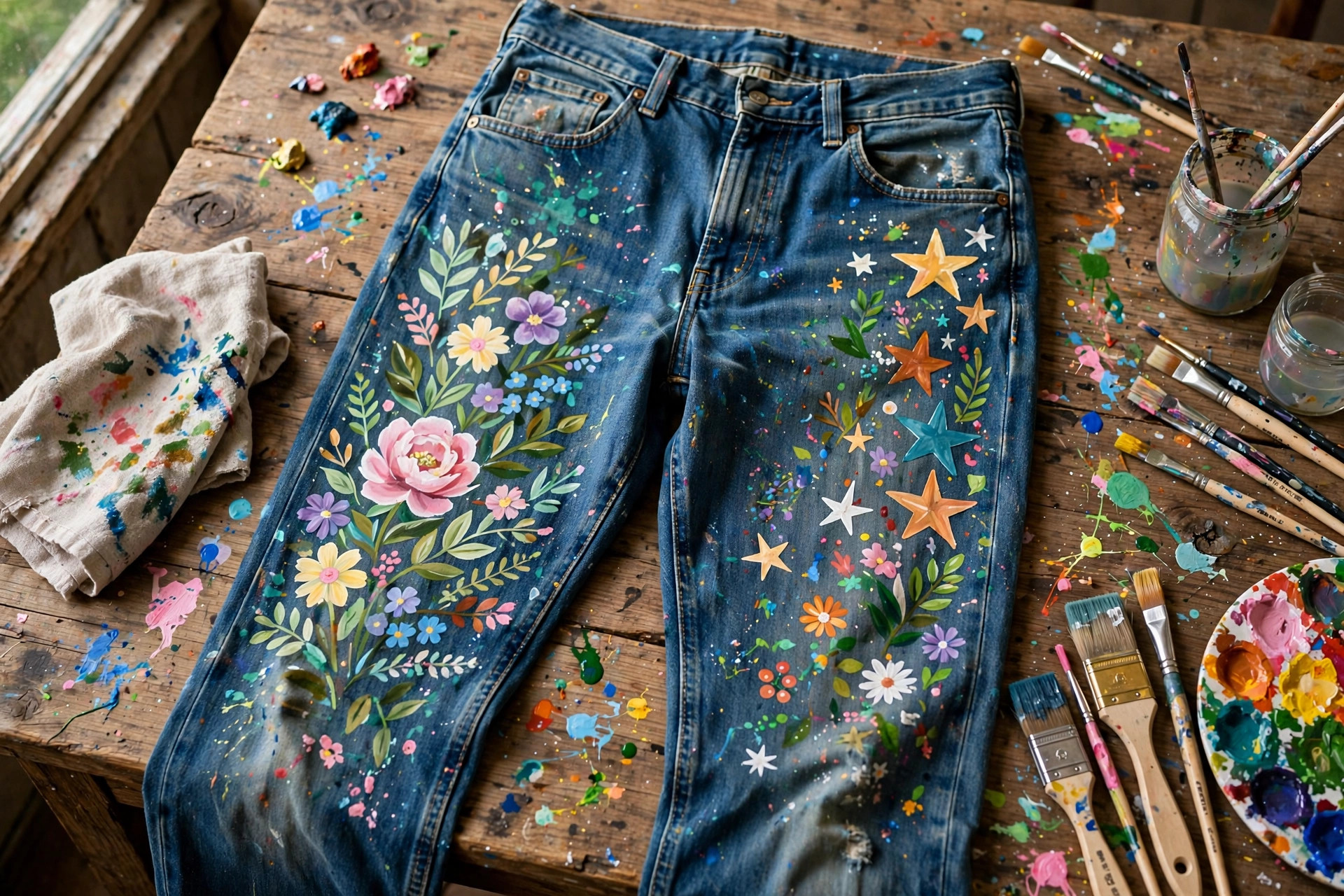
Every autumn, a new DIY tradition captures high schoolers — and this one is utterly charming. Senior jeans and hoco jeans are hand-decorated denim, painted and personalised by hand, worn for homecoming week, senior-year celebrations, and all the memory-making in between. Part craft project, part fashion statement, part time capsule, they are the kind of trend that makes you wish you could make a pair yourself.
In our experience, the appeal is simple: take a pair of jeans — thrifted, old favourites, or new and inexpensive — and transform them with fabric paint, patches, rhinestones, and embellishments. This guide covers what they are, what you need, fifteen design ideas, a full step-by-step tutorial, and the care tips that keep designs fresh.
What are senior jeans and hoco jeans?
Senior jeans mark the final year of high school, while hoco jeans mark homecoming, and both are handmade, personal, and meant to be photographed. Senior pairs usually show the class year, school colours, and personal symbols, while hoco pairs often match friends or a date around a dance theme.
Senior jeans are decorated to celebrate the graduating class: the year painted big across a leg, the school name or mascot, inside jokes, college plans, and symbols of four years of memories. They are worn on senior days, pep rallies, spirit weeks, and graduation-season events — a wearable yearbook page.
Hoco jeans follow the same DIY spirit but dress for homecoming specifically. They are often made in matching or coordinating sets — best friends painting complementary designs, couples creating coordinating pairs, or whole friend groups working in the same colour palette. Common themes include the homecoming date, the dance theme, football-season motifs, and plenty of sparkle. They are made to be photographed, so bold, readable designs win.
What makes both so beloved is the handmade quality. No two pairs are alike, and the wobbly lines and personal touches are the entire point. In our experience, clothing that carries the mark of its maker’s hand feels special precisely because it cannot be mass-produced.
What supplies do you need to get started?
You need a pair of jeans, fabric paint, a few brushes, paint markers, cardboard for inside the legs, and painter’s tape, plus optional patches, gems, and trim. Most supplies are inexpensive, and many crafters already own half of them, so this is one of the most affordable DIY projects around.
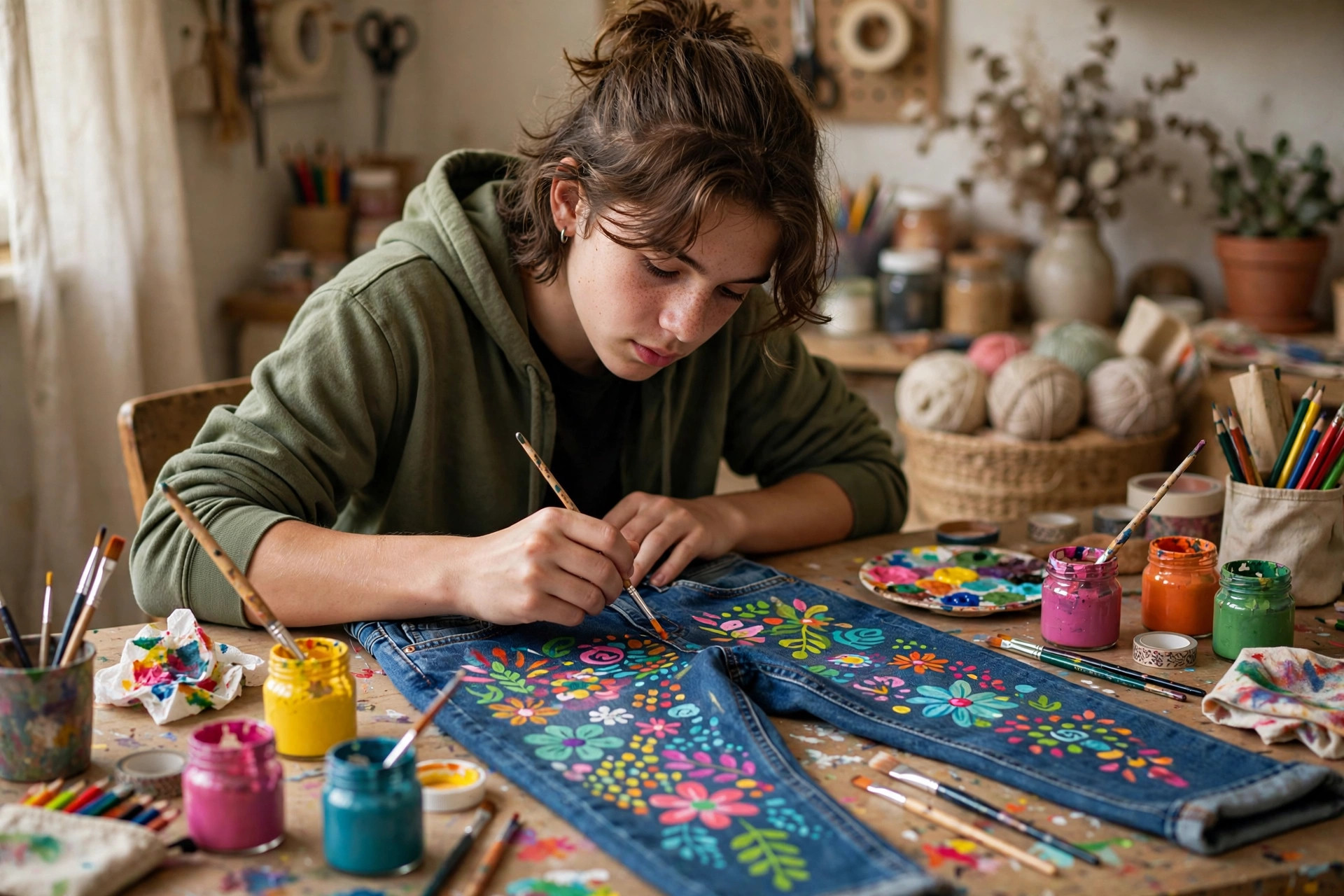
The essentials:
- A pair of jeans — thrifted or inexpensive new ones are perfect. Medium to light wash shows paint best, but dark denim works with light colours and metallics.
- Fabric paint, or acrylic paint mixed with textile medium. Fabric paint is simplest for beginners.
- Brushes in several sizes, including a fine liner brush for details and lettering.
- A fabric pen or paint markers for outlines and small writing.
- Cardboard or a cutting board to slip inside the legs while painting.
- Painter’s tape for crisp lines and borders.
The fun extras:
- Iron-on patches, rhinestones or flat-back gems with fabric glue, and lace or ribbon trim.
- Stencils for stars, hearts, and letters; glitter fabric paint for sparkle; puffy paint for raised details.
- A hairdryer to speed drying between layers, and a sealant spray or a hot iron with a pressing cloth to set the paint.
| Beginner tip | Why it helps |
|---|---|
| Best beginner paint: fabric paint in squeeze bottles | Easy to control, with no mixing required |
| Jeans choice: 100% cotton or high-cotton denim | Holds paint better than very stretchy blends |
| Test first on the inside hem or a scrap | Lets you check colours and techniques before the real thing |
| Protect your space and wear old clothes | Fabric paint does not forgive spills |
A little background helps here too: Britannica explains that denim is a sturdy cotton textile woven in a twill pattern, giving it the diagonal rib you can see on the fabric’s surface. That sturdy weave is part of why denim holds paint so well.
What are fifteen design ideas you can steal?
These fifteen starting points range from classic to creative, and the best designs usually combine two or three of them into something personal. Mix, match, and make them yours — the goal is a pair that could only belong to you.
- The big class year. The senior jean classic: the graduation year painted huge down one leg in your school colours, outlined in white or gold. Add small stars or dots for extra polish.
- School colours block. Paint each leg in one of your school colours, or split the jeans into colour-blocked panels. Add the mascot or school name in a contrasting shade.
- Floral vines. Hand-painted flowers trailing up the legs — daisies, sunflowers, or wildflowers. Simple five-petal flowers with dot centres look charming even from a beginner’s brush.
- Starry night. A dark-wash jean painted with gold and silver stars, moons, and constellations in metallic paint. Add your initials inside a crescent moon.
- Patchwork collage. Skip the paint and go all-in on iron-on patches: smiley faces, cherries, lightning bolts, hearts, varsity letters. Cluster them asymmetrically for a curated look.
- The lyric leg. A favourite song lyric, quote, or motto lettered down the leg in a pretty script. Use paint markers or stencils for neat lettering.
- Sports tribute. Jersey numbers, football laces, cheer bows, megaphones — celebrate your sport or your school’s team, matching your game-day colours.
- Rhinestone glam. A base of simple painted designs taken further with glued-on rhinestones: outlined hearts, starbursts, or your initials in gems. Use strong fabric glue and let it cure fully.
- Sunset ombre. Blend paint from yellow through orange to pink up the legs, then add black silhouettes — palm trees, birds, mountains. Blending hides beginner brush marks beautifully.
- Matching set with friends. Each friend paints one quarter of a big design across all pairs — a rainbow, a garden, a night sky — so the full picture only appears when you stand together.
- Vintage postcard. Paint the jeans like a collage of vintage postcards: stamps, postmarks, cursive writing, little landscapes. Romantic and unique.
- Animal print accents. Leopard spots on the pockets, zebra stripes down the sides, cow print on the cuffs. Keep it to accents rather than full coverage for the chicest result.
- The memory map. Paint little symbols of your high school years: the school building, your favourite hangout, your first car, your best friend’s initials, your college logo.
- Glow-in-the-dark details. Use glow-in-the-dark fabric paint for stars, outlines, or hidden messages that only appear in the dark — an unforgettable surprise at the dance.
- Lace and ribbon trim. For a softer look, sew or glue lace along the pockets and ribbon down the side seams, then add small painted flowers to tie it together.
How do you paint your first pair, step by step?
Set aside an afternoon and follow seven steps: wash and prep, plan your design, paint the base, add details, embellish, heat-set, and then wear them proudly. Rushing is the enemy of good painted denim, so let every layer dry fully before moving on.

- Step one: wash and prep. Wash the jeans without fabric softener and let them dry completely. Fresh denim holds paint better, and softener residue can stop paint adhering. Slip cardboard inside each leg to prevent bleed-through, and smooth the denim flat.
- Step two: plan your design. Sketch ideas on paper first, then lightly mark key placements on the jeans with chalk or a washable fabric marker. Choose three to five colours plus white for a cohesive palette; more than that can look chaotic.
- Step three: paint the base. If your design includes background colour-blocking or large shapes, paint those first. Use thin, even coats rather than one thick one — two thin coats give better coverage and flexibility. Let each coat dry fully; a hairdryer on low speeds this up.
- Step four: add details and lettering. Once the base is dry, add outlines, lettering, flowers, and stars. Work from large details to small, and from the background forward. Paint markers are brilliant for neat lettering. Step back frequently to check the overall balance.
- Step five: embellish. Glue on rhinestones, sew or iron on patches, add ribbon trim — after the paint is fully dry. For gems, place a dot of fabric glue, press the stone in with tweezers, and leave the jeans flat for at least 24 hours to cure.
- Step six: heat-set the paint. This is the step that makes your work washable. Once everything is bone dry (wait a full 24 hours), press each painted area with a hot iron through a pressing cloth for 30 seconds per section, or use a fabric sealant spray as directed.
- Step seven: the first wear. Wait another day after heat-setting before wearing, if you can stand it. Then wear them proudly — to school, to the game, to the dance. Take plenty of photos.
Three rules worth remembering: patience pays, because drying fully between coats prevents smudging and muddy colours; less is more, because some denim showing makes designs pop; and fix mistakes fast — wipe wet paint immediately, or paint over dry mistakes once dry.
How do you make your designs last?
Heat-set your paint, wash inside out on a cold, gentle cycle, skip the dryer, and wash as rarely as you reasonably can. Thin layers, proper fabric paint, and careful storage all help hand-painted jeans survive plenty of wear and last well beyond graduation.
- Wash gently: always wash inside out on a cold, gentle cycle, and air dry flat or on a line instead of using the dryer.
- Wash rarely: spot-clean marks with a damp cloth instead of washing the whole pair every time.
- Heat-set properly: as described above, heat-setting is non-negotiable if you want the paint to stay put.
- Choose paint wisely: proper fabric paint, or acrylic mixed with textile medium, stays flexible on denim, while plain craft acrylic can crack and flake.
- Apply thin layers: thick, gloopy paint is what cracks, so build colour up gradually.
- Be realistic about embellishments: glued rhinestones will eventually loosen with washing, so consider them semi-permanent and enjoy the sparkle while it lasts.
- Store with care: fold painted jeans with tissue paper between the painted areas, or hang them so painted surfaces do not stick together in heat.
It is worth remembering how long denim has been a workhorse fabric: Britannica notes that denim’s origins likely lie in weaving centres such as Nîmes in France and Genoa in Italy, and that it was used for hard-wearing garments long before it became fashion. Treat your painted pair with that same practical care, and it can last for years as a keepsake.
How can you wear them beyond the dance?
The bolder pairs become treasured keepsakes, while subtler designs — floral vines, patches, animal print accents — can live on in your everyday wardrobe with simple tops and trainers. The skills transfer too, opening up painted jackets, decorated tote bags, and personalised graduation caps.
Senior and hoco jeans do not have to retire after the event. The bolder pairs can be folded carefully, photographed for the yearbook, and kept for the memory box. The subtler designs can absolutely live on in everyday outfits.
So gather your friends, spread out the paint, and make something unforgettable. Years from now, when you find those jeans folded in a keepsake box, you will not just see paint on denim — you will see homecoming week, senior year, and all the people you loved through it. That is the real magic of DIY denim: it is never just about the jeans.
Leave a Reply