Last updated: October 2026
Quick answer: Group Halloween costumes work best when the whole crew agrees one clear, recognisable theme with a distinct role for everyone, keeps outfits comfortable and affordable, and arrives together so the group reads as one brilliant idea.
There is a special kind of magic that happens when a whole group walks into a Halloween party in matching costumes. Conversations stop. Phones come out. Strangers ask for photos. While a great solo costume earns admiration, a great group costume earns something better: it tells a story, and everyone in the room wants to be part of it.
Coordinating costumes with friends, family, or colleagues might sound like hard work, but it is one of the most rewarding parts of the Halloween season. The group chat debates, the DIY crafting sessions, the moment you all see each other in full costume for the first time — these are the memories that outlast the party itself. In our experience, the planning is half the fun.
Whether you are planning matching outfits with three best friends, dressing up the entire family, or organising a department-wide theme at work, this guide has you covered. We will walk through how to choose a theme everyone genuinely loves, share easy no-sew ideas and bigger DIY projects, and reveal the secrets to nailing the group photo.
Why do group costumes always steal the show?
Group costumes win because the theme does the storytelling: everyone is instantly recognisable together, small imperfections disappear into the whole, photos look brilliant, and planning together becomes part of the celebration itself.
A solo costume is a statement; a group costume is an experience. Walking into a party as one of six crayons, or as the full cast of a favourite film, creates an instant bond — not just within your group, but with everyone around you. People love a theme they can recognise, and they love it even more when it is executed with commitment.
Group costumes are also more forgiving. If one person’s outfit is a little rough around the edges, the overall effect still lands because the group reads as a whole. That takes the pressure off anyone who is not crafty, short on time, or working with a tight budget. The theme does the heavy lifting, so individual costumes can be simpler.
Then there is the photo factor. A coordinated group photo tells a clear story and gets shared far and wide. Perhaps most importantly, planning a group costume brings people together before the party even starts. The brainstorming, the shopping trips, the trying-on sessions — these become part of the celebration. For friends scattered across different cities, a group costume project is quality time disguised as party prep.
It is worth remembering how deep this tradition runs: Halloween is celebrated on 31 October, and its roots trace back to the ancient Celtic festival of Samhain, when people marked the end of harvest season with gatherings and costumes. You can read more in Britannica’s guide to Halloween.
How do you pick a theme everyone actually likes?
Pick a theme everyone loves by offering three or four strong choices, checking it suits your group’s personality and size, making sure every role feels equally fun, and agreeing a budget early so nobody feels out of pocket.
Start with a group chat vote, but keep the options tight. Offer three or four strong ideas rather than an open brainstorm, which tends to stall. Good themes share a few qualities: they are widely recognised, they offer a distinct role for every group size, and they allow for different comfort levels. A theme where one person has to wear something embarrassing while everyone else looks cool will breed resentment fast.
Consider your group’s personality:
- Film buffs: dress as the characters from a beloved movie.
- Foodies: go as a sushi platter, a box of crayons, or breakfast foods.
- Colleagues: pick something office-friendly and punny, like a pack of highlighters or famous duos and trios.
- Everyone: choose a theme that feels like an inside joke the whole group is in on.
Think practically about group size. Some themes scale beautifully — a deck of cards works for anywhere from four to fifty-two people, and a box of crayons is similarly flexible. Others are size-specific: the seven dwarfs need exactly seven, and a four-person ghost-hunting team needs four. If your numbers might change (and they always do), choose a theme that absorbs extras gracefully or survives dropouts.
Finally, set a budget expectation early. Nothing kills costume enthusiasm like discovering one person spent a lot while another cobbled theirs together from a charity shop. Agree a rough spend — or better yet, choose a theme where charity-shop and DIY versions look just as good as bought ones — and everyone stays happy.
What are the easiest no-sew group costumes?
No-sew costumes work when the idea is instantly readable: matching colours, a simple prop or a printed label, and a theme that scales to any group size, so the whole crew can get ready in a single evening.
Not everyone owns a sewing machine or has weekends free for crafting, and that is perfectly fine. Some of the best group costumes need nothing more than matching colours, a few props, and a sense of humour. Here are ideas that come together in an evening:
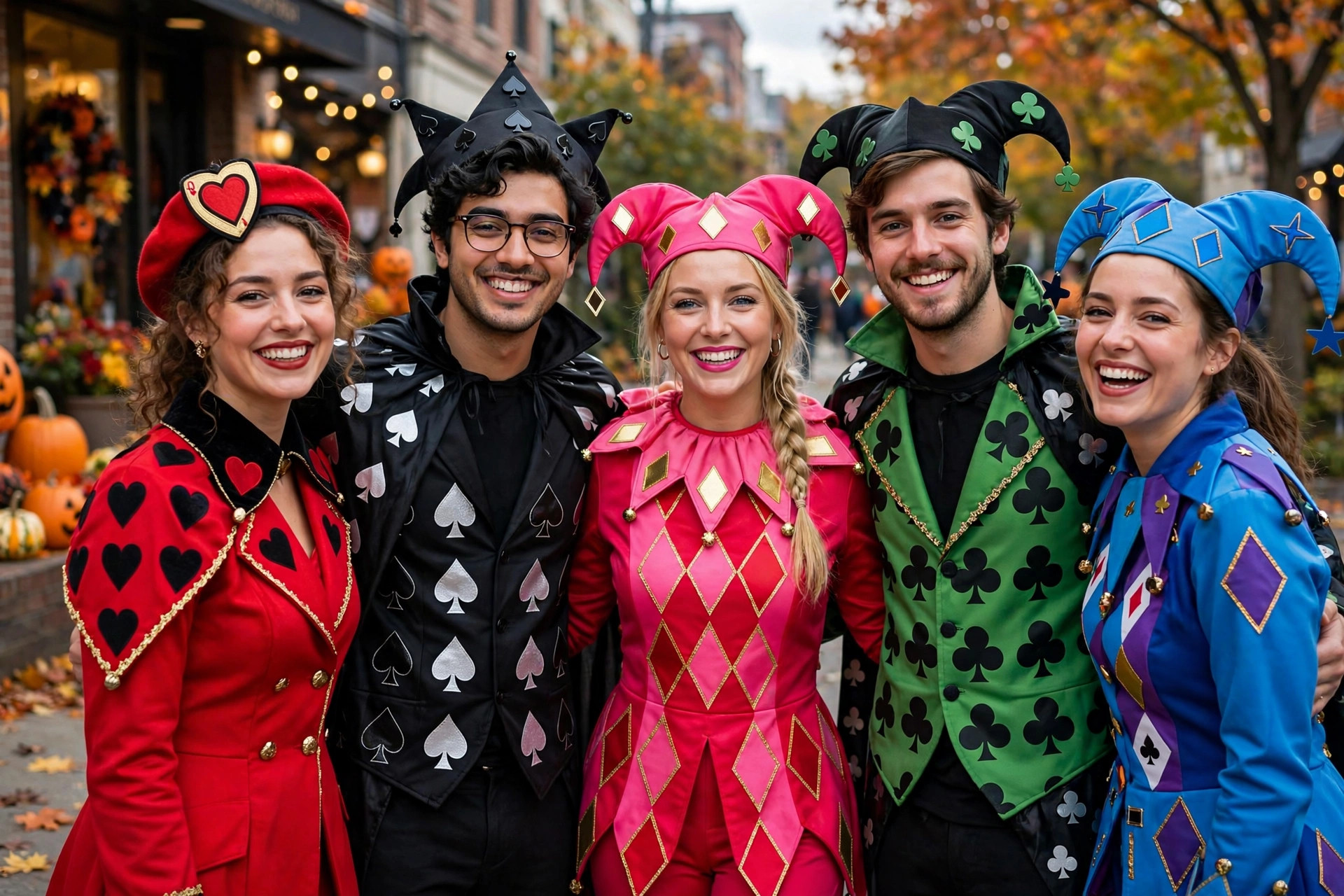
- A deck of cards. Each person wears black or white and tapes a giant playing card to their front and back — easily printed at home or drawn on card. It works for any group size and looks fantastic in photos.
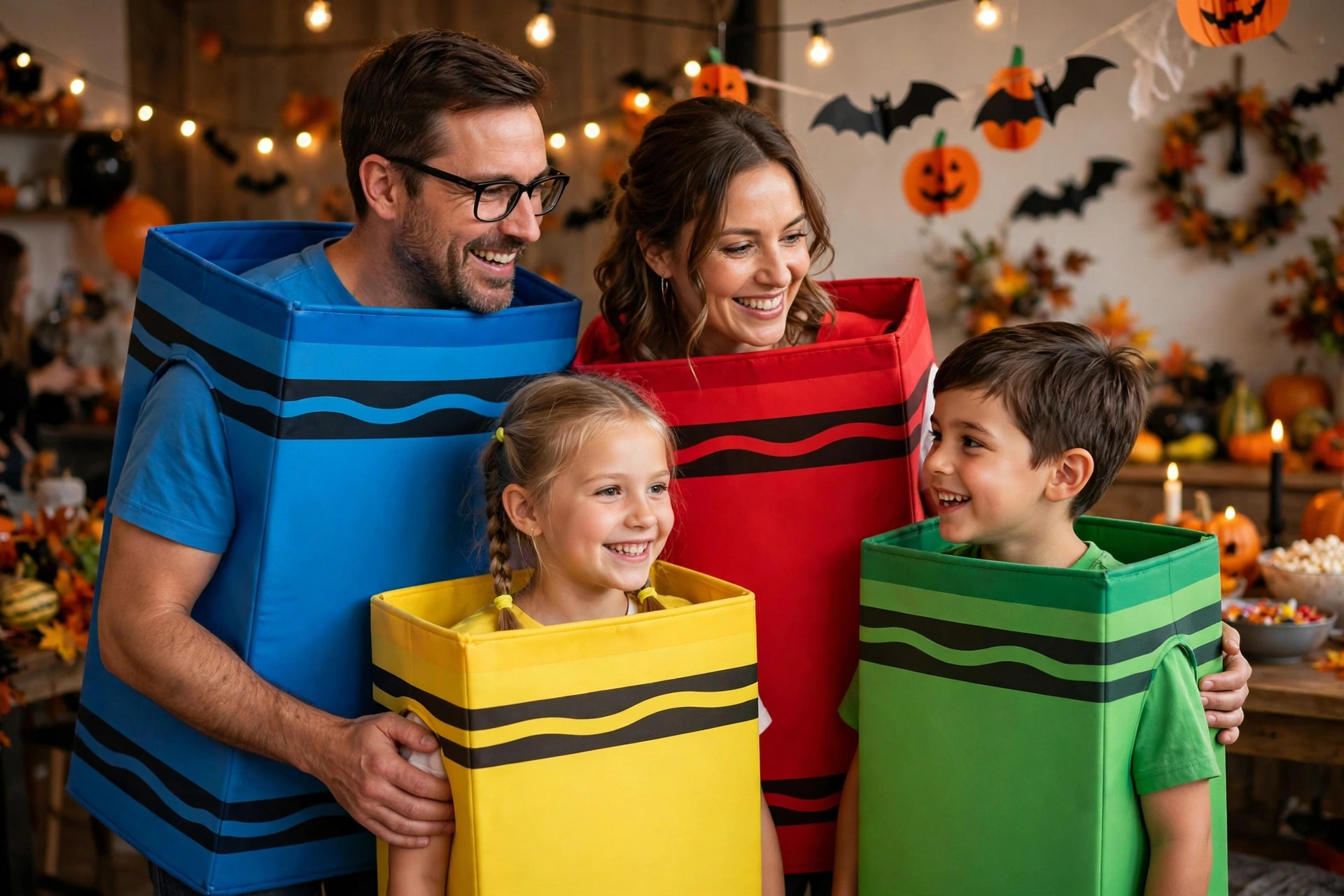
- Crayons. Everyone wears a single bright colour head to toe, with a cone-shaped hat in the same shade and a paper “crayon label” wrapped around the torso. Charity shops are goldmines for single-colour outfits.
- Tourists. Hawaiian shirts, cameras around necks, sun hats, and socks with sandals — the comedy writes itself, and most people can assemble it from their own wardrobes. One person can be the tour guide with a little flag for extra laughs.
- Emoji faces. Yellow tops, yellow face paint, and large printed emoji features on card. Each person picks the emoji that suits them best.
- Favourite apps. Each person dresses in the colours of a favourite app with a logo printed large on a t-shirt. It is current, funny, and takes about ten minutes to prepare.
- Where’s Wally and friends. Red-and-white striped tops, bobble hats, and glasses — easy to find or borrow, and the group can include Wenda, Wizard Whitebeard, and even Odlaw for variety.
Which DIY group costumes make the biggest impact?
DIY costumes make the biggest impact when the group picks one clear idea, gets the signature details right, and enjoys the crafting sessions together, turning simple materials into a look people remember long after the party ends.
If your group loves a project, these DIY themes deliver serious wow factor. They take more effort, but the results — and the crafting sessions along the way — are worth it.
| Theme | Best for | Key detail to get right |
|---|---|---|
| Cast of a favourite film | Film lovers | Each character’s signature hat, jacket or accessory |
| Sushi platter | Fun, comfortable groups | Black outfits as “nori” plus a different coloured sash per person |
| Famous paintings | Artsy crews | Gold-painted cardboard frames for the group pose |
| Board game pieces | Playful groups | A giant dice made from a painted cardboard box |
| Breakfast foods | Groups who love a laugh | White poncho plus yellow cushion yolk for the fried egg |
| Garden gnomes | Comfort-first groups | Blue tops, red cone hats, white beards, a fishing rod each |
Thrifted and adapted clothing usually does the job for film casts; the key is getting the signature details right — the hat, the jacket, the accessory everyone recognises. For paintings, each person recreates a well-known artwork using clothes, props, and face paint, then the group poses together in their frames. It is artsy, impressive, and a guaranteed conversation starter.
How do you coordinate colours, photos and the big reveal?
Coordination is what turns good costumes into a great group moment: share colours and props a week ahead, arrive together for the reveal, plan your photo order, and pack a small emergency kit.
A week before the event, share a simple style guide in the group chat: the exact colours, any must-have props, and what not to wear. A shared online shopping list or a trip to the same craft shop keeps everyone consistent. If you are DIY-ing, consider a crafting party where everyone builds their costume together — it is half the fun and guarantees a cohesive look.
Plan your big reveal. Arriving together and walking in as a unit has ten times the impact of trickling in separately. If the party is at someone’s house, gather nearby first and make an entrance. The reaction is always worth the logistics.
For photos, think like a director:
- Line up in height order or in theme order (crayons in rainbow order, cards in suit order) for the classic shot.
- Then get creative: action poses, character interactions, a “candid” laughing shot.
- Take far more photos than you think you need, in good lighting, before the evening gets too lively.
- Nominate one person as the evening’s photographer so the memories do not depend on whoever happens to have their phone out.
A small emergency kit saves the night: safety pins, double-sided tape, a mini sewing kit, spare face paint, and plasters for shoe-related emergencies. Assign it to the most organised member of the group and thank them later.
What works best for families with little ones?
Family costumes work best when comfort comes first: soft fabrics, simple designs, pram-friendly ideas for babies, and a dress rehearsal a few days before, so little ones enjoy the night as much as everyone else.
Family group costumes are some of the most heartwarming sights of Halloween, and they are easier than they look if you choose a theme built around comfort. Young children will not tolerate itchy, hot, or restrictive outfits for long, so prioritise soft fabrics and simple designs.
- Animal families: a family of lions, bears, or bunnies, with adults in simple ear headbands and face paint and little ones in cosy all-in-one suits.
- Storybook themes: a children’s book with a cast of characters gives every family member, including grandparents, a natural role.
- Pram costumes: a baby dressed as a pea in a pram decorated as a pod, or a toddler “astronaut” in a wagon decorated as a rocket, lets the littlest ones participate without wearing anything uncomfortable.
- Pets: a dog in a matching bandana or a simple themed accessory joins the group photo perfectly — but only if the animal is comfortable. Never force a costume on a pet that is distressed.
Whatever theme you choose, do a full dress rehearsal a few days before Halloween. You will discover which hats fall off, which face paint smudges, and which toddler refuses to keep their ears on — all much easier to fix at home than at a party. Then on the night itself, relax and enjoy it. The slightly crooked ears and the smudged whiskers are part of the charm, and years from now, those imperfect photos will be the ones you treasure most.
Leave a Reply