Last updated: October 2026
Quick answer: A great Halloween house party needs a clear theme, a guest list sized for your space, invitations sent three to four weeks ahead, room-by-room decorating, crowd-friendly food, opt-in games, and a plan for coats, parking, neighbours, and clean-up — so you can enjoy your own party.
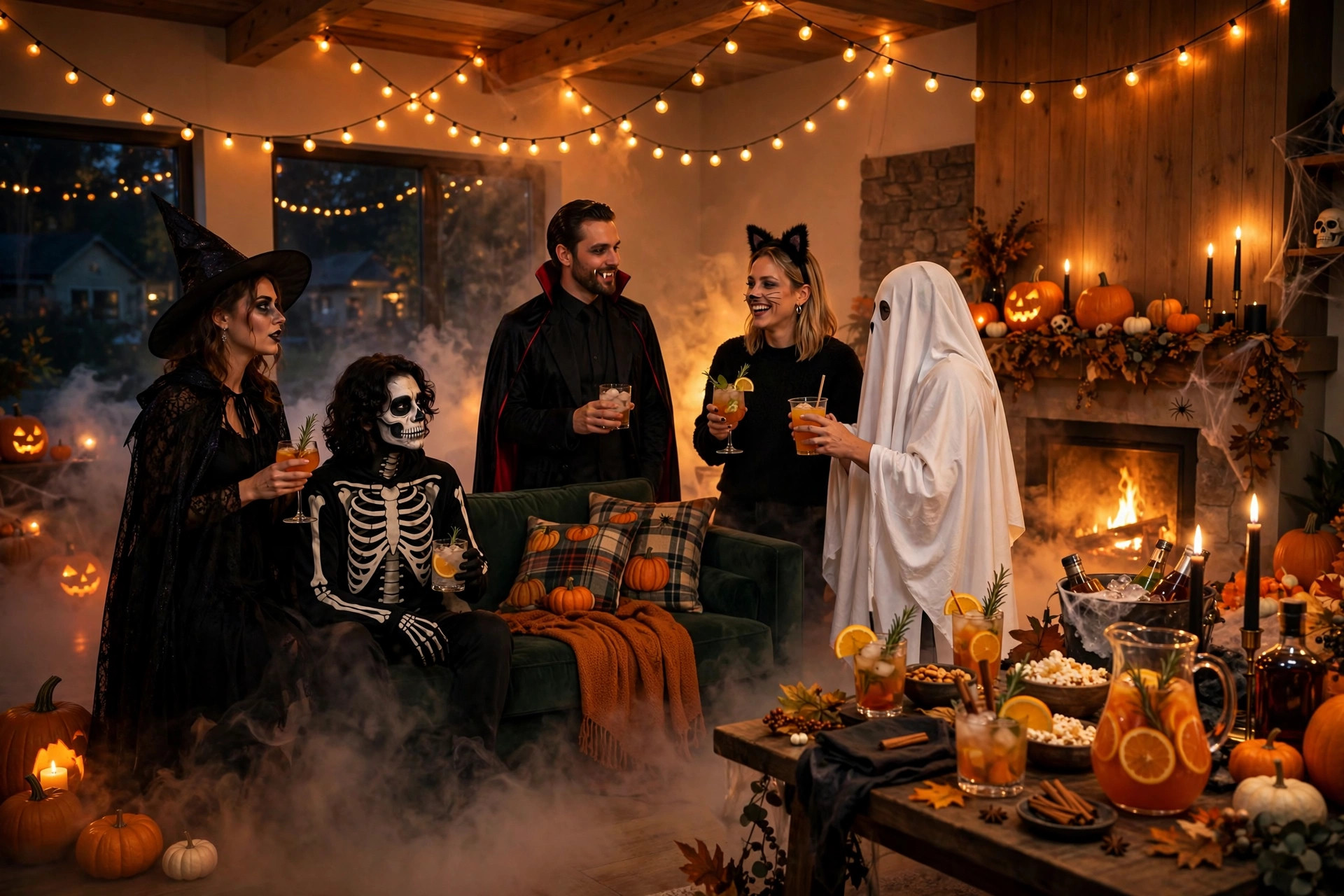
There is no party quite like a Halloween house party. Christmas has tradition, New Year’s has pressure, but Halloween has permission — permission to be silly, to be dramatic, to turn your living room into a haunted crypt and your friends into vampires, witches, and questionable pun costumes. A great Halloween party does not require a big house, a big budget, or professional decorating skills. It requires a clear plan, a strong atmosphere, and a host who is having fun instead of stressing in the kitchen.
This guide is the complete playbook: themes, invitations, room-by-room decorating, food and drinks that please a crowd, games people actually play, and the unglamorous logistics — coats, parking, neighbours, clean-up — that separate a legendary night from a chaotic one. Whether you are hosting five close friends for a spooky film night or forty costumed guests across every room, the principles are the same. Plan the bones early, decorate with commitment, feed people well, give them something to do, and take care of the practicalities so the night runs itself.
Halloween is celebrated on 31 October, according to Britannica — and in 2026, Halloween falls on a Saturday, which makes it an ideal party night (and a competitive one, so invite early).
What should you decide first when planning a Halloween house party?
Decide three things first: a clear, easy-to-costume theme (or a deliberate “anything spooky” rule), a guest list sized honestly for your usable space, and a date — ideally the nearest Saturday, with invitations sent three to four weeks ahead.
Every strong party starts with three decisions, made early. First, the theme — or the deliberate decision not to have one. A theme gives costumes direction and decor a focus: haunted mansion, witch’s coven, 80s horror, monsters’ ball, spooky masquerade. But “come as anything spooky” is also completely fine and often easier for guests. What does not work is a vague theme nobody understands. If you pick one, make it instantly clear and easy to costume for — if guests have to Google it, simplify it.
Second, the guest list, sized honestly for your space. A packed house feels festive; an overcrowded one feels stressful. Count your actual usable space — not just the living room, but the kitchen, hallway, and garden if weather allows — and invite accordingly. For a mingling party, you need less space per person than for a sit-down dinner, but everyone still needs room to move, sit occasionally, and queue for the bathroom without a queue forming down the stairs.
Third, the date. Halloween itself falls on a Saturday in 2026, which is ideal — but it also means competing parties. Send your invitations early, at least three to four weeks ahead, before calendars fill. If you are hosting on the nearest Saturday and Halloween falls midweek in another year, own it: Saturday parties always outdraw weeknight ones, whatever the calendar says.
How do you write a Halloween party invitation?
A good Halloween invitation states the theme, date, start and end times, address with parking notes, costume expectation, what guests should bring, and whether plus-ones or kids are welcome — then follows up a week before and again the day before.
The invitation is your party’s first impression, and for Halloween it should be fun. Digital invitations are fine — and expected — but make them feel special: a spooky design, a clear theme statement, and all the practical details in one place. Include the date, start and end times, address with parking notes, the costume expectation (required? encouraged? theme-specific?), what guests should bring (nothing? a dish? a non-alcoholic drink to share?), and whether plus-ones are welcome.
Be explicit about the things guests always wonder about. “Costumes required — you will feel weird without one” is kinder than letting someone arrive in jeans to a room of vampires. If kids are welcome, say so; if it is adults-only, say that too, plainly and early. Mention the end time — “until late” is fine, but a stated end time like midnight gives you a graceful exit ramp and helps guests plan transport.
A week before the party, send a short reminder with any updates: the theme refresher, parking details, and one exciting teaser (“the costume contest categories are announced…”). The reminder doubles your response rate and builds anticipation. The day before, a quick message with your address and “can’t wait to see your costumes!” keeps the energy up and catches anyone who lost the original invite.
How do you decorate room by room?
Decorate by zones, not all at once: go biggest at the entrance, keep the main room functional with decor pushed up and to the edges, give the food area and bathroom their own moments, and light any outdoor space.
The secret to party decorating that looks impressive without consuming your entire October is zoning: give each room or area one clear job and one clear look, rather than trying to make the whole house uniformly spooky. Guests experience a party as a journey — entrance, main room, food area, garden or balcony, bathroom — and each stop can have its own moment.
Start with the entrance, because first impressions set the tone. This is where you go biggest: the door, the porch, the hallway. Lights, a statement piece, atmosphere. When guests step inside, the main party room should feel transformed but still functional — people need to move, sit, and put drinks down, so keep floor space clear and push decor up (walls, ceiling, mantel) and to the edges. A decorated ceiling — hanging bats, ghosts, or draped fabric — creates huge atmosphere without stealing a centimetre of floor space.
Give the food and drinks area its own styling moment (more on the spread below), and do not neglect the bathroom — a few candles (flameless LED ones are safest in a small room with costumes and flowing fabric about), a spooky hand towel, and a themed soap turn a functional stop into a talking point. If you have outdoor space, even a small balcony, light it and put something out there: fresh-air seekers and phone-callers will use it all night, and an unlit black garden feels like a void.
On lighting for the party: keep it low, warm, and layered. Overhead lights off; lamps, fairy lights, string lights, and LED candles on. Coloured lighting — orange, purple, or red washes — transforms a normal room instantly. And the candle safety note, because parties and flames need care: with costumes, flowing fabric, and paper decorations about, real candles are a genuine hazard. Use flameless LED candles and fairy lights for all your atmospheric lighting, keep any real flames (like a jack-o’-lantern) outside or in sturdy enclosed lanterns well away from foot traffic, and never leave them unattended.
What food and drinks work best for a crowd?
Serve food that sits out safely, can be eaten one-handed, and is mostly prepped in advance: one hot anchor dish, grazing boards, sweet things, a few renamed themed items, clearly labelled dietary options, and a self-serve non-alcoholic drinks station.
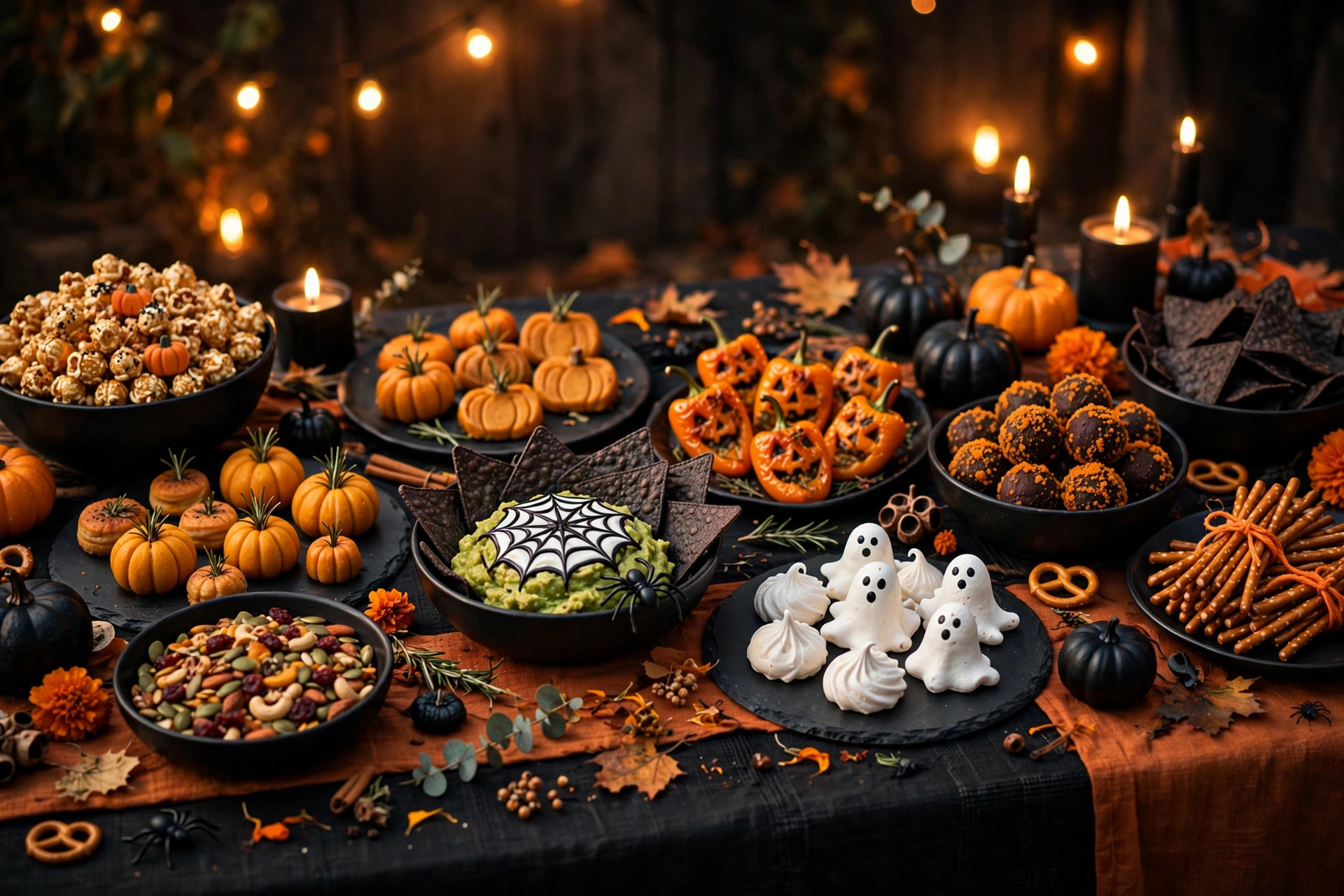
Party food has one job: keep people happy with minimal host effort during the party itself. That means food that can sit out safely, be eaten with one hand while holding a drink, and ideally be prepared mostly in advance. A grazing table or a well-stocked buffet beats passed appetisers for a house party — guests serve themselves, nothing goes cold waiting, and you are free to actually enjoy your own party.
Build the spread around a few anchors:
- Something substantial: A big pot of chilli, a tray of pulled pork sliders, or several pizzas. One hot, filling anchor stops guests getting hungry and keeps the mood up all night.
- Grazing elements: Cheese, crackers, cured meats, bread, dips, crudités. Arrange them generously on boards — abundance is the whole aesthetic.
- Sweet things: Brownies, cupcakes with spooky toppers, toffee apples, jelly sweets in bowls. Label a few with Halloween names for fun.
- Themed touches: A few renamed classics go a long way — “mummy” pigs in blankets, “witch finger” breadsticks, “pumpkin” cheese ball. Three or four themed items feel festive; relabelling everything feels try-hard.
- Dietary needs: Label vegetarian, vegan, and gluten-free options clearly, and make sure there is something substantial in each category — not just crisps.
For drinks, a self-serve station is essential: a big-batch non-alcoholic punch, sparkling drinks, fruit juices, and plenty of water. Big-batch drinks mean you are not playing bartender all night. Label everything, provide plenty of ice, and keep water visible and abundant — good hosts hydrate their guests. A “potion” theme for the punch, with dry ice for effect (handled carefully, never in drinks themselves), adds theatre for almost no effort.
One food-safety rule is worth planning around: the USDA advises that perishable food should not sit at room temperature for more than two hours, so refresh platters in small batches rather than putting everything out at once.
Which games and entertainment actually work?
The games that work are opt-in, quick to explain, and fun to watch: a costume contest judged by guest vote, a simple quiz, a photo booth, and corny physical classics like doughnuts on strings or a mummy-wrap race — plus a long playlist running all night.
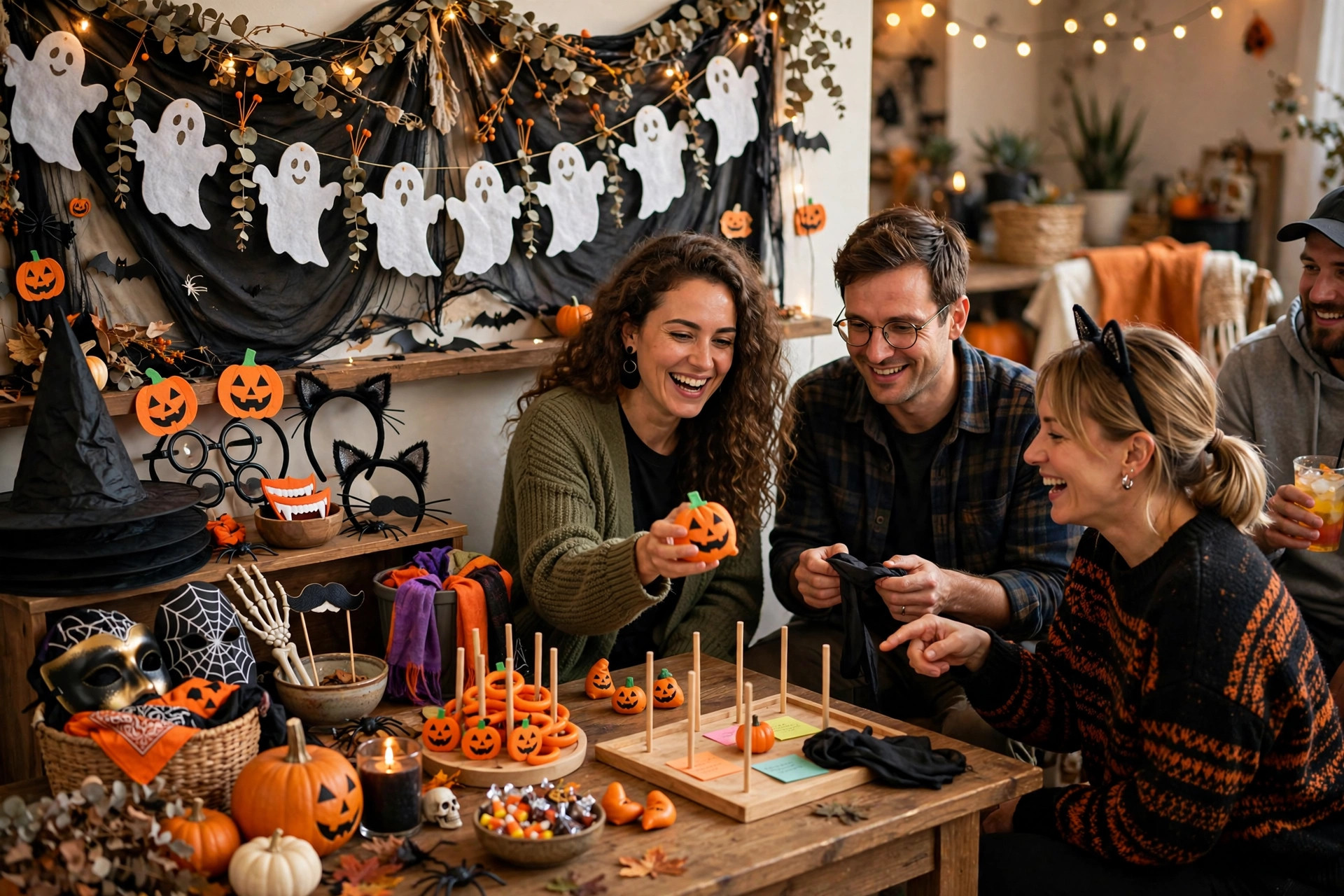
The difference between a good party and a legendary one is usually one great shared moment — and games create those moments. But party games fail more often than they succeed, usually because they are too complicated, take too long, or force participation. The rule is: games should be opt-in, quick to explain, and fun to watch even if you are not playing.
- Costume contest: The essential Halloween party game. Announce categories in advance (scariest, funniest, most creative, best group) and judge by guest vote — slips of paper in a pumpkin bucket. Prizes can be silly and cheap; the glory is the point.
- Murder mystery lite: A simplified, social version — assign a few guests secret roles at the door and let a light mystery unfold through the evening. Keep it very simple or skip it; complicated versions stall parties.
- Halloween quiz: Short rounds between other activities — horror films, spooky trivia, “guess the costume inspiration”. Teams of four, small prizes.
- Photo booth: Not exactly a game, but a decorated corner with props generates the night’s best memories and gives shy guests something to do. This is the highest-return entertainment investment of the whole party.
- Classic party games, Halloween edition: Bobbing for apples (or doughnuts on strings — less wet), a mummy-wrap race with toilet paper teams, pin the hat on the witch. Corny, physical, hilarious.
Music matters as much as games. Build a long playlist in advance — a mix of Halloween classics, party hits, and background atmosphere — and let it run. Start the evening with atmospheric background music as guests arrive, shift to party energy as the night builds. A neglected silent room kills atmosphere faster than bad decor, so assign someone the music if you cannot manage it yourself.
What logistics do hosts often forget?
Hosts often forget coats, shoes, parking and transport, bathroom supplies, neighbour warnings, and safety basics like clear exits, secured decorations, and ventilation for a fog machine — yet these details decide how the party feels.
Here is the unglamorous truth: guests remember how a party felt, and how it felt was determined by logistics. Coats: designate a bedroom or a rack near the door, because a mountain of coats on your bed is fine but a mountain of coats blocking the hallway is not. Shoes: decide in advance — shoes off means providing somewhere for them and warning guests; shoes on means protecting floors. Either is fine; indecision is not.
Parking and transport deserve a line in the invitation and a reminder on the day: where to park, which streets to avoid, the nearest taxi or rideshare pickup point. If guests are travelling late, make the transport plan obvious and easy — the host who organises a group chat for shared rides home is a hero. Bathrooms: if you have two, signpost the second one; if you have one, accept the queue and keep it stocked with toilet paper, hand towels, and soap all night. Check supplies twice during the evening.
Neighbours: warn them in advance, especially about noise and parking. A friendly note or a quick chat — and ideally an invitation, or at least a plate of party food the next day — prevents almost all complaints. Know your area’s noise expectations and bring the music inside and down after a reasonable hour. The best parties end with neighbours smiling, not with a noise complaint.
Safety basics: keep exits clear, know where your fire extinguisher is, secure any decorations that could fall, and keep the floor clear of trailing cables and costume trip hazards. If you are using a fog machine, ventilate and warn guests with asthma. None of this is fun to think about, but the host who has thought about it is the host whose party everyone remembers fondly.
When should you do each party task?
Work backwards from party night: invitations and theme three to four weeks out, non-perishables and decorations two weeks out, food planning and a deep clean one week out, decorating and prep over the final two days, and finish everything an hour before guests arrive.
| When | Do this |
|---|---|
| 3–4 weeks out | Send invitations, decide the theme, make the big shopping list |
| 2 weeks out | Buy non-perishables, decorations, and costume supplies; confirm numbers with a reminder |
| 1 week out | Plan food in detail, build the playlist, prep anything freezable, deep-clean party areas |
| 2 days before | Decorate rooms guests will not use for daily life (spare rooms, hallway displays) |
| Day before | Shop for fresh food, prep what you can, set up drinks station and displays, charge speaker and fairy lights, lay out the photo booth |
| Morning of | Fresh food prep, final decorating, set tables, stock bathrooms, walk through as a guest |
| 1 hour before | Lights on, music on, first food out, get dressed — then stop |
An hour before guests arrive: light everything (LED candles on, string lights on), start the music, put out the first round of food, get yourself dressed and ready — and then stop. The most important item on the timeline is the last one: be finished before the doorbell rings. A host who is still hanging bats when guests arrive sets a frantic tone; a host who opens the door already in costume, drink in hand, sets the tone for the whole night.
How do you wind a party down gracefully?
Wind down with gentle signals in the last hour — lights slightly up, music slightly down, water and leftovers offered to take home — then a ten-minute safety sweep before bed, and the full clean-up in waves the next day.
How a party ends matters almost as much as how it runs. Have a wind-down plan: as the night peaks, you do not need to do anything, but in the last hour, start the gentle signals — brighter lights slightly up, music slightly down, offering water and leftover food to take home. Most guests take the hint gracefully. For the few who do not, a warm “this was so fun, let’s do it again” while walking toward the door works wonders.
Do a ten-minute safety sweep before bed, even if you are tired: blow out or switch off every candle and light, unplug the fog machine and fairy lights, check the oven and hob are off, gather perishable food into the fridge, and make sure doors and windows are locked. Then stop. The full clean-up waits until morning — trying to deep-clean at 2am helps nobody and risks breakages.
The next day, clean in waves: rubbish first (biggest visual impact), then dishes, then floors, then decorations down. Enlist help if anyone stayed over — many hands make it fast, and post-party clean-up with friends and leftover pizza is weirdly enjoyable. Send a thank-you message to guests with a few favourite photos, and bask briefly in the glory. Then start a notes file on your phone: what worked, what ran out, what you would change. Next year’s ultimate spooky night in starts with this year’s lessons.
The ultimate Halloween party is not the most expensive or the most elaborate. It is the one where the host planned the practicalities, committed to the atmosphere, and then let go and had fun. So pick your date, send those invitations, and start planning your transformation. Your living room is about to become a haunted mansion, your kitchen a witch’s apothecary, and your friends a glorious parade of monsters. Host it well, enjoy it fully, and accept the compliments gracefully — you will have earned every one of them. Happy haunting, host.
Leave a Reply