
Last updated: November 2026
Quick answer: Heatless overnight curls work by setting slightly damp hair in wraps, braids, buns or rollers while you sleep, so you wake up to soft waves with no hot tools and less heat damage over time.
There is something deeply satisfying about going to sleep and waking up with your hair already done. No early alarm, no hot tools, no arm ache from holding a curling wand — just beautiful, bouncy waves waiting for you in the mirror.
The appeal goes far beyond convenience. Regular heat styling takes a real toll over time, leading to dryness, split ends and breakage. Heatless curling sidesteps all of it: your hair sets into waves while you sleep, completely untouched by damaging temperatures.
Why Do Heatless Curls Actually Work?
Damp hair is mouldable because water temporarily loosens the bonds that hold its shape, and as hair dries overnight those bonds reform, locking in waves without heat, which is why damp rather than wet or dry hair works best.
- Hair is most mouldable when slightly damp: water temporarily breaks the hydrogen bonds in the hair shaft, and as hair dries, those bonds reform in the new shape.
- Soaking wet hair will not dry fully overnight, leaving limp, half-formed waves and possibly a damp pillow.
- Completely dry hair has already set its shape and resists re-forming.
- Slightly damp hair, roughly 70 to 80 percent dry, is the sweet spot: pliable enough to shape, dry enough to set fully by morning.
Dermatologists advise limiting heat damage by using low or medium heat settings, letting hair air-dry at least partway, and keeping hot-tool contact brief (American Academy of Dermatology). In our experience, skipping heat altogether overnight is the simplest version of that advice.
Hair type affects your results, but every type can get beautiful heatless waves with the right approach: fine hair takes curl easily but loses it faster; thick hair needs smaller sections so each section dries fully; wavy hair needs only gentle encouragement; straight, resistant hair does best with the most structured methods and a little extra hold.
How Do You Choose the Right Method for Your Hair?
Match the method to your hair and sleep style: headband wraps suit medium to long hair, sock curls suit long hair, braids suit restless sleepers, buns suit shorter hair, and foam rollers suit resistant straight hair.
| Method | Best for | Result | Sleep comfort |
|---|---|---|---|
| Robe-tie / curling headband | Medium to long hair | Big, bouncy, salon-blowout waves | Very comfortable; lies flat |
| Sock curls | Long hair | Defined, spiral curls | Comfortable; costs nothing to try |
| French braids | Wavy or textured hair; restless sleepers | Relaxed, beachy waves | Most secure and sleep-friendly |
| Twisted buns (space buns) | Short to medium hair | Soft, voluminous waves with root lift | Good, but buns sit on top of the head |
| Foam rollers | Resistant, straight hair | Structured, long-lasting curls | Soft foam is comfortable to sleep on |
Consider your sleep style too. Back sleepers can wear almost anything comfortably. Side sleepers do best with low-profile methods like braids or the headband technique. Restless sleepers should choose the most secure options — braids and buns survive tossing far better than loose wrapping methods. If you have a sensitive scalp, avoid anything pulled tight.
What Evening Prep Routine Makes Curls Hold?
Prep decides whether waves last: start with clean hair at about seventy to eighty percent dry, add leave-in conditioner and a light hold product in the right order, avoid heavy oils before setting, and detangle thoroughly first.
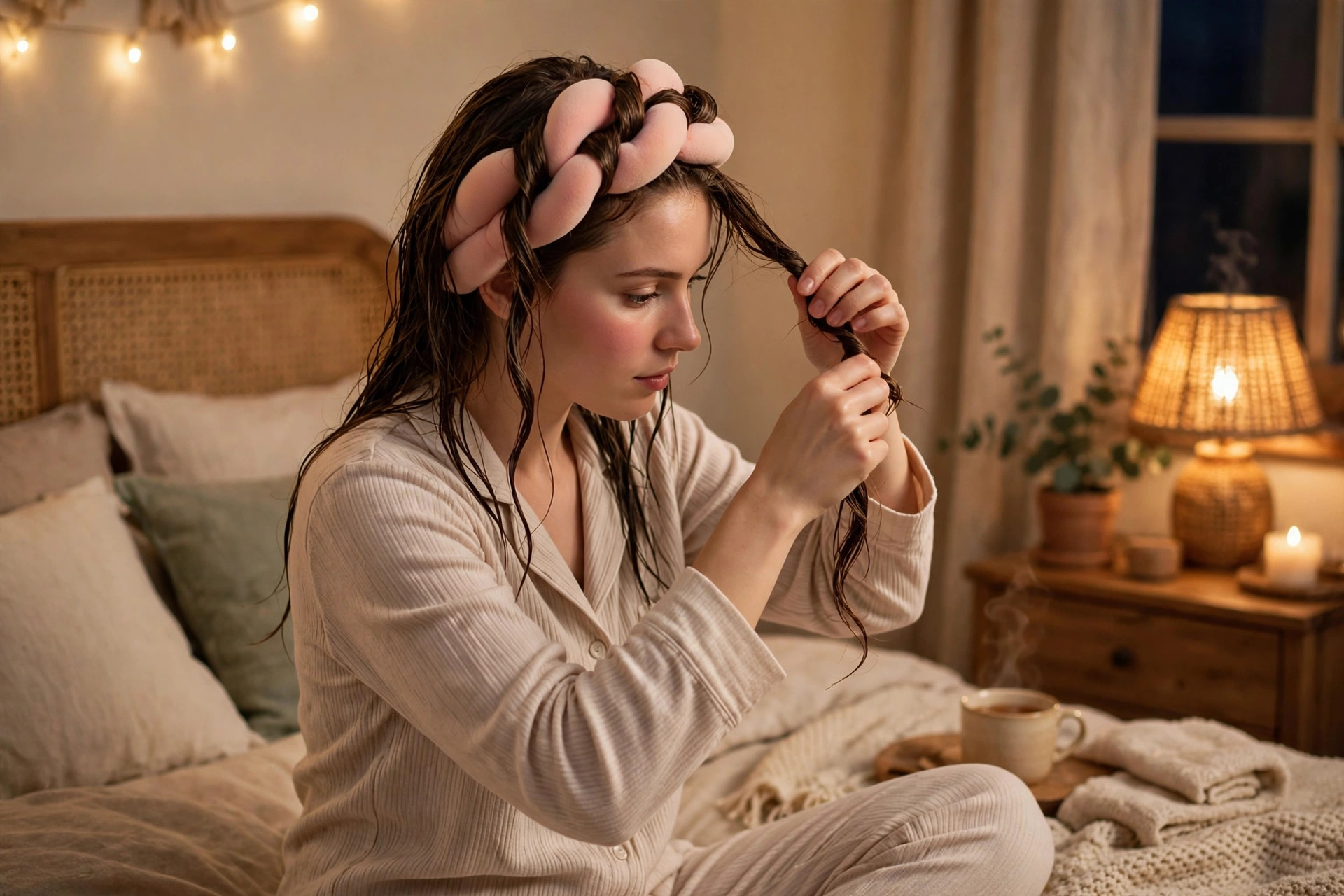
- Start with freshly washed or refreshed hair. If freshly washed hair is very slippery, a light texturising spray adds helpful grip.
- Get hair to 70-to-80-percent dry: let it air-dry until just damp, or lightly mist dry hair with water. It should feel cool and slightly damp, never dripping.
- On damp hair, work a small amount of leave-in conditioner or curl cream through the mid-lengths and ends.
- Follow with a light mousse or volumising foam at the roots if you want lift, and a flexible-hold product through the lengths if your hair struggles to hold curl.
- Avoid heavy oils or silicones before setting — they coat the hair and prevent it from taking shape.
- Detangle thoroughly with a wide-tooth comb — every knot you leave in will become a kink in the morning.
If your scalp tends toward oiliness, a light dusting of dry shampoo at the roots before wrapping keeps things fresh overnight. If you have dandruff, an itchy scalp, or any ongoing scalp condition, treat that first — wrapping irritated scalps tightly overnight can make discomfort worse.
What Are the Five Overnight Methods, Step by Step?
Five reliable methods cover every need: wrap hair around a robe tie or headband, roll sections around socks, French-braid for beachy waves, twist space buns for volume, or use foam rollers for the most defined curls.
- The robe-tie headband method. Place a soft robe belt or dedicated heatless curling headband over the top of your head like a headband, with equal lengths hanging on each side. Starting at the front on one side, take a section of damp hair and wrap it around the belt, adding more hair as you work backward. Repeat on the other side, then secure the ends with a scrunchie.
- Sock curls. Take a clean, long sock and lay it vertically against a section of damp hair, with the toe end near your ends. Roll the hair up around the sock toward your scalp, then tie the sock’s ends together. Repeat in sections — four to six socks for loose waves, eight or more for tighter curls.
- French braids. Part damp, detangled hair into two sections (or one for looser waves) and French-braid each side from the crown down, keeping tension even but not painfully tight. Secure with soft scrunchies — never tight elastics, which leave dents.
- Twisted space buns. Part damp hair down the middle, twist each half into a rope, then coil it against your head and pin or scrunchie each coil into a bun. Two buns give balanced waves; one high bun gives more uniform curl.
- Foam rollers. Roll sections of damp hair onto soft foam rollers, rolling away from your face for a classic shape, and clip or secure each roller. Smaller rollers mean tighter curls; larger rollers mean soft waves. Remove carefully in the morning, unrolling rather than pulling.
How Do You Sleep Comfortably With Your Hair Set?
Sleep comfortably by covering set hair with a silk or satin bonnet or scarf, using a satin pillowcase to reduce friction, choosing flatter methods if you sleep on your side, and keeping the bedroom cool and dry.
- A silk or satin bonnet or scarf over set hair reduces friction, keeps everything in place, and protects curl formation as you move.
- A satin pillowcase helps for the same reason — cotton pillowcases create friction that frizzes and flattens developing waves.
- If your method involves buns or rollers on top of your head, try falling asleep on your back or propped slightly upright.
- Braids and headband wraps are the kindest to side sleepers since they lie relatively flat.
- Keep your bedroom cool if you can — warmth and humidity work against curl formation, while cool, dry air helps the set hold.
Be realistic about the adjustment period: most people find their comfort sweet spot within three or four tries. Do not judge a technique on a single uncomfortable night.
How Do You Unwrap Like a Pro in the Morning?
Unwrap gently and let curls relax before judging them: separate with fingers rather than a brush, smooth a pea-sized amount of serum over the ends, stretch any section that is too tight, and mist lightly with flexible-hold spray.
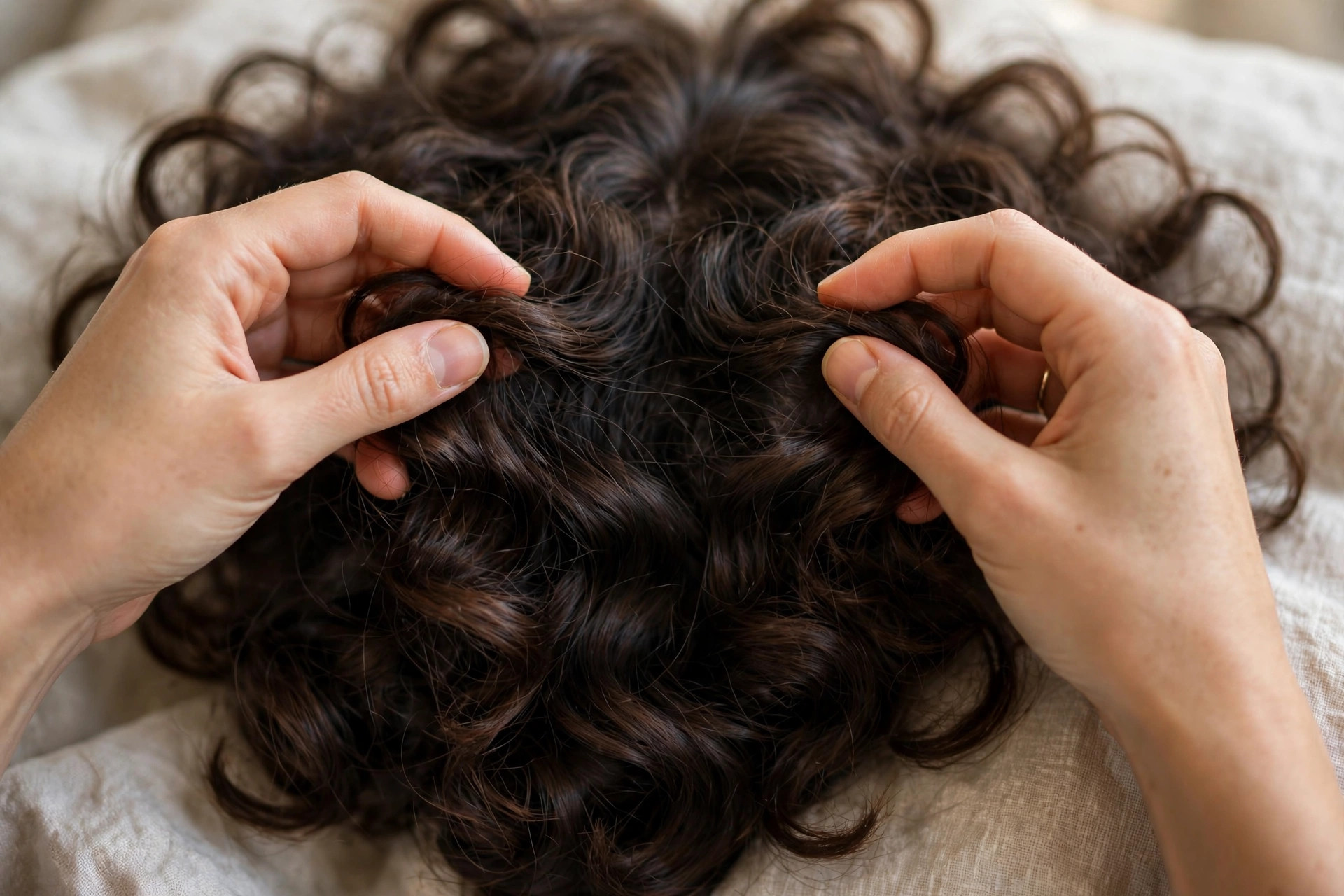
- Remove everything gently — unroll, untie, and unbraid slowly rather than yanking. Curls will look tighter than the final result; they relax and soften over the first hour.
- Let curls fall naturally for a few minutes, then separate them with your fingers — never a brush, which breaks the curl pattern into frizz.
- Work a pea-sized amount of light serum or oil between your palms and smooth it over the mid-lengths and ends.
- For extra volume, flip your head upside down and gently massage at the roots, then flip back and arrange.
- If any section is too tight, gently stretch it downward; if a section fell flat, twist it loosely around your finger for thirty seconds.
- Finish with a light mist of flexible-hold hairspray held at arm’s length — the goal is touchable, lived-in waves, not a helmet.
How Do You Keep Your Waves Bouncy All Day?
Keep waves going by keeping hands off styled hair, using an anti-humidity or flexible-hold spray on damp days, reviving flat roots with dry shampoo or texturising spray, and pineappling hair loosely overnight for second-day waves.
- Hands off: every touch transfers oils and breaks up the curl pattern.
- On damp or rainy days, a light anti-humidity spray or flexible-hold hairspray helps waves survive the weather.
- If hair falls flat by afternoon, a travel-size dry shampoo or texturising spray revives roots with a quick scrunch.
- For second-day waves, pineapple your hair overnight: gather it loosely into a high, loose ponytail on top of your head with a silk scrunchie, then shake out and refresh in the morning.
What Heatless Curl Mistakes Should You Avoid?
Most failed sets come from wrapping hair that is too wet, skipping styling products, using sections that are too large to dry, or brushing curls out in the morning instead of finger-separating them once they have relaxed.
- Too wet: hair that is too wet simply cannot dry by morning. When in doubt, err on the drier side.
- No styling products: most hair needs a little help — a mousse, a curl cream, something.
- Sections too large: thick sections do not dry through, so keep sections modest, especially if your hair is thick.
- Morning impatience: brushing out curls, or judging the result in the first five minutes before curls have relaxed, ruins more good sets than any wrapping error.
- Giving up too soon: consistency beats perfection — your third attempt will look noticeably better than your first.
Heatless overnight curls are one of beauty’s kindest bargains: healthier hair, extra sleep, and beautiful waves, all from a few minutes of evening effort.
Leave a Reply