
Last updated: October 2026
Quick answer: To fix cakey makeup in cold weather, hydrate well, switch to cream or liquid formulas, apply thin layers with a damp sponge, and set lightly. The right winter prep and products keep foundation smooth, dewy and flake-free all day.
Learning how to fix cakey makeup in winter can completely change your relationship with your foundation. One minute your base looks flawless, and by lunchtime it is clinging to dry patches and looking far heavier than it should. Sound familiar? You are not doing anything wrong — your skin simply behaves differently when the temperature drops.
The good news is that cakey makeup in cold weather is almost never about the quality of your foundation. It is about how your skin is prepared, which formulas you reach for, and how you apply them. In our experience, a few small tweaks can take you from patchy and chalky to smooth and glowing. Here is the routine that works, broken into seven simple steps.
Why Does Makeup Go Cakey in Winter?
Quick answer: Cold air holds less water vapour, and indoor heating dries the air further, so dry air pulls moisture from your skin. Foundation then sits on flaky, dehydrated skin instead of melting in — which is why makeup looks patchy and cakey all winter.
Think of your skin as a canvas. When it is smooth and plump, foundation glides on beautifully. When cold weather leaves it dry and flaky, every product catches on those rough patches. Matte foundations are the biggest culprits, because they are designed to absorb oil — and in winter your skin has very little oil or moisture to spare.
There is real science behind it. Cold air holds less water vapour than warm air, and heating dry indoor air draws even more moisture out of it. The Oklahoma Medical Research Foundation explains that this dry air pulls water from the outer layer of the skin, leaving it dry, cracked and flaky (OMRF). So a cakey December base is not your imagination — your skin really is drier than it was in September.
Heavy layering makes it worse: one thick coat separates and cracks on dry skin, while two sheer layers look seamless. Powder also soaks up the little moisture your skin still has, turning a smooth base chalky within hours.
How Do I Prep My Skin to Fix Cakey Makeup in Winter?
Quick answer: Cleanse gently with a creamy cleanser, then layer a hydrating serum and rich cream moisturiser onto slightly damp skin. This traps moisture where foundation needs it, creating the smooth, plump base that stops makeup going cakey.

Good prep is honestly the whole secret. In winter, your morning skincare does more for your makeup than any primer. Start with a gentle creamy cleanser rather than a foaming one, and use lukewarm water — dermatologists recommend warm rather than hot water to stop dry skin getting worse (AAD).
- Hydrating serum: press into slightly damp skin. Glycerin or hyaluronic acid draw water in and help skin hold on to it.
- Rich moisturiser: choose a cream over a lightweight lotion — dermatologists note creams and ointments are more effective and less irritating than lotions for dry skin (AAD).
- Wait five minutes: let everything sink in before makeup touches your face. Rushing causes pilling and patchiness.
Apply your moisturiser while skin is still slightly damp. The AAD advises moisturising immediately after washing, because it traps existing moisture in your skin (AAD). In our experience, this single habit does more to prevent cakey winter makeup than any product swap.
Which Products Work Best When It’s Cold?
Quick answer: In winter, cream and liquid formulas beat powders. Swap matte foundation for a satin or dewy finish, trade powder blush and bronzer for cream versions, and pick a hydrating concealer — formulas that move with your skin.

You do not need a whole new makeup bag — just favour the right formulas. Anything labelled matte or long-wear tends to grip and cake on dry skin, while satin, dewy, hydrating or luminous formulas glide and flex with it.
- Foundation: liquid or cream with a satin finish — melts in instead of clinging to dry patches.
- Concealer: hydrating liquid — will not crease or crack under the eyes.
- Blush and bronzer: cream sticks or tints — blend seamlessly and add natural glow.
- Setting: hydrating mist plus the tiniest dusting of powder through the T-zone only.
- Lips: tinted balm or satin lipstick — matte formulas settle into chapped lips.
If you love your current foundation, mix one pump with a drop of facial moisturiser on the back of your hand. This sheer-tint trick instantly makes any heavy base more winter-friendly.
What Is the Right Application Order?
Quick answer: The 7-step winter routine: hydrate on damp skin, wait five minutes, apply a hydrating primer, dot on sheer foundation and blend with a damp sponge, conceal sparingly, set only the T-zone, then finish with a hydrating mist.
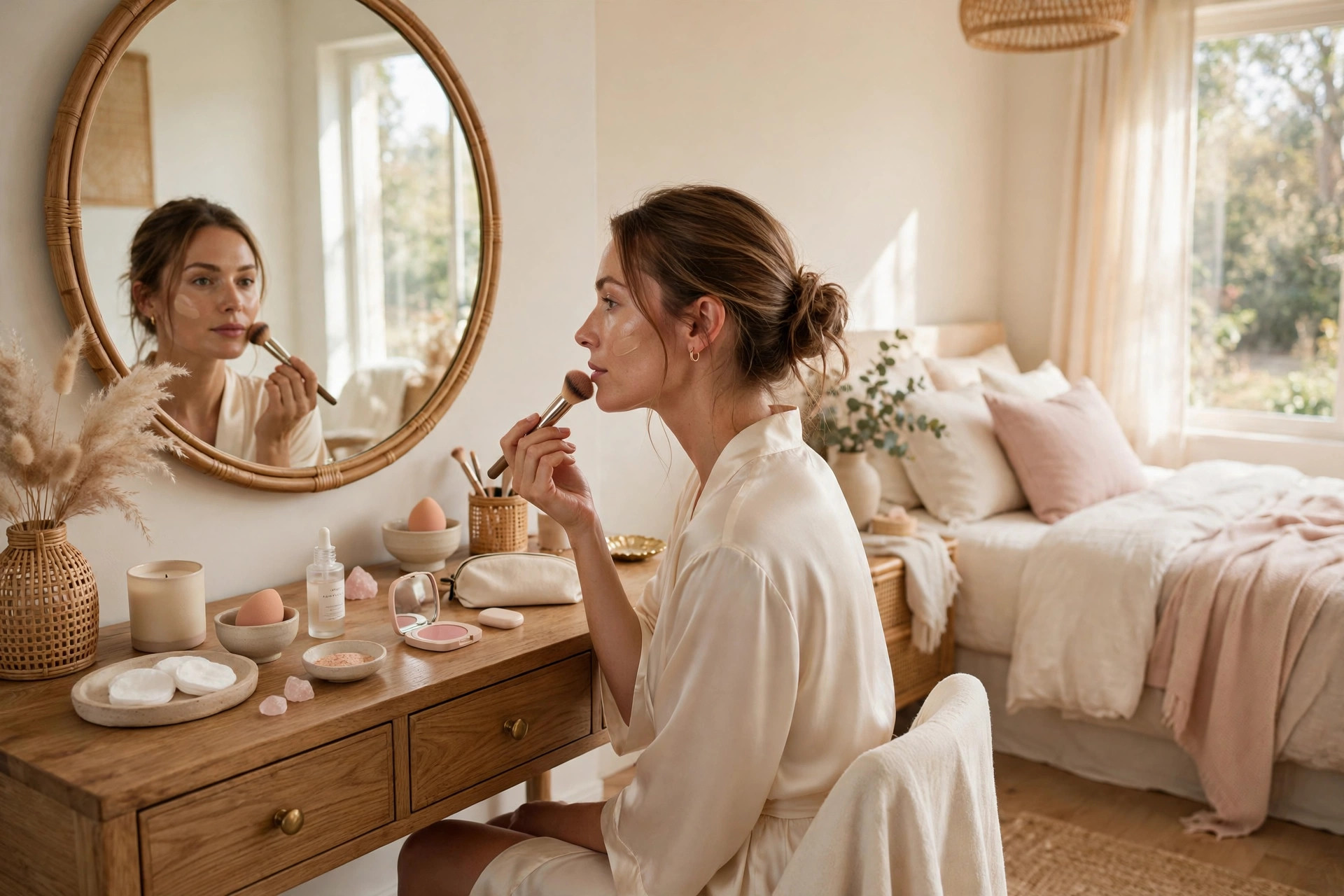
The golden rule through all seven steps is thin layers — you can always add more, but you cannot easily take product away once it has caked.
- Hydrate on damp skin — serum then rich cream, applied while your face is still slightly damp to lock water in.
- Wait five minutes — let skincare absorb fully so it does not mix with foundation and pill.
- Prime with hydration — a hydrating or illuminating primer smooths texture; skip mattifying primers entirely in winter.
- Apply foundation sheer — dot on the centre of the face and blend outward with a damp sponge, adding coverage only where needed.
- Conceal sparingly — a little hydrating concealer on blemishes and dark circles, blended with your fingertip.
- Set lightly — the tiniest press of translucent powder through the T-zone only.
- Mist to finish — a few spritzes of hydrating mist melt the layers together so makeup looks like skin.
Steps one, four and seven do the heavy lifting: damp-skin hydration, damp-sponge blending and a final mist keep winter makeup smooth from morning to night.
How Do I Refresh Cakey Makeup Midday?
Quick answer: Never pile more powder over cakey makeup — it makes things worse. Press a damp sponge over dry patches to re-blend, spritz hydrating mist, blot shine with blotting paper, and tap a tiny dab of moisturiser over cracks.
Central heating and cold commutes can dry your makeup out by afternoon. Reaching for the powder compact is exactly the wrong move — powder on top of dry, cakey makeup just adds more chalkiness.
- Mist first — a spritz rehydrates the top layer of your makeup and softens any cracking.
- Press, do not rub — gently press a damp sponge over patchy areas to re-blend.
- Blot instead of powdering — blotting paper lifts shine without adding a dry layer.
- Spot-moisturise — warm a tiny dab of moisturiser between your fingers and tap it over stubborn dry patches.
Keep a small hydrating mist and blotting papers in your bag all winter. Together they rescue almost any midday makeup meltdown in under a minute.
What Mistakes Make Cakey Makeup Worse?
Quick answer: The biggest winter mistakes: skipping moisturiser, applying foundation to unprepared skin, using too much powder, layering too thickly, and exfoliating too often. Each strips moisture or adds texture — the recipe for cakey makeup.
- Skipping moisturiser — bare dry skin plus foundation equals cakiness every time.
- Over-exfoliating — once or twice a week is plenty; daily scrubbing creates more flakes.
- Too much powder — a full face of powder is the fastest route to a chalky winter finish.
- Thick all-over foundation — one heavy layer cracks; sheer, buildable layers flex.
- Hot water on the face — strips the natural oils your skin needs; lukewarm is best.
- Ignoring lips — matte lipstick on chapped lips highlights dryness; wear a tinted balm instead.
If your makeup has been cakey all winter, one or two of these habits is probably the culprit. Fix the prep and the formulas first — those two changes alone solve it for most people.
Winter vs Summer: What Should I Change?
Quick answer: Winter makeup needs more moisture and less powder than summer. Swap mattifying primers and heavy powder for hydrating primers and mist, choose cream formulas, and moisturise on damp skin for a smooth finish.
Wearing the same routine all year is why winter punishes your base. Dermatologists point out that sticking to one routine year round may not work when humidity drops, because dry air makes fine lines and texture more noticeable (AAD).
| Routine step | Summer approach | Winter adjustment |
|---|---|---|
| Cleanser | Foaming or gel cleanser | Gentle creamy cleanser |
| Moisturiser | Lightweight lotion or gel | Rich cream, applied on damp skin |
| Primer | Mattifying or pore-filling | Hydrating or illuminating |
| Foundation | Matte or long-wear liquid | Satin or dewy liquid, sheered out |
| Blush and bronzer | Powder formulas | Cream formulas |
| Setting | Generous setting powder | T-zone only, then hydrating mist |
| Touch-ups | Powder compact | Mist and blot, no extra powder |
Start with the two swaps that matter most — a richer moisturiser and a dewier foundation — and adjust the rest as the coldest weeks arrive. By mid-winter your routine will be fully winter-proof.
Can I still wear powder in winter?
Yes, but far less of it. Keep powder to the areas that truly shine — usually just the T-zone — and use the lightest dusting. If your skin looks dull or chalky a few hours later, switch to blotting papers and a hydrating mist for touch-ups instead.
Should I change my foundation shade in winter?
Often, yes. Most of us lose our summer tan by December, and an August shade can look too dark in January. If your winter base looks heavy, check the match along your jawline in natural daylight — half a shade lighter usually fixes it.
Does drinking more water stop cakey makeup?
Drinking water is great for your health, but it does not directly change how makeup sits on your skin’s surface. What matters is moisture applied from the outside — hydrating serums, a good cream on damp skin, and some humidity in your environment.
How often should I exfoliate in winter?
Once or twice a week is plenty for most skin types. Gentle exfoliation clears the flakes that make foundation patchy, but overdoing it damages your skin’s barrier and creates more dryness. Always follow with a rich moisturiser.
Fixing cakey makeup in winter comes down to one simple idea: happy, hydrated skin makes makeup behave. Moisturise on damp skin, choose cream and liquid formulas, apply in thin layers and finish with a mist — and that chalky winter base will be history.
Leave a Reply