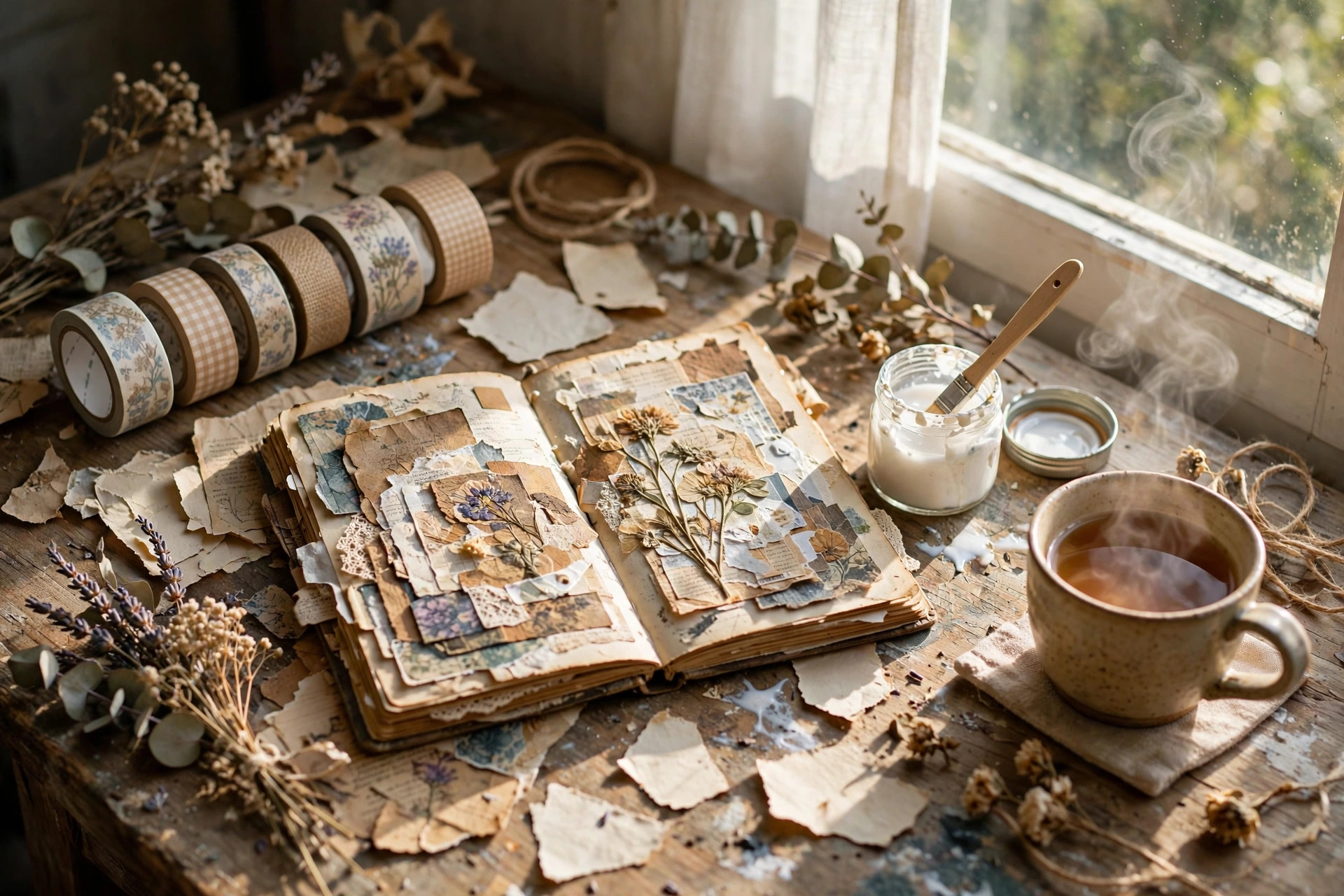
Last updated: October 2026
Quick answer: Junk journaling is a handmade journal built from everyday paper scraps — old envelopes, ticket stubs, wrapping paper and dried leaves — layered into pages that are entirely yours. It needs almost no supplies, has no right or wrong outcome, and makes a gentle, pressure-free creative ritual.
There is a special kind of calm that comes from making something with your hands that doesn’t need to be perfect. Junk journaling is exactly that: a handmade journal built from the beautiful clutter of everyday life — old envelopes, wrapping paper, ticket stubs, dried flowers, magazine clippings and ribbons — layered into pages that are entirely, unapologetically yours. Nothing in it is precious, which is precisely why it feels so freeing.
In a world of polished feeds and perfect morning routines, junk journaling celebrates the opposite: torn edges, crooked glue lines, mismatched colours. It is creativity without performance, and for many women it has quietly become one of the most soothing self-care rituals around. If your brain feels noisy and your evenings feel rushed, this might be the hobby you’ve been waiting for.
What Is Junk Journaling, and Why Do Perfectionists Love It?
A junk journal is a book you make yourself from ordinary paper, folded and sewn or tied into a cover, then filled with collages, pockets, tags and notes. Because it is supposed to look layered and lived-in, there is no pressure to be good at it.
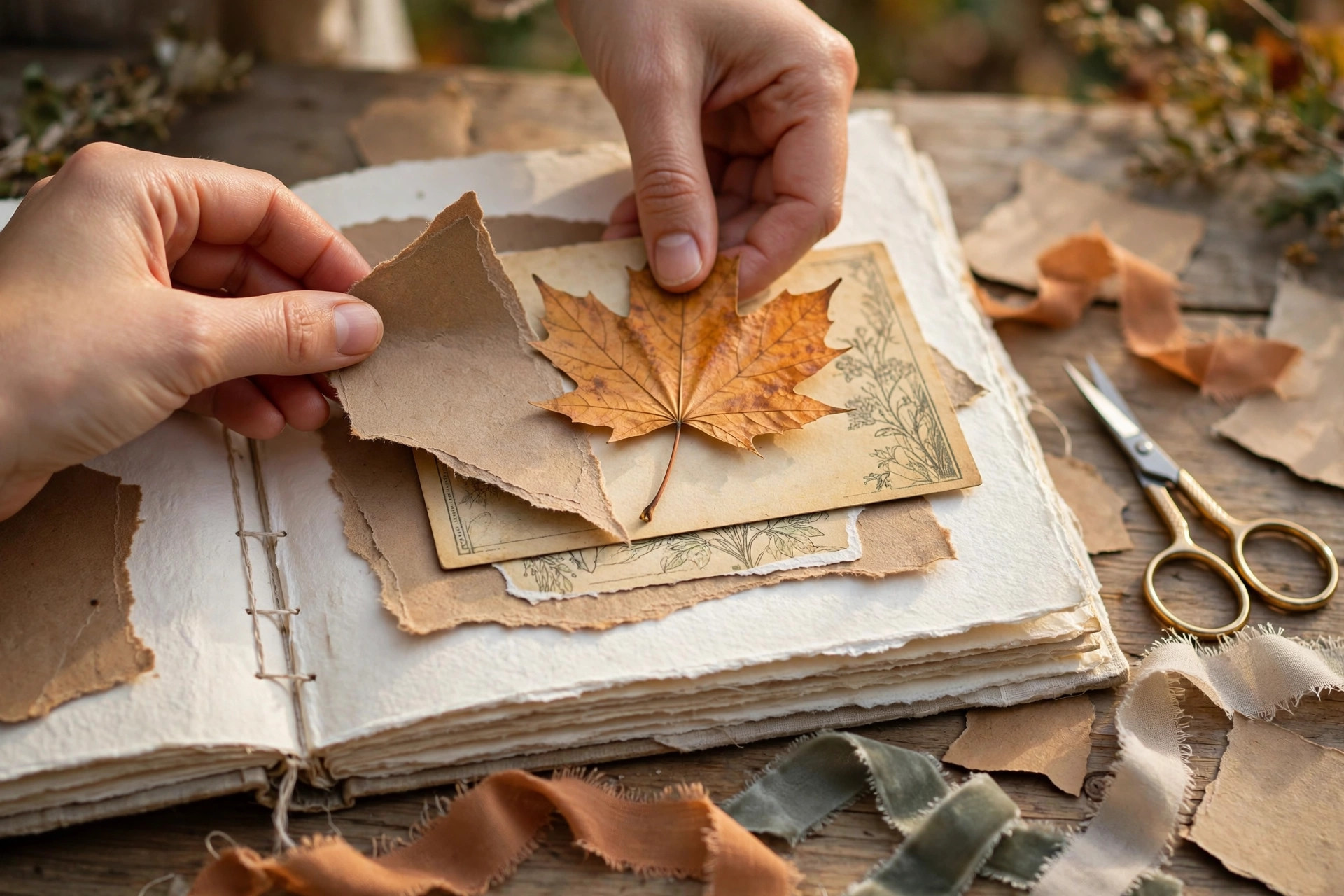
At its heart, a junk journal is a book you make yourself from ordinary paper — folded pages sewn or tied into a cover made from a cereal box, an old book cover or thick card — which you then fill with collages, pockets, tags and notes. The “junk” is the point: instead of buying expensive supplies, you use what you already have. Yesterday’s shopping list becomes a background layer. A bus ticket becomes a memory. A dried leaf from your autumn walk becomes art.
What makes this such a gentle self-care practice is that it completely removes the pressure to be good at it. A bullet journal can start to feel like homework; a sketchbook can feel intimidating when your drawing skills are rusty. But a junk journal? It is supposed to look layered and lived-in. The wonkier, the better. Activities with low stakes and no “right” outcome can feel the most restorative, because they let your mind wander instead of judging. Many journalers say twenty minutes of gluing and layering leaves them calmer than an hour of scrolling ever did.
It is also wonderfully personal. Your journal becomes a tactile memory-keeper: the menu from a lovely dinner, a photo booth strip with your sister, a pressed flower from the park. Months later, flipping through it feels like opening a treasure box of your own life. Unlike a phone full of photos you never look at, a junk journal is something you actually touch, smell and revisit — and because every page is handmade, even ordinary weeks start to feel worth recording.
This kind of hobby has deep roots: keeping personal books of scraps, quotations and memorabilia goes back to commonplace books and friendship albums popular in England from the 15th and 16th centuries, as described in the history of scrapbooking. In our experience, that long, low-pressure tradition is part of its charm — you are joining a very old habit of keeping what matters.
What Do You Need to Start Junk Journaling?
Almost nothing. Any stack of paper folded in half can become a journal, stitched with thread or ribbon, and decorated from a small box of glue, scissors, tape and paper scraps you already own. Keep it all in one tray so starting takes no effort.
One of the loveliest things about this hobby is the price tag: practically nothing. You probably own everything you need already. Start with a base — any stack of paper folded in half will do. Old envelopes, brown paper bags, pages from a damaged book, printer paper, even junk mail. Fold ten to fifteen sheets together, poke three holes along the spine with a large needle, and stitch them with embroidery thread or ribbon. Just like that, you have a journal.
- Base: folded paper, old envelopes, brown paper bags or damaged-book pages.
- Binding: a large needle with embroidery thread or ribbon.
- Decorating: a glue stick or double-sided tape, scissors, washi tape, ribbon scraps, buttons and stickers.
- Ephemera: old magazines, receipts, tags, wrapping paper and postcards.
- Optional treats: autumn-toned ink pads or a small watercolour set — entirely optional.
Many journalers also keep a “bits envelope” in their handbag for collecting treasures on the go — an interesting leaflet from a café, a pretty sugar packet, a pressed flower from a walk — so inspiration is never more than an arm’s reach away when a spare ten minutes appears.
Set up a small corner — even a tray you can carry to the sofa counts — so your supplies are always within reach. The biggest barrier to creative self-care is faff; if you have to dig everything out of a cupboard each time, you won’t do it. Keep your journal, your box of bits and your glue together, and the habit practically builds itself.
Which Junk Journal Spreads Should You Try This Autumn?
Start with one gentle prompt at a time, in any order, and skip anything that does not spark joy. The autumn walk page, memory pocket, gratitude collage and “currently” list are easy first spreads, and half-finished pages are part of the charm.
Staring at a blank page is the hardest part, so here are ten gentle prompts to get you going. Pick whichever sounds most fun — there is no order, no homework, no wrong answers.
- The autumn walk page: Glue down a pressed leaf, a feather or a seed head you collected, and write two sentences about where you found it.
- The cosy drinks spread: Layer coffee cup sleeves, tea bag tags and a torn-out magazine photo of a candle, then list your three favourite autumn drinks.
- The memory pocket: Make a simple envelope from patterned paper, tuck in a cinema or train ticket, and label it with the date.
- The colour story: Pick one autumn colour — rust, mustard, forest green — and fill a page only with scraps in that shade.
- The gratitude collage: Cut out words and images that represent things you’re thankful for and arrange them loosely before gluing.
- The recipe keeper: Stick in a handwritten recipe card for your favourite autumn bake, with a doodle of a whisk in the margin.
- The nature rubbing page: Place a leaf under thin paper and rub with a crayon, then glue the rubbing beside the real leaf.
- The “currently” list: Note what you’re currently reading, watching, craving and dreaming about, framed with torn washi tape.
- The fabric swatch page: Glue down scraps of fabric — an old scarf, a ribbon, a bit of lace — and note what each one reminds you of.
- The future wishes page: Collage images of things you’re looking forward to, from a holiday to simply a quieter December.
Work on one spread at a time, and don’t finish in one sitting if you don’t feel like it. Half-finished pages are part of the charm — come back tomorrow with fresh eyes and a new scrap. If a prompt doesn’t spark joy, simply skip it and try another; the list is a buffet, not a syllabus, and your journal will be all the better for following your own curiosity.
Where Can You Find Beautiful Bits and Bobs for Free?
Start at home in the recycling pile, ask friends to save pretty paper, browse charity shops for damaged illustrated books and fabric remnants, and gather only abundant, already-fallen leaves and seed heads outdoors. Press flat finds between heavy books for a week first.
Half the fun of junk journaling is the treasure hunt. Start at home: the recycling pile is genuinely a goldmine. Interesting envelopes, patterned tissue from parcels, gift wrap offcuts, old calendars with pretty pictures, the paper band around a bunch of flowers — all of it belongs in your creativity box. Ask friends to save their interesting bits too; most people are delighted to have an excuse not to throw pretty paper away.
Out in the world, charity shops are wonderful for old books with illustrated pages (pick damaged ones destined for the bin anyway), vintage postcards and fabric remnants. Libraries often have free magazines to take. In autumn specifically, nature provides the best materials of all: fallen leaves in copper and gold, seed heads, dried grasses, feathers and interesting bark. Press flat finds between heavy books for a week before using them so they don’t buckle your pages.
A word of gentle caution: only ever take what is abundant and already fallen, and never pick from gardens or protected areas. The loveliest junk journals are made from things that were freely given — by your letterbox, your walks and your own kitchen drawer.
How Do You Keep Junk Journaling a Real Self-Care Practice?
Keep the bar low: ten minutes counts, one glued-down leaf counts, and a mostly blank page with a single ticket stub counts. Pair sessions with a small ritual, return to one thing and one sentence when stuck, and treat the hobby as support — not a substitute for professional help.
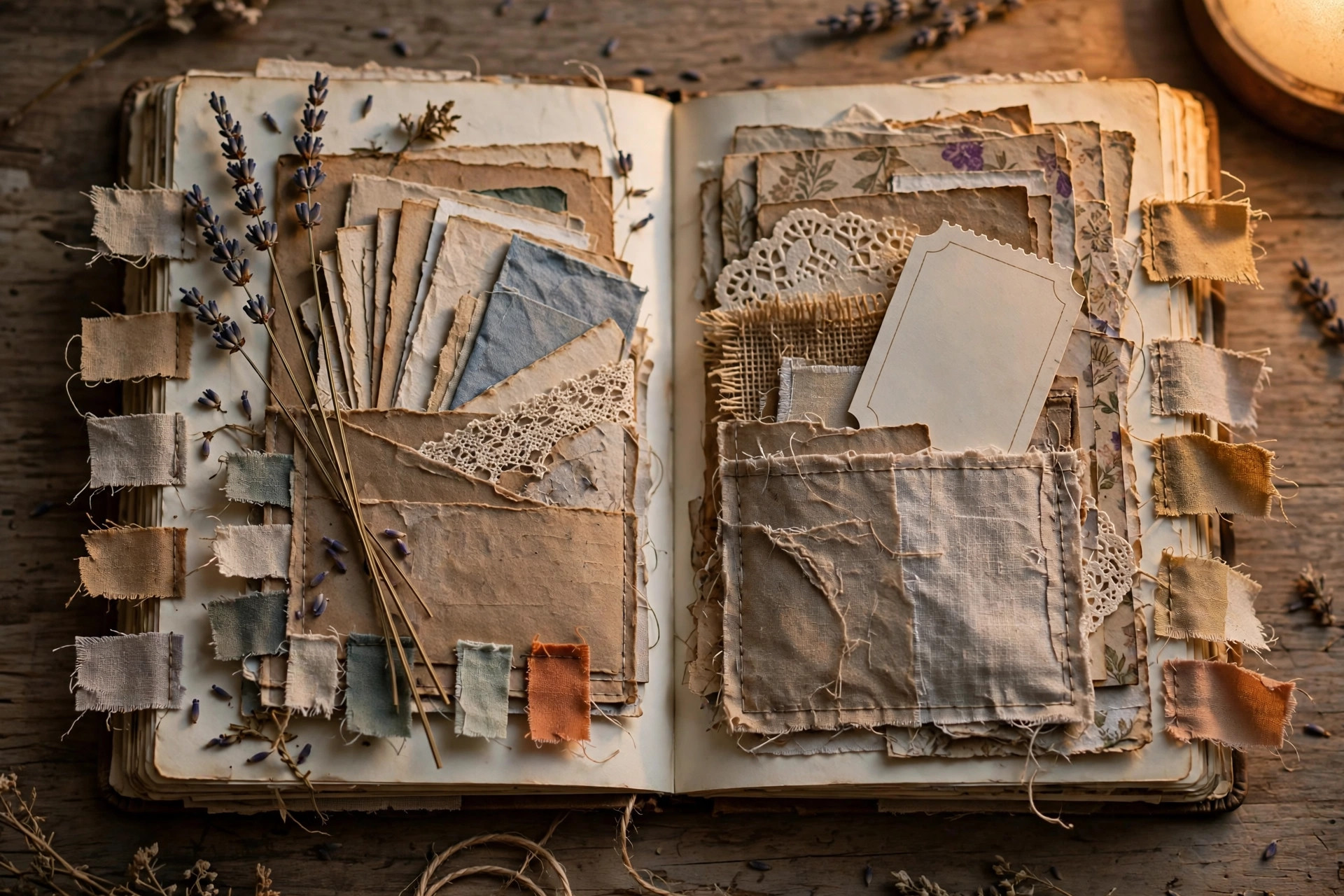
Here’s the important part: junk journaling only nourishes you if it stays pressure-free. The moment it becomes something you “should” do daily, it stops being self-care. So set the bar deliciously low. Ten minutes counts. One glued-down leaf counts. A page that’s mostly blank with a single ticket stub in the middle counts.
Many journalers pair their sessions with a small ritual: a cup of tea, a candle, a favourite playlist or twenty minutes of a comfort show in the background. The sensory layering — the smell of paper and glue, the crinkle of tissue, the warmth of lamplight — is a big part of why it calms a busy mind. It gently pulls you into the present moment, which is really all that mindfulness is.
That fits with the NHS’s five steps to mental wellbeing, which include learning new skills and paying attention to the present moment, as set out by NHS Talking Therapies. In our experience, a low-stakes creative habit is an easy way to practise both, without turning self-care into another chore.
If you ever feel stuck, return to the simplest possible act: stick one thing down and write one sentence about your day. That’s a complete journaling session. Over weeks and months, those single sentences become a mosaic of your life — imperfect, layered and completely yours. And do remember: if low mood or anxiety is affecting your daily life, creative hobbies are a lovely support but not a substitute for professional help — please do speak to your GP or a qualified counsellor.
So gather your scraps, clear a little corner of the table, and make something gloriously imperfect tonight. Your future self — flipping through a journal full of ticket stubs, autumn leaves and half-remembered Tuesdays — will be so glad you did.
Leave a Reply