Last updated: November 2026
Quick answer: A light therapy lamp is a bright lamp, rated around 10,000 lux, that people sit near in the morning while eating breakfast or reading. It brightens dark fall mornings as a routine, not as a medical treatment, and works best alongside daylight, consistent wake times, and dim evenings.
There is a particular kind of tiredness that arrives with fall. The alarm goes off and it is still dark outside. The house is cold, the sky is grey, and your body seems to be asking a very reasonable question: why are we getting up when the sun clearly has not? If that sounds familiar, you are not alone — and it is one of the reasons light therapy lamps have become such a beloved part of people’s autumn routines.
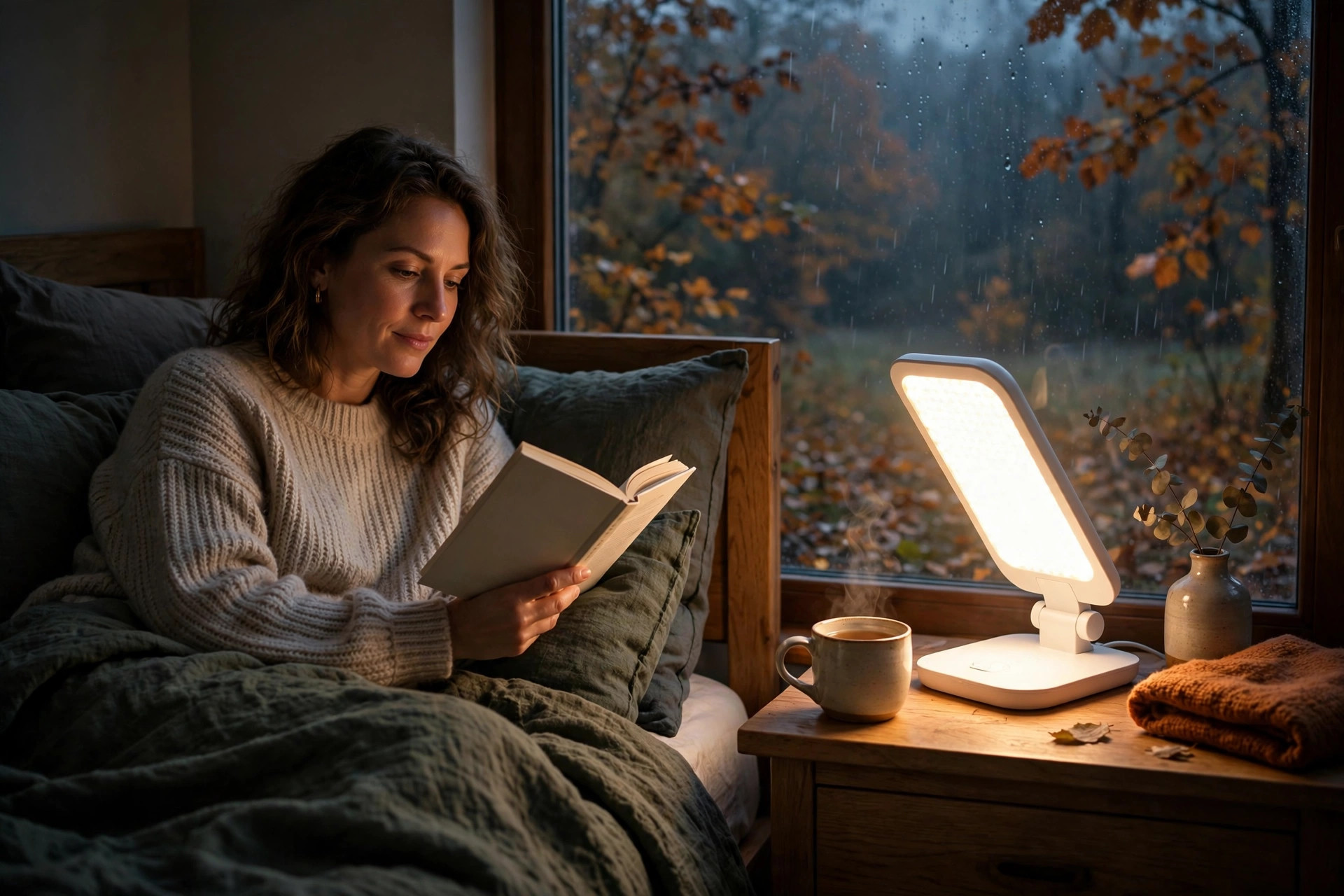
A light therapy lamp is simply a lamp designed to produce very bright light, much brighter than ordinary room lighting. People sit near one in the morning while they read, have breakfast, or get ready for the day. The idea is straightforward: when natural daylight is scarce, the lamp gives your mornings a dose of brightness that a regular bulb cannot match. It has become a staple of cozy-season self-care, right alongside candles, blankets, and slow weekend mornings.
General-information note: this article is about a popular lifestyle routine, not a medical treatment. A light therapy lamp is not a cure for anything, and it cannot diagnose or treat low mood, sleep problems, or seasonal difficulties on its own. If you are struggling with persistent low mood, trouble sleeping, or anything that is affecting your daily life, please talk to a doctor or a qualified health professional. Think of a lamp as one small, pleasant piece of a bigger morning routine — not a solution to a health problem.
With that said, let us look at what these lamps actually are, how people use them, how to choose one, and the other small things that can make dark fall mornings feel a little kinder.
What Is a Light Therapy Lamp, Actually?
A light therapy lamp is built to be far brighter than ordinary room lighting, most often around 10,000 lux. Panels, portable models, and dawn simulators all serve the same simple purpose: adding brightness to your morning routine while you do normal things.
At its core, a light therapy lamp is a lamp built to be exceptionally bright. Most models produce around 10,000 lux — a measure of light intensity — which is many times brighter than typical indoor lighting. To put that in perspective, a well-lit office might be around 500 lux, while a bright sunny day outdoors can exceed 50,000 lux. The lamp sits somewhere in between: far brighter than your ceiling light, but nowhere near actual sunlight.
| Light source | Typical brightness |
|---|---|
| Well-lit office | Around 500 lux |
| Light therapy lamp | Usually around 10,000 lux |
| Bright sunny day outdoors | Can exceed 50,000 lux |
Lamps come in several shapes. The most common is a flat panel, roughly the size of a small picture frame, that sits on a desk or table. There are also smaller, more portable models designed for travel, and dawn-simulator alarm clocks that gradually brighten your bedroom like a sunrise. Some newer models offer adjustable colour temperature, letting you shift between cooler and warmer light depending on your preference.
Most lamps filter out UV light, so you are not getting the sunburn-causing rays — but it is still worth checking the product specifications before you buy, and choosing a reputable brand. You do not necessarily need the fanciest option to enjoy a brighter morning routine.
It is worth repeating the key distinction: people use these lamps as part of a morning routine they enjoy. The lamp makes the kitchen brighter, the breakfast table cheerier, and the first hour of the day a little easier to face. That is the honest, realistic frame — a pleasant ritual, not a medical device in your home.
For wider context, the NHS describes light therapy as using a bright light, sometimes called a SAD lamp or light box, to simulate daylight in winter, and notes that it is not usually available on the NHS because there is not enough evidence to tell whether it is effective (NHS, Seasonal affective disorder). The NHS also advises speaking to a GP before trying light therapy, and if buying a lamp, choosing one that is 10,000 lux, UV-free, and carries a UKCA or CE mark (NHS, Seasonal affective disorder).
Why Do Dark Mornings Feel So Hard?
Morning light is one of the body’s main signals for feeling awake, so late sunrises delay that signal and leave grogginess lingering. Shorter days also shrink daylight exposure, which can make days feel compressed and energy feel lower than usual.
To understand why a bright lamp appeals in autumn, it helps to understand what dark mornings do to a routine. Humans are deeply responsive to light. Morning light is one of the main signals our bodies use to feel awake and alert; when the sun rises late, that signal arrives late too. The result is the familiar fall experience: grogginess that lingers, an afternoon slump that arrives early, and evenings where you feel ready for bed at eight o’clock.
Shorter days also shrink our routines. We stop taking evening walks because it is dark. We see less daylight overall because we are indoors during the few bright hours. The days can start to feel compressed — dark, work, dark — and that compression affects mood and energy for a lot of people, even those who generally feel fine.
None of this is a personal failing. Feeling sluggish on dark mornings is an extremely common, normal human response to less light. Recognising that can itself be a relief: you are not lazy, and your willpower is not broken. Your environment changed, and it makes sense to change your routine to match it. A light therapy lamp is one of several small environmental tweaks that can help the mornings feel more like mornings again.
And again, gently: if low mood or exhaustion goes beyond the usual autumn grogginess — if it is persistent, deepening, or interfering with your life — that is a sign to talk to a professional, not to buy a brighter bulb. A lamp can make a routine nicer; it cannot replace proper support.
How Do You Fit a Lamp Into Your Morning Routine?
Sit near the lamp for about twenty to thirty minutes in the morning, roughly an arm’s length away, while you eat, read, or get ready. Use it early and daily through the darker months, then switch it off by midday so evenings stay dim.
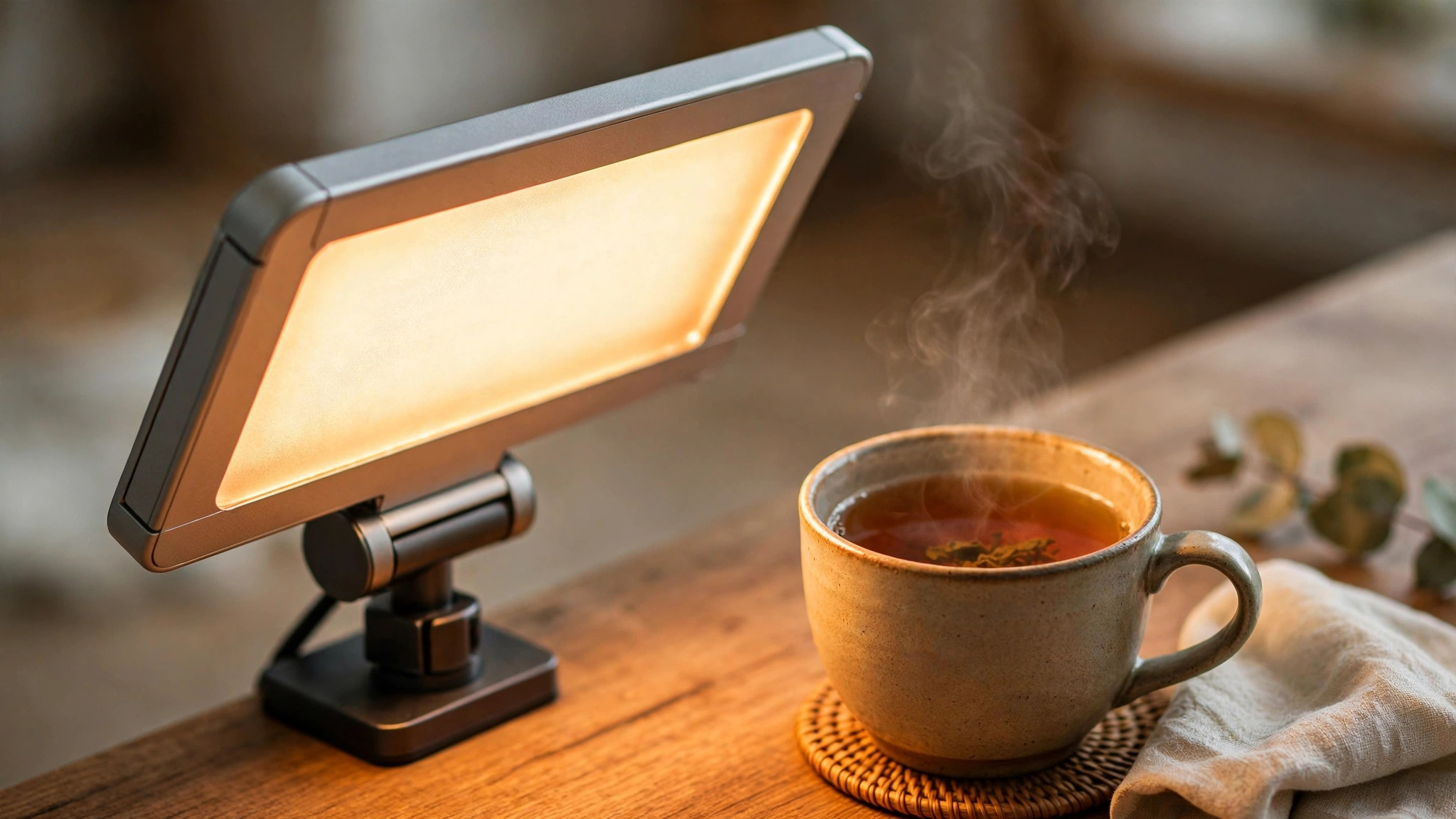
The most common way people use a light therapy lamp is beautifully simple: they sit near it for about twenty to thirty minutes in the morning while doing something they would be doing anyway. There is no special ritual required. Here is what a typical lamp morning looks like:
- Place the lamp nearby: set it on the breakfast table, your desk, or a side table, roughly an arm’s length away. You do not need to stare into it — just have it in your field of view while you go about your morning.
- Use it early: most people switch the lamp on within the first hour after waking, while they eat breakfast, read the news, answer emails, or get ready. Morning timing is the whole point.
- Keep doing your normal things: read, scroll, journal, eat toast, apply your skincare — the lamp simply brightens the scene. You glance toward it occasionally; that is enough.
- Make it consistent: people who enjoy their lamp tend to use it daily through the darker months, the same way they would make coffee every morning. Routine beats intensity.
- Turn it off by midday: bright light late in the evening can make it harder to wind down, so the lamp is a morning companion only. Evenings belong to dim, warm lighting.
That is genuinely all there is to it. There is no complicated protocol, no app to configure, no data to track. The lamp becomes part of the furniture of your morning — as ordinary and comforting as a favourite mug.
Some people pair their lamp time with other pleasant morning habits, and this is where it really shines as self-care. Twenty minutes with the lamp on, a warm drink in hand, and a few pages of a book or a slow journaling session can transform the first part of the day from something endured into something savoured. The lamp provides the brightness; the ritual provides the meaning.
How Do You Choose a Lamp That Suits You?
Check brightness at a realistic sitting distance, not just the headline lux figure, and confirm UV filtering and adjustable brightness. Choose a size that fits your space and a design you enjoy seeing daily, since calm, factual descriptions signal a trustworthy product.
Shopping for a light therapy lamp can feel overwhelming because the options range from very basic to surprisingly fancy. Here is how to think through the choice without overthinking it:
- Brightness: most lamps advertise around 10,000 lux at a certain distance — check what distance that figure refers to, since brightness drops off quickly as you move away. A lamp that is 10,000 lux at 15 centimetres but dim at arm’s length is less useful than one rated at a realistic sitting distance.
- Size and placement: think about where you will actually use it. A large panel suits a home office desk; a compact model fits a small breakfast table or travels well. Measure your space before you fall in love with a design online.
- UV filtering: look for a lamp that explicitly states it is UV-free or has a UV filter. This is standard on reputable models, but worth confirming.
- Adjustability: a tilting stand or adjustable brightness is genuinely useful — it lets you angle the light comfortably and tone it down if full brightness feels too much at first.
- Design: you will look at this object every morning for months, so choose one you do not mind seeing. Many newer models are designed to look like ordinary stylish lamps rather than medical equipment.
- Features over extras: focus on brightness, build quality, and design rather than extra features you may never use. Read reviews from people who have used the lamp for a full season, not just a week.
Avoid lamps that make extravagant health claims on their packaging. A trustworthy product describes itself as a bright light for your morning routine; a suspicious one promises to fix your mood, sleep, or life. Let the marketing be your filter — calm, factual descriptions are a good sign.
If you wear glasses or have sensitive eyes, start with the lamp a little further away or at a lower brightness setting and see how it feels. And if you have any eye condition, or you take medication that increases light sensitivity, check with your doctor or pharmacist before using a bright lamp regularly. It is a small step that keeps a pleasant routine safely pleasant.
How Can You Make Mornings Brighter Beyond the Lamp?
A lamp works best as one part of a brighter-morning toolkit. Get outside at midday, open curtains wide, keep a consistent wake time, move gently in the morning, and keep evenings dim so your daily light rhythm feels natural.
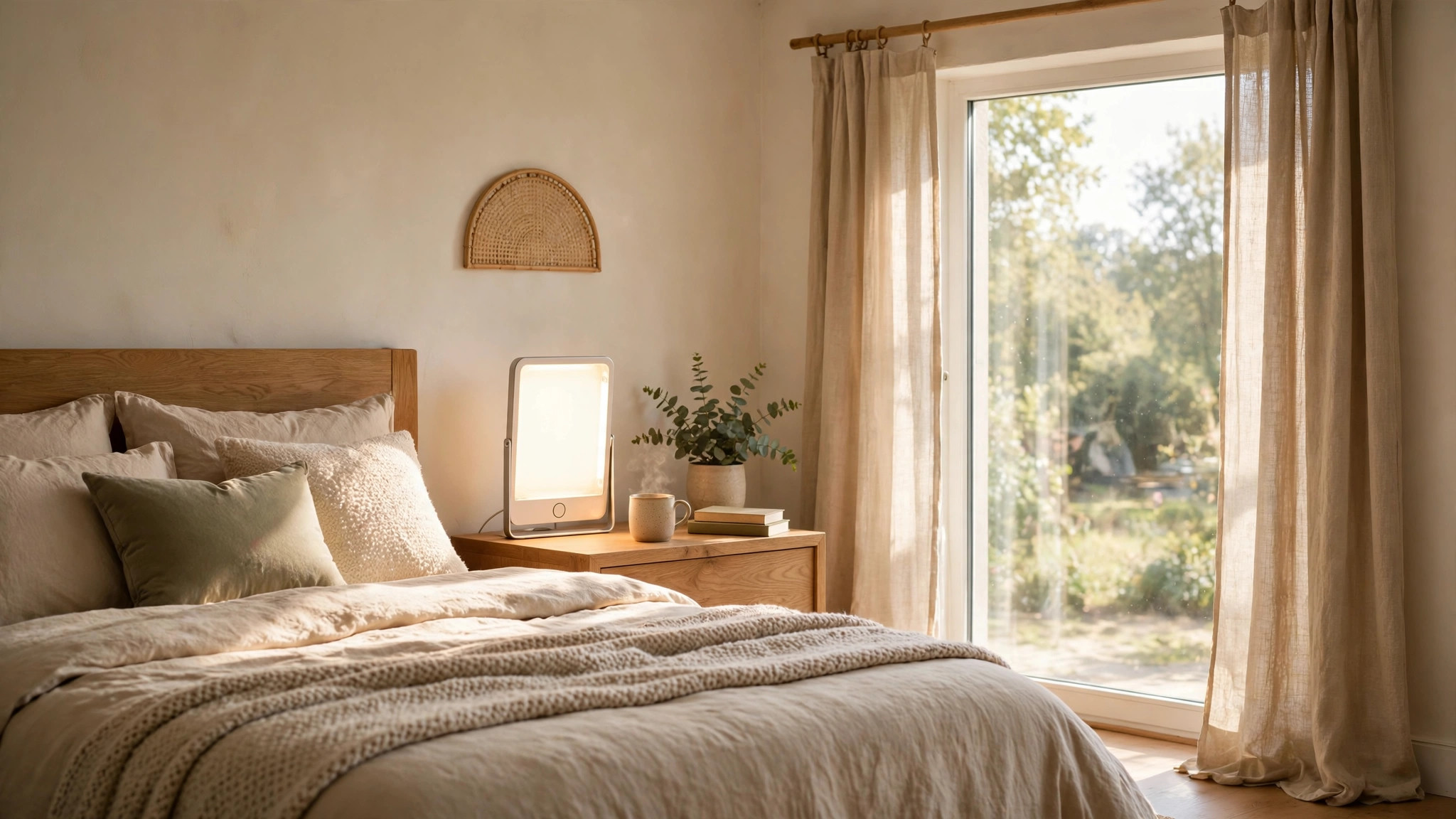
A lamp is one tool, but the kindest fall mornings are built from several small choices working together. Think of it as assembling a brighter-morning toolkit:
- Get outside when you can: even on cloudy days, outdoor light is far brighter than indoor light. A ten-minute walk at lunchtime does more for your daylight exposure than any lamp. If mornings are too dark, the middle of the day is your window — use it.
- Open the curtains wide: it sounds obvious, but many of us keep blinds half-closed out of habit. Let in every bit of available daylight, and sit near windows when you work if you can.
- Keep a consistent wake time: going to bed and getting up at roughly the same time each day helps your body settle into a rhythm, dark mornings included. Weekend lie-ins that shift your schedule by hours tend to make Monday harder.
- Move a little in the morning: gentle movement — stretching, a short walk, even tidying the kitchen — helps shake off grogginess. It does not need to be a workout; it needs to be movement.
- Warm up the evenings instead: since bright light belongs to mornings, make evenings deliberately cozy and dim: warm lamps, candles, screens off earlier. A clear contrast between bright days and dim evenings helps the whole rhythm feel natural.
None of these require a purchase, a subscription, or a personality transplant. They are small environmental nudges, and their power is in combination. The lamp brightens the kitchen; the walk brightens the middle of the day; the dim evening helps you actually feel sleepy at bedtime. Together, they rebuild the light rhythm that fall takes away.
Dark mornings are not a flaw in you — they are a feature of the season, and seasons are manageable. A lamp on the breakfast table, curtains thrown open, a walk at lunch: these are modest, doable things. And on the darkest mornings, when getting up still feels like a negotiation, be kind to yourself about it. The sun will be back. Until then, we make our own light.
Leave a Reply