
Last updated: October 2026
Quick answer: A morning light routine means greeting the day with bright, gradual light on purpose: open the curtains, switch on warm indoor lights, sit by a window, and step outside briefly. Bright mornings and dim evenings help your body settle into a gentler daily rhythm.
There is a particular kind of struggle that arrives with fall. The alarm rings while the sky is still dark, the bedroom is cold, and your body begs you to stay under the duvet for just ten more minutes. You are not lazy. You are not doing anything wrong. The light has changed, and mornings simply feel different now.
Our bodies are quietly tuned to daylight. When the sun rises later and sets earlier, that shift can leave us feeling groggy, slow, and a little flat in the mornings. A few small, gentle changes to your first hour of the day can make those dark fall mornings feel much kinder.
That is where a morning light routine comes in. It is not a complicated programme, and it does not require any special equipment or an expensive gadget. It is simply a way of greeting your day with light on purpose — soft, warm, gradual light that tells your body the day has begun. In this article, you will find a simple six-step routine designed for fall, which you can shape around your own life, whether you wake at five in the morning or roll out of bed at eight.
Why do fall mornings feel so much harder?
When days shorten, the gap between your body’s inner clock and the actual sunrise grows wider. Light is the strongest daytime signal your body uses, so a dark morning can leave you groggy, slow and a little flat until daylight finally arrives.
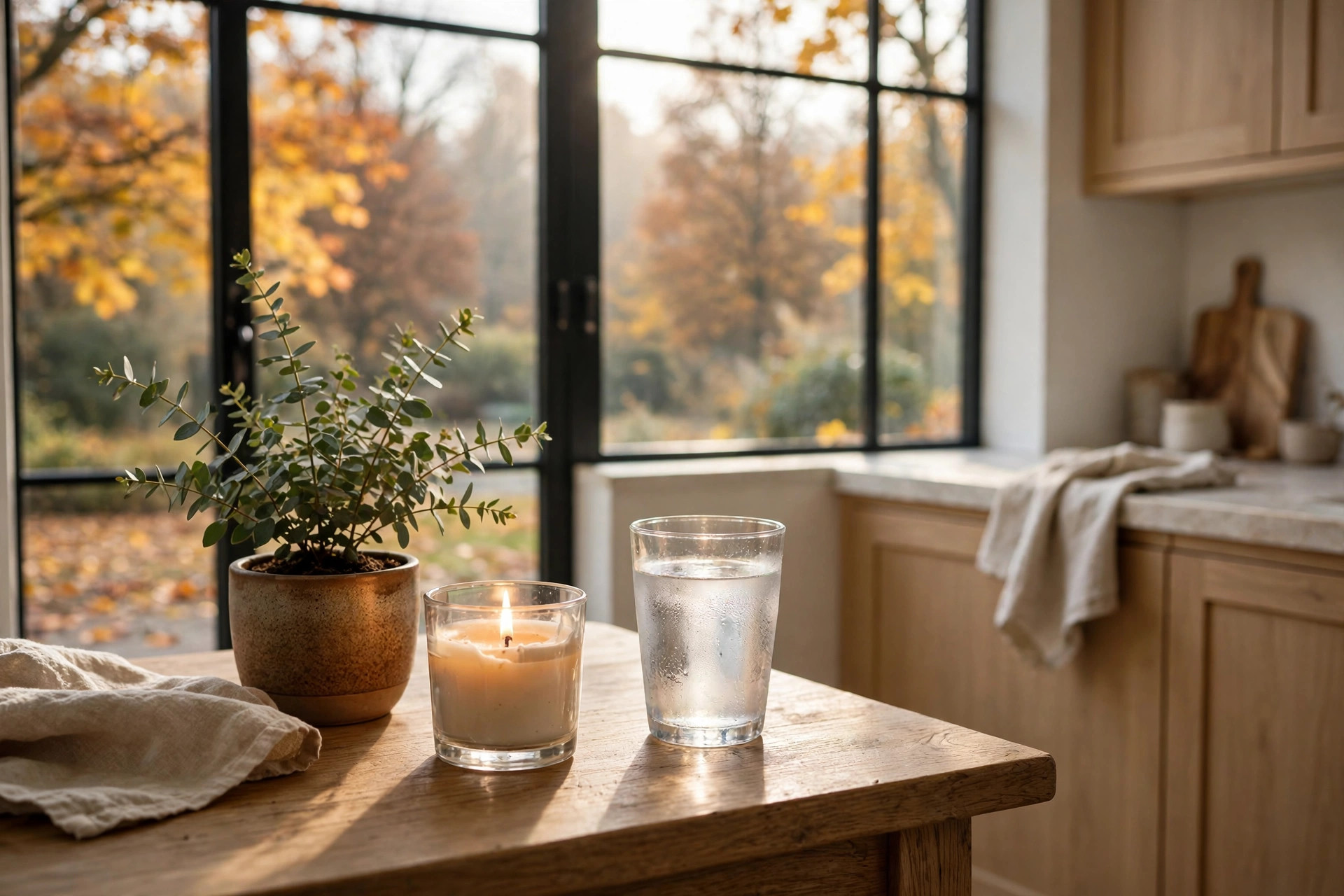
Before we get into the routine itself, it helps to understand why getting up in fall feels like such a battle. Your body still expects a full morning of light, but the sky stays dark long after you are supposed to be awake. In summer, that signal arrives naturally: the sun pours through the window, and you wake feeling ready. In fall and winter, that signal goes missing, so your body stays in its night-time mode a little longer.
This is not a personal failing. It is biology. Britannica describes circadian rhythms as roughly 24-hour cycles that help living things respond to light and darkness. While a morning light routine cannot change the sunrise, it can give your body a gentler, clearer signal that the day has started. Instead of jolting awake to a harsh alarm in pitch darkness, you ease into the morning with light that grows slowly, the way dawn used to do it.
A word of care here: if you find that low mood in the darker months feels heavy, persistent, or interferes with your daily life, that may be something more than ordinary seasonal sluggishness. It is always wise to speak to a doctor or mental health professional if you are struggling. A light routine is a comfort, not a treatment.
What are the six steps of a gentle morning light routine?
The routine below is built to be flexible: some steps take two minutes, others take ten. Do all six on a slow morning, or pick your favourite two or three when time is tight — the only rule is to be gentle with yourself.
Step 1: Let the light in, slowly
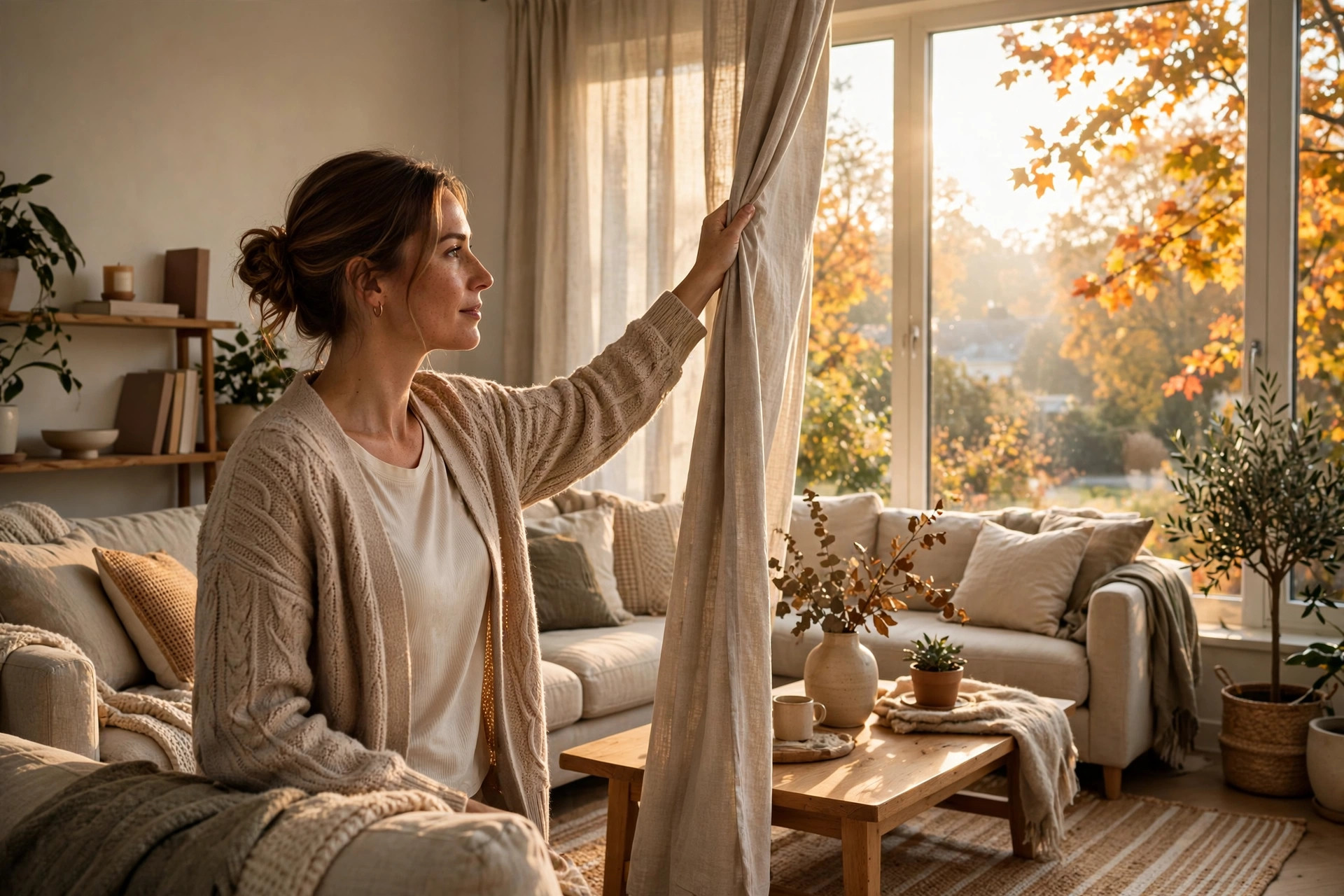
The moment you wake, open your curtains or blinds all the way — even if the sky outside is still grey. Natural daylight, even on an overcast fall morning, is far brighter than indoor lighting, and it is the most powerful signal you can give your body. If your bedroom faces away from the sunrise, open the curtains in the room where you spend your first minutes instead. If you can, leave the curtains open from the night before so the first daylight reaches you naturally as it arrives.
Step 2: Turn on warm, bright indoor lights
On the darkest mornings, natural light alone will not be enough. Switch on the main lights in the rooms you move through — the bedroom, the bathroom, the kitchen. Choose warm-white bulbs rather than cold, blue-toned ones for your bedroom and living spaces, because warm light feels cozy and welcoming first thing in the morning. Some people like a gradual wake-up light that brightens slowly over twenty minutes, mimicking a sunrise on the bedside table. It is a lovely addition if you have one, but it is entirely optional.
Step 3: Sit by the brightest window with your morning drink
Once you are up, give yourself five to ten minutes by the brightest window in your home with your coffee, tea, or water. You do not need to stare at the sun or sit in direct glare — just being near a window, with daylight falling on your face, is enough. This quiet window moment is the heart of the routine. Sip your drink slowly, look at the sky, watch the street wake up, or simply sit with your thoughts, phone away.
Step 4: Step outside, even briefly
If you can manage it, step outside for even five minutes. A short walk to the end of the street, a few minutes on the balcony or doorstep, or simply standing in the garden with your coat on — outdoor light is many times stronger than indoor light, even on a cloudy fall day. You do not need to make this a workout. A gentle stroll around the block, feeling the crisp air on your cheeks and watching the autumn leaves, is perfect.
Step 5: Keep your home bright through the morning
It is tempting to leave the house dim and cozy all day, but keeping your main living spaces well lit through the morning hours helps your body stay in daytime mode. Keep the curtains open, the lamps on where needed, and your workspace near a window if you work from home. Layer your lighting: overhead lights for brightness, a lamp or two for warmth, and maybe a candle for coziness.
Step 6: Ease into the evening the opposite way
A morning light routine works best when evenings tell the opposite story. As the day winds down, dim your lights, switch off the bright overheads, and let your home grow soft and dusky. Try to keep screens dim in the last hour before bed, or switch them off entirely. Light a candle, read a book, or simply sit in the soft lamplight. Your morning self will thank your evening self.
How do you adapt the routine to your real life?
No two mornings are alike, and the best routine is the one you will actually keep. Focus on the steps that fit your wake-up time, your household and your commute, and let consistency matter more than perfection.
| Your morning | Prioritise these steps |
|---|---|
| Leaving before dawn | Steps 1, 2 and 5 — brighten home first, catch outdoor light on the commute |
| Sharing a bedroom | A bedside sunrise-style lamp on your side, or start in the hall or bathroom |
| Parent or night-shift worker | Just two minutes of bright light and a glass of water by the window |
| Slow morning at home | All six steps, including the window sit and a short step outside |
If you leave the house before dawn, focus on steps one, two, and five — brighten your home as much as you can before you go, and catch the outdoor light on your commute by walking part of the way or sitting near a window on the bus or train. If you share a bedroom with a partner who wakes at a different time, a bedside sunrise-style lamp that brightens only on your side can be a considerate solution, or simply keep the hall or bathroom light on and move your first steps of the routine there.
For parents of early risers or night-shift workers, the routine shrinks beautifully. Even two minutes of bright light and a glass of water by the window is a signal worth sending. Consistency matters far more than perfection. A gentle routine done most days will always beat an ambitious one abandoned after a week.
What small extras make mornings cozier?
Once the light is in place, a few extra touches can turn your mornings from tolerable to genuinely lovely. Lay things out the night before, add one pleasant scent, and keep a short list of small things to look forward to.
- Keep a soft throw and slippers by the bed so getting up feels warm, not cold.
- Prepare your morning drink station the night before to remove one decision.
- Choose one pleasant scent for mornings — coffee, citrus, or a favourite candle.
- Write down three small things you are looking forward to each day.
- Play gentle music or open a window to hear the morning sounds.
Lay out a soft blanket or your favourite cardigan the night before, so your first moments out of bed feel warm rather than chilly. Scent can be a gentle wake-up companion too: a citrus or rosemary candle, a sprig of eucalyptus in the bathroom, or simply the smell of fresh coffee can make the morning feel like an occasion rather than an obligation.
When is light alone not enough?
A morning light routine is a lovely daily comfort, but it is not a cure for anything. If low energy comes with persistent sadness, loss of interest, or difficulty getting through the day, please reach out for real support — there is no shame in asking.
Be honest with yourself as the season deepens. If your low energy comes with persistent sadness, loss of interest in things you usually enjoy, changes in appetite or sleep, or difficulty getting through the day, please reach out to a doctor or mental health professional. Seasonal low mood that feels heavy deserves real support.
The NHS describes seasonal affective disorder as a type of depression linked to the seasons, often worse in winter, and notes that light therapy is sometimes used as part of its care. You might also consider talking to your doctor about whether a light therapy lamp could be suitable for you, especially if you live somewhere with very dark winters. These are brighter than normal lamps and are designed to be used for a set time each morning. Your doctor can advise whether one makes sense for your situation.
How can you start softer tomorrow?
Fall mornings will always be a little darker, a little colder and a little harder to face than summer ones. But you do not have to meet that darkness with nothing — one small step tomorrow is enough.
A warm lamp, an open curtain, five quiet minutes by the window with a hot drink — these are small things, and small things are exactly what self-care is made of. Start tomorrow with just one step. Open the curtains. Let the grey morning light in. Sit with it for a moment before the day begins. You might be surprised how much kinder the morning feels when you greet it with light.
Leave a Reply