Last updated: October 2026
Quick answer: Neo Deco borrows 1920s Art Deco glamour — chrome, brass, bold geometry and jewel tones — and uses it as accents in modern rooms. One mirror, one bar cart or one sculptural light can carry the whole reference.
Glamour is back — but not as we knew it. The 2026 revival of Art Deco, nicknamed Neo Deco, takes the bold geometry, rich materials and unapologetic shine of the 1920s and gives it a modern, liveable edge. More of us are reaching for interiors with drama, polish and a little bit of sparkle.
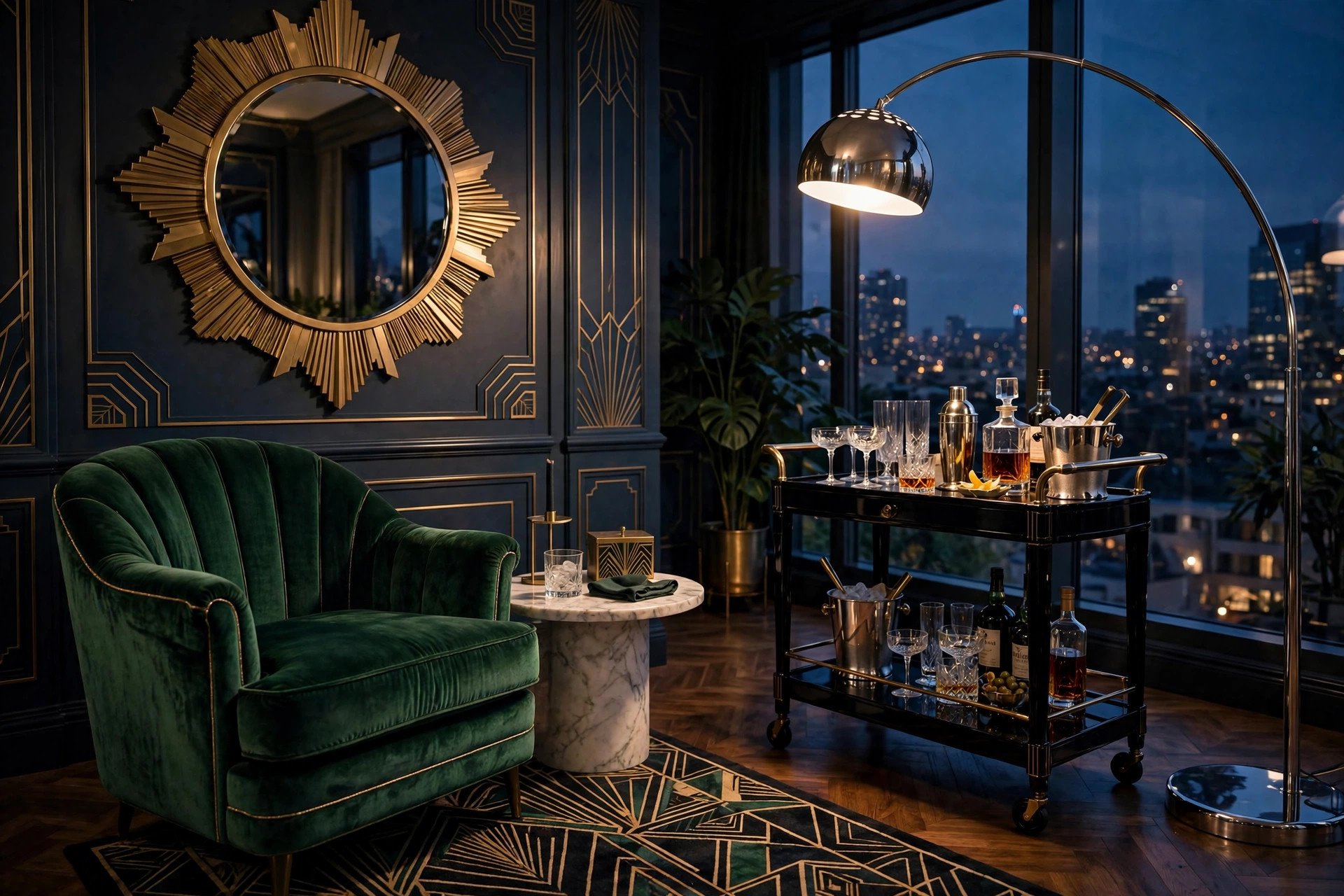
Neo Deco is not about recreating a period film set. It is about borrowing Deco’s greatest hits — chrome and brass, sunburst mirrors, geometric pattern, lacquered surfaces, jewel-toned velvet — and using them as accents in contemporary rooms. A single chrome lamp or brass mirror can give a plain modern space instant character, which is why this trend suits real homes and real budgets so well.
The look works because it balances shine with restraint. Deco was always about precision: clean lines, symmetrical arrangements, materials chosen for their lustre. That discipline keeps the glamour feeling chic rather than gaudy, even in small doses. This guide shows you how to layer in Neo Deco accents room by room, from a ten-minute mirror swap to a full bar-cart moment.
What Makes It Neo Deco, Not Just Deco?
Original Deco was formal, matchy and full-commitment; Neo Deco keeps the geometry, shine and jewel tones but mixes freely, welcomes modern colours, and works happily as a single accent in any room.
Original Art Deco, born in 1920s Paris, was the style of ocean liners and skyscrapers: symmetrical, streamlined, luxurious. It loved exotic materials, bold geometry — chevrons, sunbursts, stepped profiles — and a palette of black, gold, ivory and jewel tones. The Victoria & Albert Museum notes that one of the most pivotal moments for Art Deco was the Exposition Internationale des Arts Décoratifs et Industriels Modernes held in Paris in 1925, and its collections record that the style takes its name from that 1925 exhibition (V&A Explore the Collections).
Neo Deco keeps all of that visual language but applies it with a lighter, more eclectic hand suited to how we live now. The differences matter:
| Original Deco | Neo Deco | |
|---|---|---|
| Approach | Formal and matchy | Mixes freely — a Deco mirror above a mid-century sideboard |
| Commitment | Full commitment required | Happy as an accent: one bar cart, one mirror, one light fitting |
| Palette | Strictly black and gold | Classics plus emerald, blush and terracotta |
Chrome is the metal that marks the revival most clearly. Brass and gold never really left, but polished chrome — with its cool, mirror-like reflectivity — feels fresh again after years of brushed and matte finishes. It bounces light around a room, which makes it genuinely useful in darker autumn months, and it pairs beautifully with both warm brass (mixed metals are very Neo Deco) and with black lacquer for that classic Deco contrast.
Geometry is the other signature. Look for the Deco motifs: fan and sunburst shapes, chevron and zigzag patterns, stepped silhouettes like miniature skyscrapers, and arched forms. These appear in mirrors, screens, textiles, tiles and lighting. You do not need many — a single geometric mirror or a pair of chevron cushions can establish the reference, and everything else simply needs not to contradict it.
How Do You Style the Bar Cart Moment?
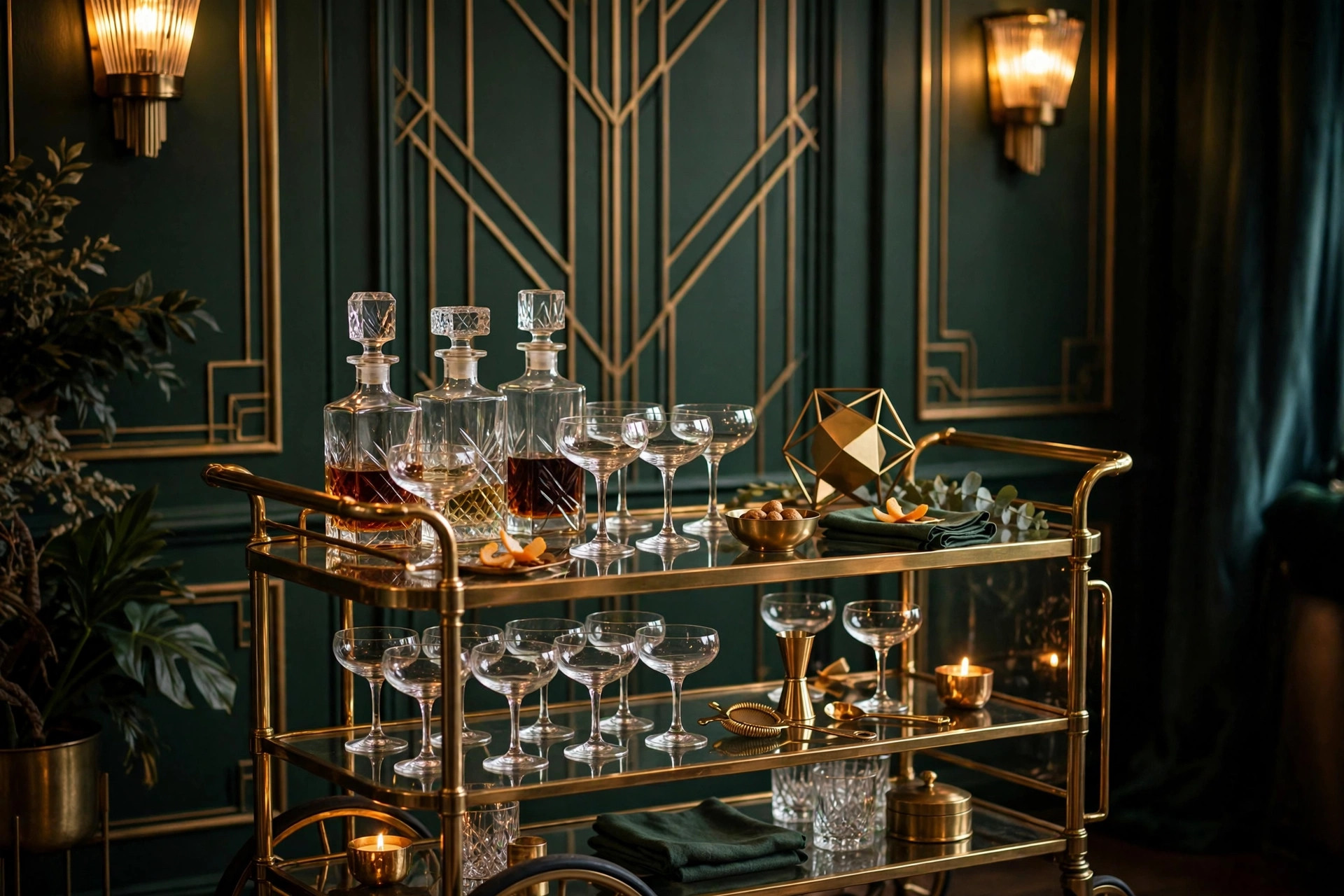
Style a brass or chrome bar cart as a serving station or display shelf: a tight palette, items in odd numbers, varied heights and empty space on each shelf. Place it near seating, where light catches the glass and metal.
No piece says Neo Deco quite like the bar cart. A bar cart is part furniture, part theatre: a brass or chrome frame with glass shelves, styled with beautiful glassware, a small sculpture or a stack of hosting books. It turns an empty corner into a destination and gives a room instant grown-up glamour.
You do not need to be a drinks enthusiast to own one. Style yours as a coffee cart, a tea station, or simply a beautiful display shelf — the form does the work either way. Hunt vintage first: brass bar carts from the mid-century turn up regularly in charity shops, flea markets and online marketplaces at a fraction of new prices, often with a patina that new pieces cannot fake. Check that the wheels turn and the glass is intact; surface tarnish on brass usually polishes up beautifully.
Styling a bar cart is an art of curation, not accumulation:
- Choose a tight palette: glassware, one or two larger pieces, a small plant or a single stem in a bud vase, a stack of two or three beautiful books.
- Group items in odd numbers and vary the heights.
- Leave empty space on each shelf; a crowded bar cart reads as clutter, while a curated one reads as luxury.
- Add a small tray on the top shelf to corral smaller items and add another layer of polish.
Placement matters as much as styling. Bar carts love corners near seating — beside a sofa, at the end of a dining room, in a hallway nook. They need good light to make the glass and metal sing, so position yours where lamplight or daylight will catch it. And keep it functional: stock it with what you actually serve and enjoy, rather than what looks impressive. Authenticity is the difference between a prop and a piece you love.
How Do Mirrors and Metals Brighten a Room?
Use a sunburst or arched brass mirror as the hero piece, then repeat reflective surfaces — a chrome tray, brass candlesticks, a mirrored side table — to multiply lamplight as autumn days shorten.
If the bar cart is Neo Deco’s showpiece, mirrors are its workhorse. A round brass mirror with a sunburst frame is the single most transformative Deco accent you can buy — it adds light, geometry and glamour in one move. Hang one above a mantel, a console table or a bed, and watch the room lift. Arched mirrors are equally on-trend, echoing Deco’s love of the stepped arch, and they soften the hard geometry of modern rooms.
Beyond mirrors, think about where reflective surfaces can multiply light as autumn days shorten. A chrome tray on a coffee table, brass candlesticks, a mirrored side table, polished chrome lamp bases — each one catches lamplight and throws it back into the room. This is not just decorative; in a north-facing room, a few well-placed reflective pieces can genuinely make the space feel brighter in the evening.
Mixing metals is encouraged, but with discipline. Chrome and brass together are very Neo Deco — the cool shine against the warm glow is part of the look’s tension and richness. Keep to two metals per room and repeat each at least twice so the combination looks intentional rather than accidental. Black metal or black lacquer can join as a third element, grounding the shine the way a dark frame grounds a bright picture.
Maintenance keeps the glamour alive: chrome shows fingerprints, so keep a microfibre cloth handy and give high-touch pieces a weekly wipe. Brass can be left to develop a natural patina or polished to a shine — either is fine, but be consistent within a room. Lacquered surfaces scratch, so use coasters and felt pads. These are small habits, but polished metal that is actually polished is what separates the look from its cheaper imitations.
How Do Pattern, Colour and Textiles Work in Neo Deco?
Use one strong geometric pattern per room, anchor it in black, ivory and gold or a jewel tone, and let velvet carry the textile story. In the bedroom, symmetry and sheen — matching tables and lamps — create hotel-like polish.
Neo Deco pattern is bold but orderly — chevrons, fans, scallops, geometric borders — and it works best in measured doses. A pair of chevron cushions on a velvet sofa, a geometric rug under a coffee table, or fan-patterned wallpaper inside an alcove all deliver the reference without overwhelming. Because the patterns are so graphic, one strong pattern per room is usually enough; let the metals and the geometry of your furniture carry the rest.
The classic Deco palette — black, ivory, gold — remains unbeatable for drama. A black lacquered side table, ivory walls, brass accents: it is a combination that has looked expensive for a hundred years. But Neo Deco also embraces jewel tones: emerald green velvet, sapphire blue, deep ruby and even blush pink all sit beautifully with chrome and brass. Velvet is the textile of choice — its pile catches light like the metals do — in cushions, upholstery or even a single dramatic armchair.
In the bedroom, Deco glamour translates to symmetry and sheen. Matching bedside tables, matching lamps with chrome or brass bases, a geometric cushion arrangement and perhaps a sunburst mirror above the bed create a hotel-like polish. High-sheen bedding — sateen or silk-look fabrics in ivory or a jewel tone — completes the effect. It is a look that makes ordinary weeknights feel a little bit special.
Do not forget the power of a lacquered finish. A single piece — a side table, a tray, a picture frame — in high-gloss black or deep green adds the Deco depth that matte modern furniture often lacks. If buying new is not in the budget, high-gloss spray paint can transform a charity-shop frame or small table in an afternoon. The key is preparation: sand, prime and apply thin coats for that glass-smooth finish.
How Do Small Bathrooms Get Big Deco Energy?
Bathrooms are small, so bold choices feel contained rather than overwhelming. Focus on three swaps — the mirror, the lighting shade and the textiles — plus gleaming chrome and one mixed-metal accent.
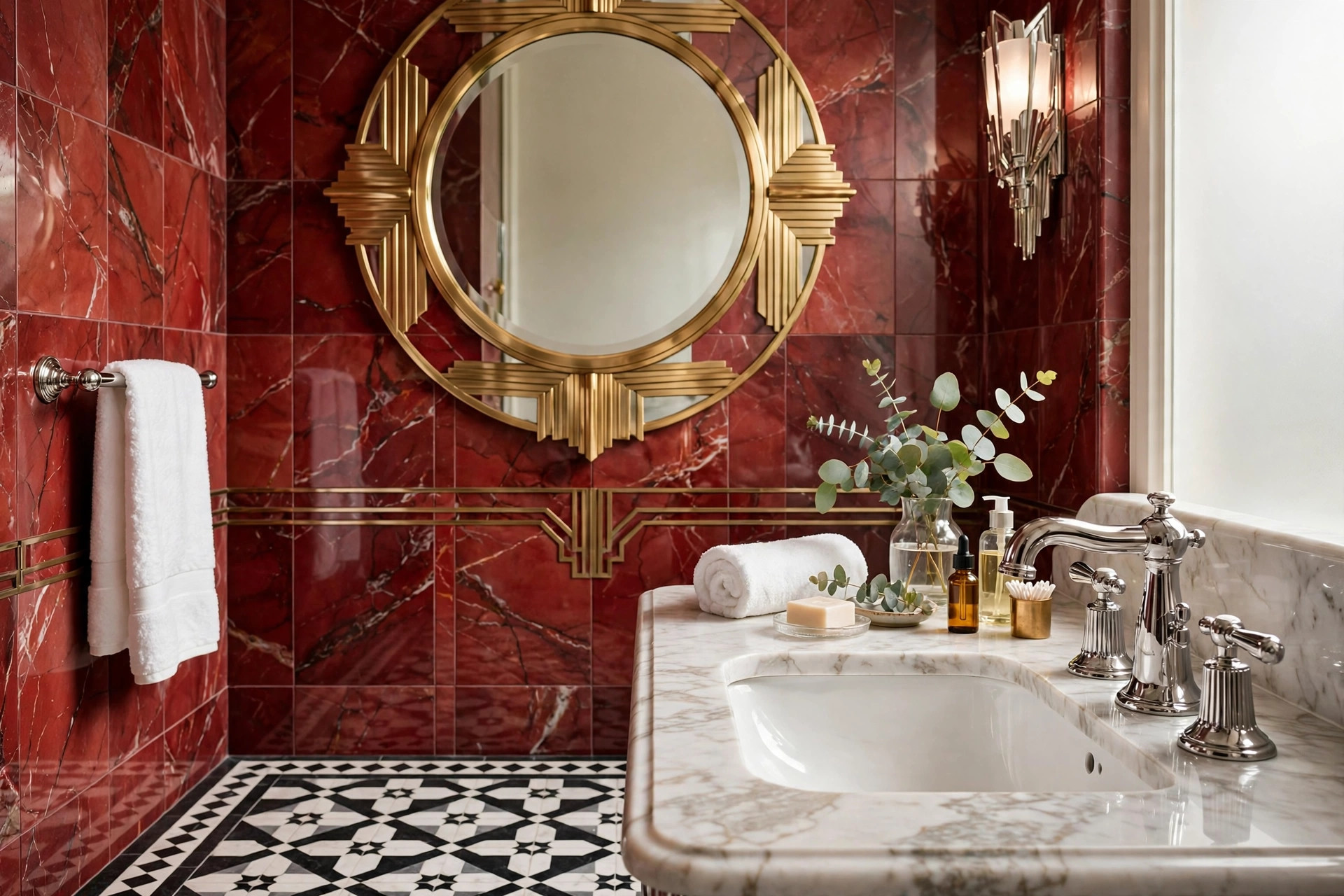
The bathroom is secretly one of the best rooms for Neo Deco. Bathrooms are small, so bold choices feel contained rather than overwhelming — the perfect place for drama. Red or pink marble-effect tiles, even on a single wall or just in the shower enclosure, deliver instant 1920s hotel glamour.
Chrome is the bathroom’s natural metal, and Deco lets you celebrate it. Polished chrome taps, a chrome-framed round mirror, chrome towel rails — keep them gleaming and they become jewellery for the room. Pair with a brass accent or two (a soap dispenser, a small tray) for that mixed-metal richness, and add black geometric floor tiles or a black-and-white border tile for the classic Deco floor.
Lighting makes or breaks a Deco bathroom. Fluted or globe wall lights in chrome or brass either side of the mirror give flattering, even light and strong period character. If rewiring is not an option, even swapping a shade or adding a pair of battery-operated picture lights can shift the mood. A small stool or lidded basket in a luxe material keeps the practicalities elegant.
On a tight budget, focus on three swaps: the mirror, the lighting shade and the textiles. A round brass mirror, a more glamorous light shade and fresh towels in ivory or a jewel tone can take a plain bathroom most of the way there. Decant toiletries into matching dispensers — visual clutter is the enemy of glamour — and add one green plant for life. Small room, big Deco energy, minimal spend.
Why Is Lighting the Jewel in the Crown?
Deco lighting is sculptural: globe pendants, geometric chandeliers, chrome arc lamps and fluted wall lights. Hang dining pendants about 75 centimetres above the table, use warm white bulbs, and add dimmers so metals glow rather than glare.
Deco lighting is sculptural, and it is worth investing here because lights are used every single day through autumn and winter. Look for the signatures: globe pendants in opal glass with brass fittings, geometric chandeliers with stepped or fan profiles, chrome arc floor lamps that curve dramatically over seating, and wall lights with fluted or frosted glass shades. Each one is both a light source and a piece of art.
Scale and placement follow Deco’s love of symmetry. A pair of matching table lamps on either side of a sofa or bed, a central pendant hung lower than you think (dining pendants should sit about 75 centimetres above the table), a floor lamp anchoring a reading corner. Dimmer switches are transformative — Deco glamour is evening glamour, and being able to lower the lights lets chrome and brass glow rather than glare.
Bulb choice matters enormously with metallic finishes. Warm white bulbs (2700K) make brass glow golden and keep chrome from looking cold or clinical. Avoid cool daylight bulbs anywhere near your Deco pieces — they flatten the warmth that makes the metals luxurious. And consider the shades: frosted or opal glass diffuses light softly, while clear glass or exposed bulbs suit only the most modern Neo Deco schemes.
If new lighting is beyond the budget, work with what you have. A chrome or brass spray transformation can update tired lamp bases; new shades in fluted glass-look or simple drum shapes modernise old fittings instantly. Even repositioning an existing floor lamp so its light catches a mirror or metallic tray can create a Deco moment from nothing. Light is the cheapest luxury there is — aim it well.
The Final Word
Neo Deco is ultimately about confidence: the confidence to choose shine over safety, geometry over vagueness, a little drama over total restraint. Start with one mirror or one bar cart, style it with care, and let the glamour spread at your own pace.
Your home already has the bones — Deco just adds the jewellery.
Leave a Reply