Last updated: October 2026
Quick answer: A no-phone walk means leaving your phone at home and walking for twenty to thirty minutes with no music, podcasts, photos or step counting. It costs nothing, fits any schedule, and gives your mind a rare stretch of uninterrupted quiet.
Think about your last walk. Did you really see where you were going, or did you spend most of it glancing at your phone — checking messages, scrolling through feeds, listening to a podcast at double speed while your eyes stayed on the pavement? If that sounds familiar, you are in good company. Most of us have forgotten how to take a walk without a screen.
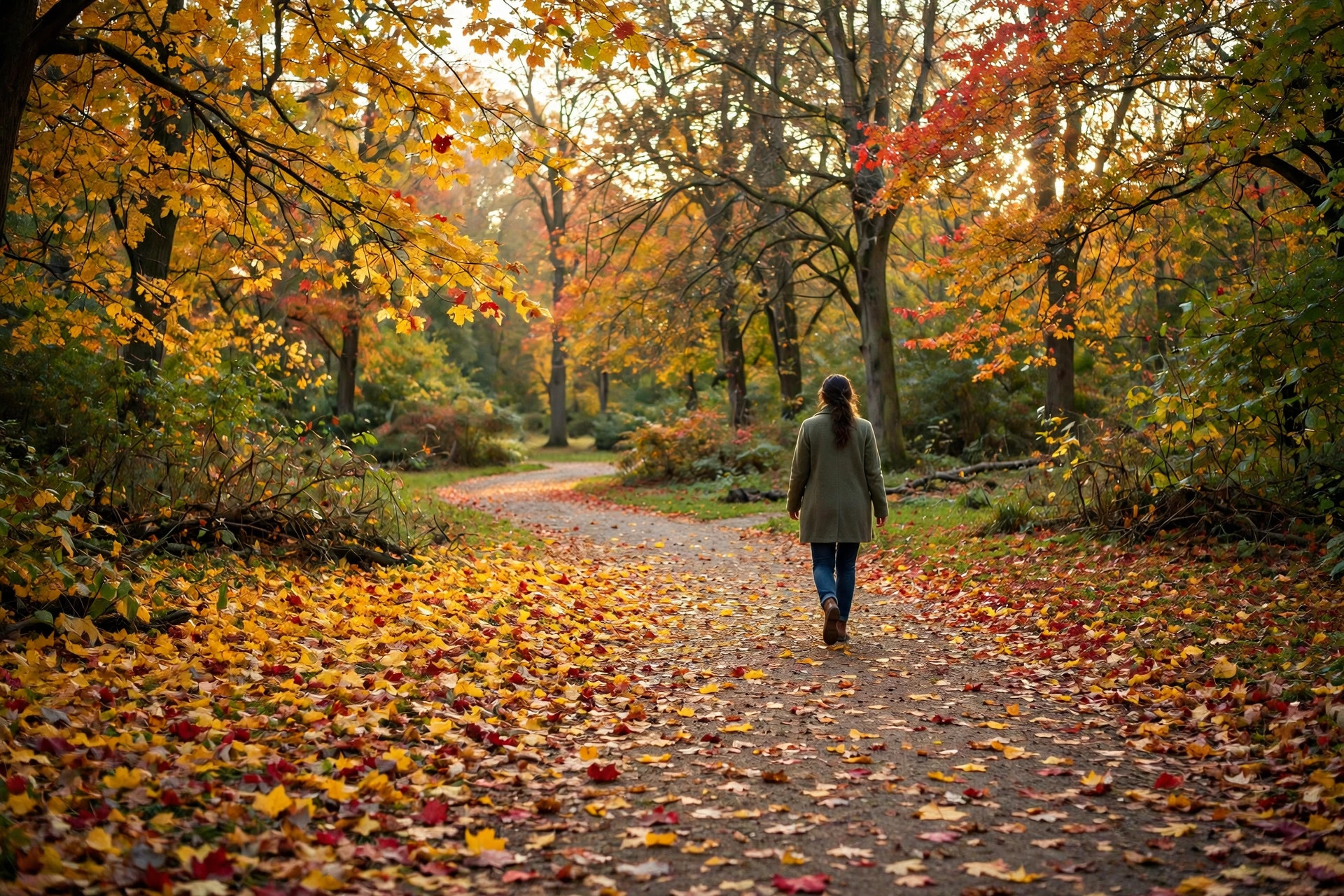
Here is a small experiment worth trying this fall: leave your phone at home and go for a walk. Just a walk. No music, no podcasts, no step counter, no photos. At first it might feel strange, even a little uncomfortable — that phantom urge to check something will appear more than once. But give it ten minutes, and something lovely happens. The world comes back into focus.
Fall is the perfect season for this experiment. The air is crisp, the leaves are turning, and every street and park looks a little bit magical. In this article, you will find five reasons to try this simplest of self-care upgrades, plus practical tips for making your first screen-free stroll a success.
Why does your mind finally get a break?
Phones keep our minds in a state of low-level alertness all day, with every notification a tiny interruption. Remove the possibility of interruption on a walk, and your mind can settle into a slower, calmer rhythm where thoughts untangle themselves.
Our phones keep our minds in a state of low-level alertness all day. Every notification is a tiny interruption; every scroll is a stream of other people’s lives, news, and demands competing for our attention. Even when we are not actively using our phones, their presence keeps part of our brain on standby, waiting for the next buzz.
A no-phone walk removes that background hum completely. Without the possibility of interruption, your mind can settle into a slower, calmer rhythm. Thoughts that have been circling for days often untangle themselves on a quiet walk. Worries shrink a little. Ideas surface. It is not magic — it is simply what happens when you give your brain some uninterrupted space.
You do not need to aim for any particular mental state. You do not need to meditate or think positive thoughts. Just walk, look around, and let your mind wander wherever it wants to go. That freedom is the whole point.
How do you actually see fall happening?
Fall is the most beautiful season to pay attention to, and the easiest to miss with your eyes on a screen. Without a phone, your senses wake up — the crunch of leaves, the cool air, the smell of rain — and walking becomes a full experience again.

When your eyes are on a screen, you walk straight past the maple tree that turned overnight, the spider web beaded with dew, the smell of woodsmoke drifting from someone’s chimney. These small wonders are happening all around you, every single day of the season.
Without a phone, your senses wake up. You notice the particular crunch of leaves under your boots. You feel the cool air on your face and the weak sun on your back. You smell rain coming before it arrives. Walking becomes a full experience instead of just a way to get from one place to another while looking at a screen.
Many people find that after a few no-phone walks, they start noticing things on their regular days too — a habit of attention that carries over. The world gets a little more vivid, even when the phone is back in the pocket.
How does it break the scrolling habit gently?
A no-phone walk is one of the gentlest ways to push back against phone overuse. You are not deleting apps or fighting willpower all day — you are simply choosing one small window of twenty or thirty minutes where the phone does not exist.
If you have ever told yourself you spend too much time on your phone, a no-phone walk is one of the gentlest ways to push back. You are not deleting apps, setting screen-time locks, or fighting with willpower all day. You are simply choosing one small window — twenty or thirty minutes — where the phone does not exist.
That first walk will show you how strong the pull is. You will reach for your pocket. You will feel a flicker of anxiety about what you might be missing. And then, gradually, the urge will fade, replaced by something calmer. Each walk makes the next one easier, and the confidence builds: if you can do thirty minutes, you can do an hour. If you can do a walk, you can do a phone-free dinner.
Think of it as training, not punishment. You are teaching yourself that you are fine without the phone — that nothing terrible happens, that the world keeps turning, and that you might even enjoy the quiet.
How does walking become yours again?
Somewhere along the way, walking turned into content — photographed, tracked and shared. A no-phone walk gives the walk back to you: no podcast in your ears, no camera, no number to chase, just the walk itself.
Somewhere along the way, walking turned into content. We photograph our walks, track our walks, share our walks, and listen to other people’s thoughts while we walk. The walk itself became the background to everything else. A no-phone walk gives the walk back to you.
Without a podcast in your ears, you hear your own thoughts for the first time in a while. Without a camera, you look at things just to look at them, not to capture them. Without a fitness tracker, you walk at whatever pace feels good instead of chasing a number. The walk becomes an experience rather than a performance.
This is especially precious in fall, when the season itself invites slowness. There is no need to rush through the prettiest weeks of the year. Let the walk be the whole point.
Why does it cost nothing and fit any schedule?
Self-care advice often comes with a price tag, but a no-phone walk costs absolutely nothing. You need shoes, a coat, and a door — and a fifteen-minute loop around the block counts just as much as a longer stroll.
Self-care advice often comes with a price tag: the class, the product, the retreat. A no-phone walk costs absolutely nothing. You need shoes, a coat, and a door. That is the entire equipment list. Walking itself is also one of the simplest ways to stay active — the NHS describes walking as an easy, accessible form of exercise that can fit into everyday routines.
It also fits into almost any schedule. A fifteen-minute loop around the block at lunch counts. A ten-minute wander after dinner counts. You do not need a park, a trail, or a scenic route — an ordinary neighbourhood street in October is full of things worth noticing. The barrier to starting is so low that there is really no excuse not to try it today.
How do you take your first no-phone walk?
Starting is simple, but a little preparation makes the first walk much more pleasant. Leave the phone at home, pick a route you enjoy, dress for the weather, give it at least twenty minutes, and let your attention wander.
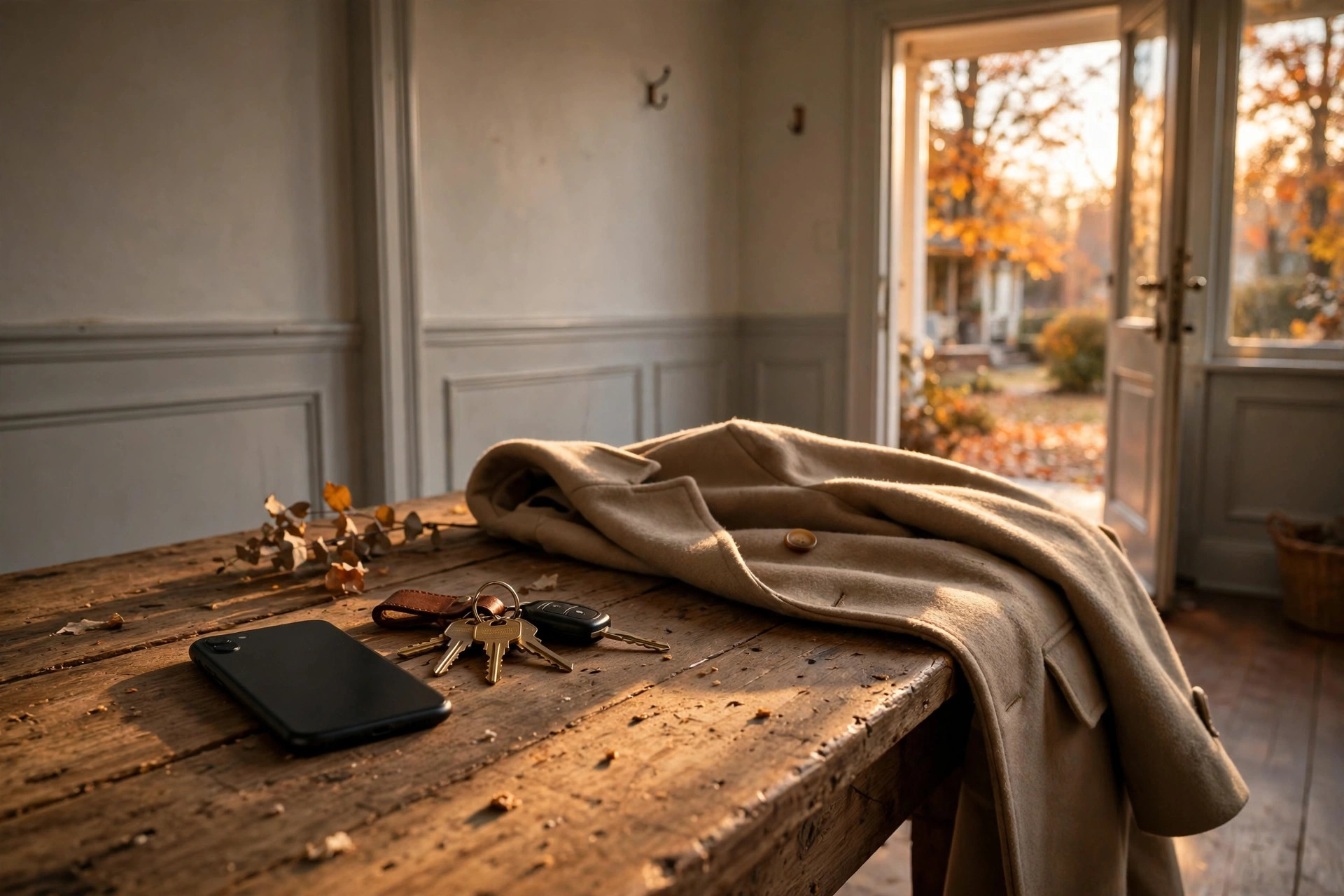
- Leave the phone at home — really. Putting the phone on silent in your pocket does not count. Leave it at home, on the hallway table, screen down. Tell someone where you are going if that makes you feel safer, and take a house key. That is all you need.
- Choose a route you enjoy. For your first no-phone walk, pick a route you already like — somewhere with trees, a park, a pretty street, or a waterside path. Familiar ground means you will not worry about navigation, and you can give your full attention to the season instead of the map.
- Dress for the weather. Fall weather changes fast. Layer up, wear comfortable shoes with decent grip for slippery leaves, and bring a light rain jacket if the sky looks uncertain. Being cold or wet will cut your walk short; being warm and dry lets you wander as long as you like.
- Give it at least twenty minutes. The first ten minutes are the hardest — that is when the phantom phone-checking urge is strongest. Around the fifteen-minute mark, most people find the urge fades and the walk starts to feel genuinely pleasant. Twenty to thirty minutes is the sweet spot for a first attempt.
- Let your attention wander. You do not need a technique. Look at the trees. Listen to the birds and the traffic and the wind. Feel the air. If your mind drifts to worries or to-do lists, that is fine — notice it, and then notice something in front of you: a colour, a sound, a smell.
What should you know about safety?
Leaving your phone behind is liberating, but be sensible about it. Stick to daylight hours, familiar areas and paths other people use — and if you walk somewhere remote or after dark, keeping your phone with you is the wiser choice.
Leaving your phone behind is liberating, but be sensible about it. Stick to routes and times of day where you feel safe — daylight hours, familiar areas, paths other people use. If you are walking somewhere remote or after dark, keeping your phone with you (switched off or on silent in a zipped pocket) is the wiser choice. Self-care should never come at the cost of your safety.
If a health condition means you need your phone nearby for emergencies, keep it with you but out of reach — powered off in a bag, for example. You can still enjoy most of the calm of a screen-free walk while staying safe. As the days shorten, daylight itself becomes part of the picture: the NHS notes that reduced daylight in winter is linked to seasonal low mood, which is one more reason a daylight walk can feel so welcome in fall.
What do you do with the urge to check?
It will happen, probably several times on your first walk: a sudden urge to check your phone, a worry that you are missing something urgent, a boredom that feels unbearable for about ninety seconds. This is completely normal — it is your brain protesting a broken habit.
When the urge comes, try this: pause, take three slow breaths, and name five things you can see right now. A red leaf. A grey cloud. A dog. A bicycle. A chimney. By the time you finish, the urge will usually have passed. Each time you ride one out, the next one is weaker.
- Expect the urge — it is normal, not a sign of failure.
- Pause and breathe slowly when it hits.
- Name five things you can see, hear, or smell around you.
- Remind yourself: nothing urgent has ever happened in twenty minutes.
- Notice how good it feels afterwards — that feeling is the reward.
What is the simplest upgrade you will try this fall?
You do not need a new routine, a new product, or a new app to take better care of yourself this fall. You need to leave one thing behind — and get back calmer thoughts, sharper senses, and twenty quiet minutes entirely your own.
The no-phone walk is the rare self-care practice that asks less of you, not more — less noise, less input, less doing — and gives back more: calmer thoughts, sharper senses, and twenty quiet minutes that are entirely your own. So the next time the afternoon light turns golden and the leaves are glowing, put the phone on the hallway table, pull on your coat, and step outside. Fall is waiting. Go and actually see it.
Leave a Reply