Last updated: October 2026
Quick answer: Upcycling turns clothes you no longer wear into fresh autumn pieces through sorting, simple repairs, no-sew tweaks, refashioning and dyeing. Start with a wardrobe audit, pick one easy project, and build a small fall capsule from what you already own.
There is a quiet revolution happening in our wardrobes. More of us look at the back of the wardrobe — the jeans that no longer fit quite right, the jumper with the moth hole, the shirt we have not worn in years — and see potential instead of clutter. Upcycling, the art of transforming existing clothes into something new and wearable, is one of fall’s most satisfying trends.
The appeal is threefold, and it is hard to argue with any of it. Upcycling saves serious money at a time when everything costs more. It keeps textiles out of landfill — a genuinely meaningful environmental win. And it gives you pieces nobody else owns, cut and customised exactly to your taste. A refashioned jacket carries a story no high-street purchase can match.
Best of all, you do not need to be an expert seamstress. Many of the most effective upcycles need no sewing at all, and the ones that do can be learned in an evening. This guide takes you from wardrobe audit to finished pieces, with ideas ranked from five-minute no-sew wins to weekend projects worth savouring — all chosen with autumn layering in mind.
How Do You Start With a Wardrobe Audit?
Pull out everything unworn for a year and sort it into four piles: wear, repair, refashion and finished. Judge each piece by its fabric, buttons and usable cloth, not its current shape, and wash everything before you cut or sew.
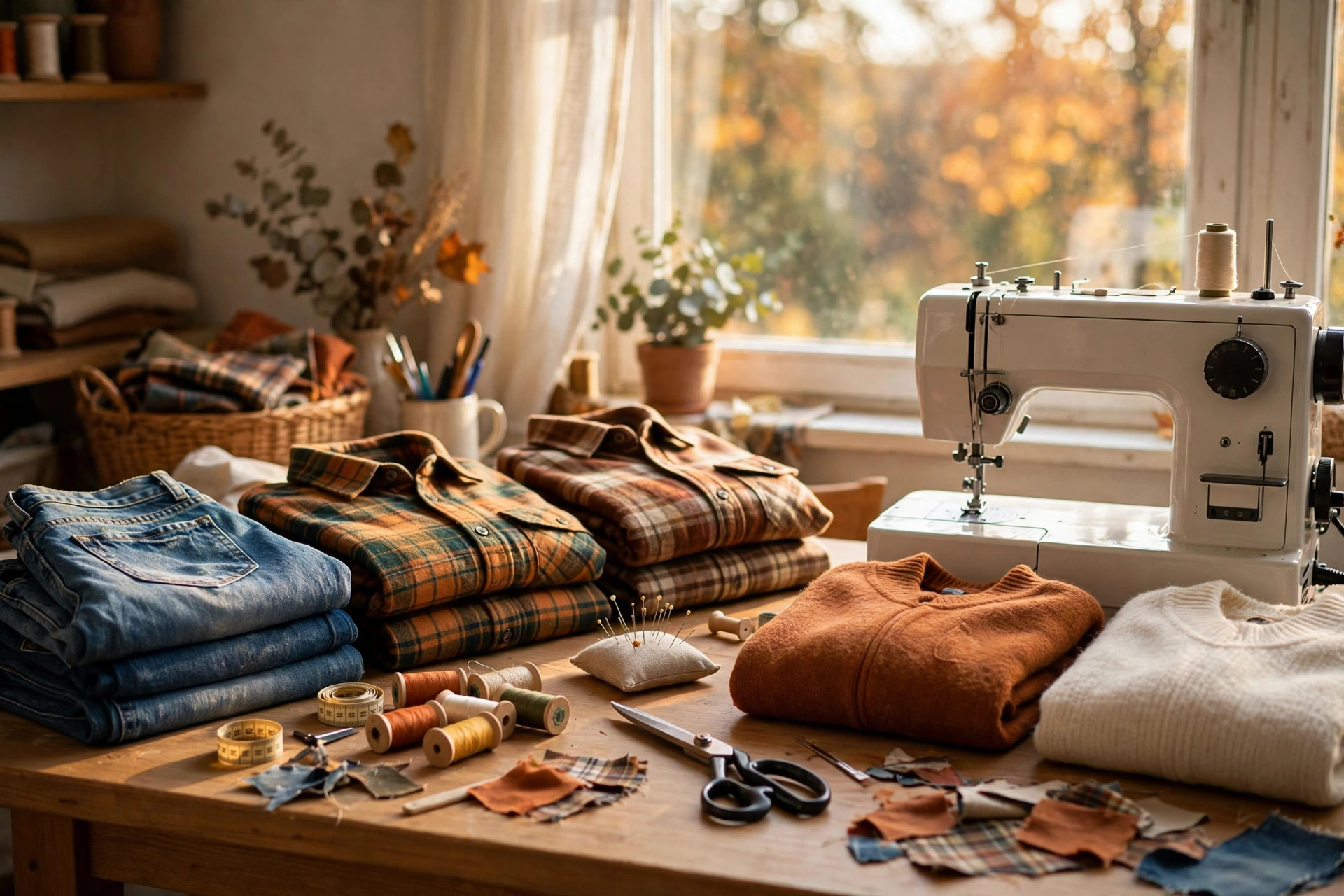
Every great upcycling project starts not with scissors but with sorting. Pull out everything you have not worn in the past year and divide it into four piles:
| Pile | What goes in it |
|---|---|
| Love and wear | Pieces that fit, flatter and get worn regularly |
| Needs a small repair | Good garments with a hole, loose button or fallen hem |
| Could be refashioned | Pieces with good fabric but a wrong shape, size or colour |
| Genuinely finished | Stained, threadbare or misshapen beyond rescue as clothing |
Be honest but also be imaginative — the “could be refashioned” pile is where the magic lives. As you sort, look at each piece with a maker’s eye rather than a wearer’s eye. That means looking past the current shape to the raw material: the quality of the fabric, the amount of usable cloth, the buttons, the lining. A shapeless dress in beautiful wool becomes a skirt and a scarf. Oversized men’s shirts — from partners, fathers, charity shops — are upcycling gold: masses of good cotton in classic patterns, perfect for autumn overshirts and shackets.
Check the fabric content before you plan anything, because it dictates what is possible. Natural fibres — cotton, wool, linen, denim — are the easiest to work with: they press well, sew neatly and age gracefully. Synthetics can be trickier to sew but are fine for no-sew projects. Hold fabric up to the light to check for thin spots, and give everything a wash first; you want to work with clean cloth, and washing also reveals any shrinkage before you cut.
The “genuinely finished” pile still has value. Worn-out cotton becomes cleaning rags and then compost; wool scraps become stuffing for draught excluders or pet beds; denim too far gone for wearing makes sturdy tote bags, storage baskets or patch material. Almost nothing needs to go in the bin. Keep a scrap bag as you work — those offcuts become tomorrow’s patches, pockets and trims.
The scale of the problem is real: the US Environmental Protection Agency (EPA) estimated that 17 million tons of textiles were generated in 2018, with only 14.7% recycled — which is exactly why keeping a garment in use matters.
How Can You Refresh Clothes Without Sewing?
You can refresh a garment in minutes with styling alone: tuck, roll, belt, layer or crop it. Scissors, iron-on hemming tape and fabric glue handle the rest, turning too-long tops, oversized shirts and tired knits into wearable autumn layers.
No sewing machine? No problem. Some of the most effective upcycles need nothing more than scissors, and a few need no tools at all. Start with the simplest:
- Restyle it: rolling sleeves to the elbow and doing a neat front tuck can make a tired shirt look intentional and current.
- Crop it: a too-long T-shirt becomes a cropped autumn layer in one straight cut — cut longer than you think, since you can always take more off.
- Fray it: cut denim jeans into cropped straight-legs and pull a few threads for a natural fray.
- Bag it: turn an oversized T-shirt into a tote bag with two cuts and a knot.
- Layer it: that too-short dress becomes a tunic over jeans; the thin summer top becomes a base layer under a cardigan.
Belt it, brooch it, layer it. A wide belt over an oversized shirt or dress creates a waist and a silhouette where none existed. A vintage brooch (charity shops are full of them) pinned at the collar or waist transforms a plain knit. Autumn, the season of layers, is the most forgiving season for creative styling.
Fabric glue and iron-on tape open up a world of no-sew hemming and repairs. Iron-on hemming tape shortens trousers and skirts in minutes and survives washing. Fabric glue reattaches loose trims and appliqués. And for knitwear, a simple needle and thread can close small holes invisibly from the inside — if you can sew a button, you can darn a hole, and there are excellent five-minute video tutorials for both.
Which Repairs Are Worth Learning?
Visible mending turns flaws into design details: darn moth holes with contrasting thread or patch jeans with sashiko-style stitching. Three basic stitches, plus button, hem and waist fixes, rescue most garments in under half an hour.
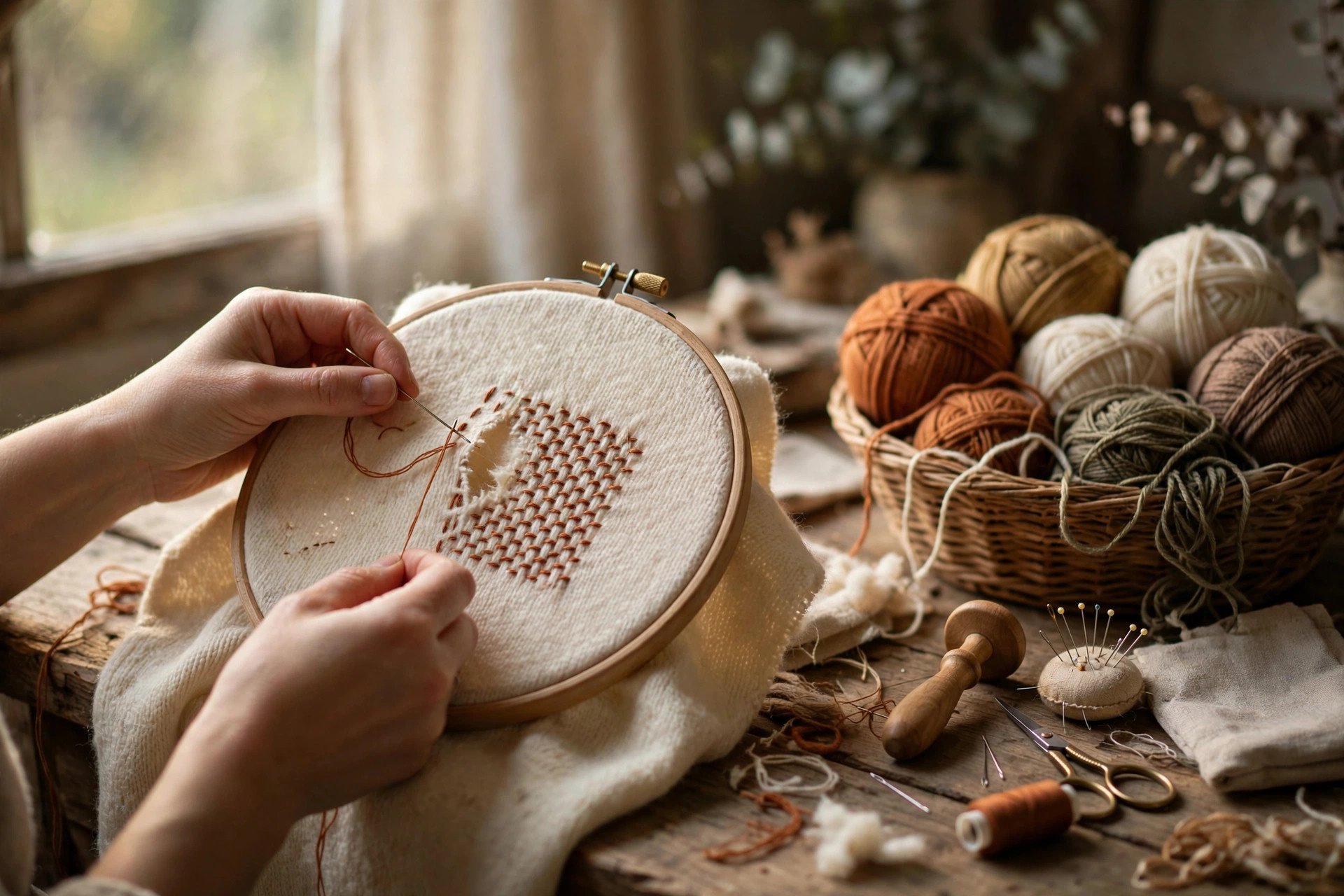
Before refashioning anything, consider whether a repair would bring it back — and consider making the repair beautiful. Visible mending, the Japanese-inspired practice of repairing with contrasting thread and decorative stitches, turns flaws into features. A moth hole darned with rust-coloured wool on a cream jumper, a torn knee patched with sashiko-style stitching on jeans: these are not compromises, they are design details people pay extra for in shops.
The basic stitches are genuinely easy. Running stitch, backstitch and blanket stitch cover most repairs, and each takes about ten minutes to learn. A darning mushroom or even a jam jar lid gives you a firm surface for darning knits. Start with something low-stakes — an old pair of socks, a tea towel — and you will have the skills for real garments within an evening. In our experience, mending is slow, tactile work that feels like the opposite of doom-scrolling.
Beyond stitching, learn three machine-free repairs that extend garment life enormously:
- Replacing buttons: keep a tin of spare buttons from worn-out clothes — they are free and always match the era of your wardrobe.
- Fixing hems: use iron-on tape or a simple slip stitch.
- Taking in a waist: two discreet darts or a bit of elastic makes charity-shop trousers fit like tailored ones.
For knitwear specifically, a fabric shaver or even a disposable razor removes pilling and can make a five-year-old jumper look nearly new in minutes. Deodorant marks often lift with a paste of bicarbonate of soda and water; grease spots respond to washing-up liquid worked in before washing. Maintenance is the unglamorous half of upcycling, but a wardrobe that is cleaned, depilled and repaired is a wardrobe you actually wear.
What Are the Best Refashioning Projects for Autumn?
Autumn layering makes refashioning easy: an oversized shirt becomes an overshirt, jeans become tapered or cuffed staples, and a dated maxi becomes a skirt. Denim forgives beginners, so start there if you are new to sewing.
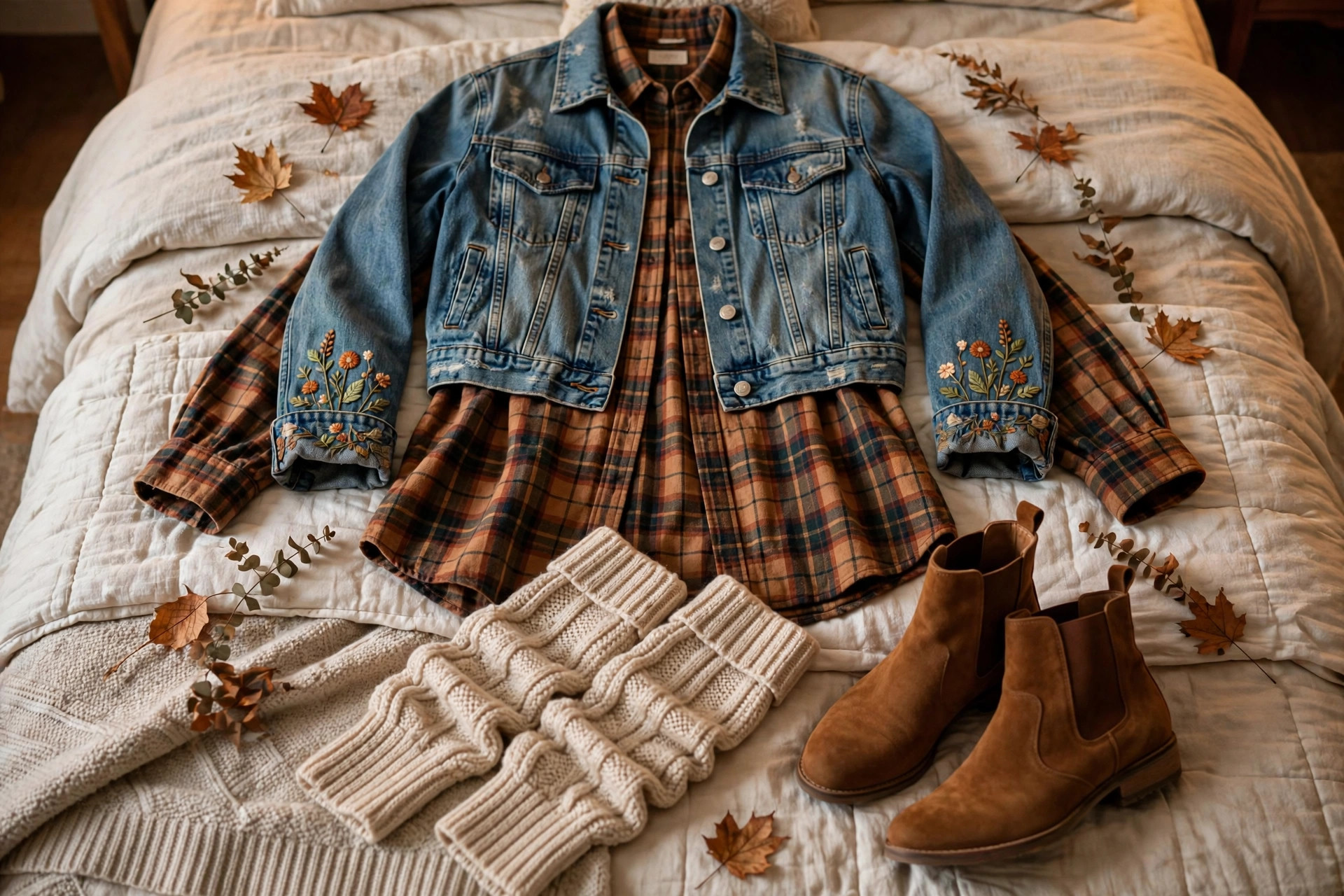
Now the exciting part: turning one thing into another. Autumn’s layered dressing makes it the ideal season for refashions, because almost everything becomes a layer. An oversized flannel shirt becomes a shacket-style overshirt: remove nothing, just wear it open over a thermal top with the sleeves rolled, or take in the sides slightly for a neater fit. Add new buttons from your button tin for a custom touch.
Jeans are refashioning gold. Wide-leg cast-offs can be tapered with a simple inside-leg seam; too-short jeans become perfect ankle-grazers with a deep turned-up cuff; worn knees become deliberate distressing or patches. A denim jacket customised with embroidered cuffs, swapped buttons or a blanket-stitch hem becomes a one-of-a-kind autumn staple. Denim’s tight weave forgives beginner sewing, which is why it is the ideal learning fabric.
Dresses offer dramatic transformations. A maxi dress with a dated print becomes a midi skirt (cut, hem, add elastic at the waist) plus a headscarf or bag from the leftover fabric. A too-tight dress becomes a skirt by removing the bodice. Two coordinating garments can be combined — the sleeves of one becoming the yoke of another. And long skirts, which cycle in and out of fashion, can be shortened, or have their waistbands replaced for a better fit.
Crochet and knitting add a handmade layer that screams autumn. Crochet cuffs on jacket sleeves, a crocheted collar on a plain sweatshirt, knitted leg warmers from unravelled old jumpers (yes, you can unravel knitwear and reuse the yarn — wool unravels beautifully). Granny-square patches on elbows, a crocheted yoke added to a plain dress: these details take a basic refashion from clever to covetable. Even simple finger-crocheted chains can become drawstrings, belts and bag handles.
How Do Dyeing, Printing and Surface Transformations Work?
When shape is fine but colour is not, dyeing gives the fastest total transformation. Tie-dye and shibori hide stains with pattern, fabric paints add motifs, and small embroidered details personalise a plain garment completely.
Sometimes a garment’s problem is not its shape but its colour. Dyeing is the fastest total transformation in upcycling: a faded black dress becomes rich espresso, a stained white shirt becomes warm terracotta, a boring beige jumper becomes deep forest green — all autumn-perfect shades. Machine dyes are widely available and straightforward; choose fibre-reactive dyes for cotton and all-purpose dyes for blends, and always dye in the washing machine’s hottest safe setting for even colour.
Before you dye, embrace the stains. Tie-dye and shibori techniques — twisting, folding and binding fabric before dyeing — create patterns that hide a multitude of sins and look thoroughly modern in autumn tones. An ice-dye in rust, ochre and brown over a stained tablecloth-weight cotton produces something genuinely beautiful. Even simple dip-dyeing — a white shirt’s hem dipped in tea or dye for an ombré effect — refreshes a garment in minutes. The Victoria and Albert Museum describes shibori as binding tiny sections of cloth with thread before dyeing, so colour does not penetrate the protected areas — the same principle behind those crisp resist patterns.
Printing adds pattern where none existed. Fabric paints and simple stamps (a cut potato, a carved eraser, a lace doily as a stencil) let you add motifs to plain garments. Stencil a geometric border on a plain tote, stamp stars on a denim jacket, or use bleach pens to draw on dark denim for a high-contrast effect. These techniques are forgiving for beginners because handmade imperfection reads as artistic intention.
Embroidery is the slowest transformation but often the most loved. A sprig of flowers on a collar, a bee on a cuff, your initial on a pocket — small embroidered details personalise a garment completely. Start with simple backstitch outlines and French knot centres; even a single motif transforms a plain sweatshirt. There is a reason embroidered vintage sells for multiples of plain: the hand of the maker is visible, and in an age of mass production, that visibility is luxury.
How Do You Build a Fall Capsule From What You Own?
A working fall capsule needs roughly three bottoms, five layering tops, three mid-layers, two coats and shoes you actually wear. Keep colours coordinated, fill gaps second-hand first, and do a fifteen-minute weekly check to keep it working.
With your repairs and refashions done, the final step is curation: assembling a working autumn wardrobe from what you already own plus your new creations. Lay everything out and look for the formula of a fall capsule:
- Three bottoms: jeans, trousers, a skirt
- Five tops that layer: tees, thermals and thin knits
- Three warm mid-layers: cardigans, overshirts, a blazer
- Two coats: one everyday, one smarter
- Shoes and boots you actually wear
Most wardrobes already contain this; it is just buried under the unworn. Colour-coherence is what makes a capsule feel intentional. Autumn’s palette — rust, ochre, cream, denim blue, forest green, brown, black — is forgiving, and most upcycled pieces will naturally fall into it if you dye and choose accordingly. When everything roughly coordinates, getting dressed takes minutes and every combination works. Photograph your favourite outfits as you discover them; a phone album of proven combinations is the antidote to morning indecision.
Fill genuine gaps second-hand before buying new. Need a camel coat to complete the capsule? Charity shops, vintage stores and resale apps are full of them in autumn, often in better fabrics than new equivalents. When you do buy new, buy the boring essentials that upcycling cannot easily provide — good thermal base layers, quality tights — and let your refashioned pieces be the stars.
Finally, maintain the system. A fifteen-minute weekly wardrobe check — rehang, spot-treat stains, note what needs mending — keeps the capsule working all season. Keep your mending kit accessible rather than buried: a small basket with needles, thread, buttons and iron-on tape by your wardrobe turns repairs from chores into five-minute habits. The most sustainable garment is the one you actually wear, and a curated, repaired, refashioned wardrobe is one you will reach for every chilly morning.
Upcycling is not really about clothes — it is about seeing possibility where others see waste, and about wearing your creativity quite literally on your sleeve. Start this weekend with one drawer, one pile, one pair of scissors. By the time the leaves turn, you will have a fall wardrobe that is more personal, more sustainable and more you than anything you could have bought.
Leave a Reply