Last updated: October 2026
Quick answer: A vinyl listening corner needs a quiet corner, a level surface for your turntable, speakers at ear height angled toward your chair, and warm low lighting. Add vertical record storage within reach, and you have a small sanctuary for listening to whole albums properly.
Something lovely is happening in homes everywhere: the record player is back. A generation raised on streaming is rediscovering the particular pleasure of choosing a record, lowering a needle and listening to a whole album, side A to side B, without skipping. And where there is a record player, there deserves to be a corner made for it.
A vinyl listening corner is more than a place to put a turntable. It is a small sanctuary — a chair that invites long sits, light that flatters the evening, your records within arm’s reach, everything arranged to say: stay a while, listen properly. In a world of background music and endless playlists, a dedicated listening corner is a small act of devotion to the idea that music deserves your attention.
The good news is that you do not need a spare room, expensive hi-fi or a vast record collection. A corner of a living room or bedroom, a comfortable seat, thoughtful lighting and clever storage are the whole formula. This guide walks you through each element — the setup, the seating, the light, the storage and the styling — so your corner becomes the favourite square metre of your home.
How Do You Choose the Right Corner?
Pick a spot away from main traffic but still part of home life, with room for the setup, your chair and storage. Corners naturally boost bass, but keep the turntable off the speaker surface and out of direct sunlight.
Start by finding the right spot, because location shapes everything else. The ideal corner is away from the main traffic flow of the room — you want to settle in, not be jostled — but still part of the home’s life, not exiled to a cold spare room. A corner of the living room, a bay window recess, the end of a bedroom or even a wide hallway landing can all work beautifully.
Think about sound as well as space. Corners naturally reinforce bass, which can make music sound fuller — a happy accident for small setups. But avoid placing your turntable on the same surface as a speaker if you can, since vibrations travel and can cause skipping or muddy sound. A solid, level surface away from foot traffic is ideal; wobbly floors and slamming doors are the enemies of clean playback.
Consider the light at the times you will actually listen. Most of us play records in the evening, so a corner that feels cosy under lamplight matters more than one with a great daytime view. That said, a window nearby is lovely for afternoon listening sessions — just keep direct sunlight off your records and your turntable, since heat and UV warp vinyl and fade sleeves over time.
Measure before you fall in love with furniture. A listening corner needs room for three things:
- The turntable setup: roughly 120 centimetres of surface width
- Your seating: with room to recline or swivel
- Record storage within reach: so you can flip a record without gymnastics
Sketch it on paper or mark it with tape on the floor — a corner that fits on paper but not in reality is a common and avoidable disappointment.
What Do You Need for the Setup?
You need a decent belt-drive turntable, a solid level surface and bookshelf speakers at seated ear height, angled toward your chair. That simple triangle of you and two speakers creates the stereo image that makes vinyl so immersive.
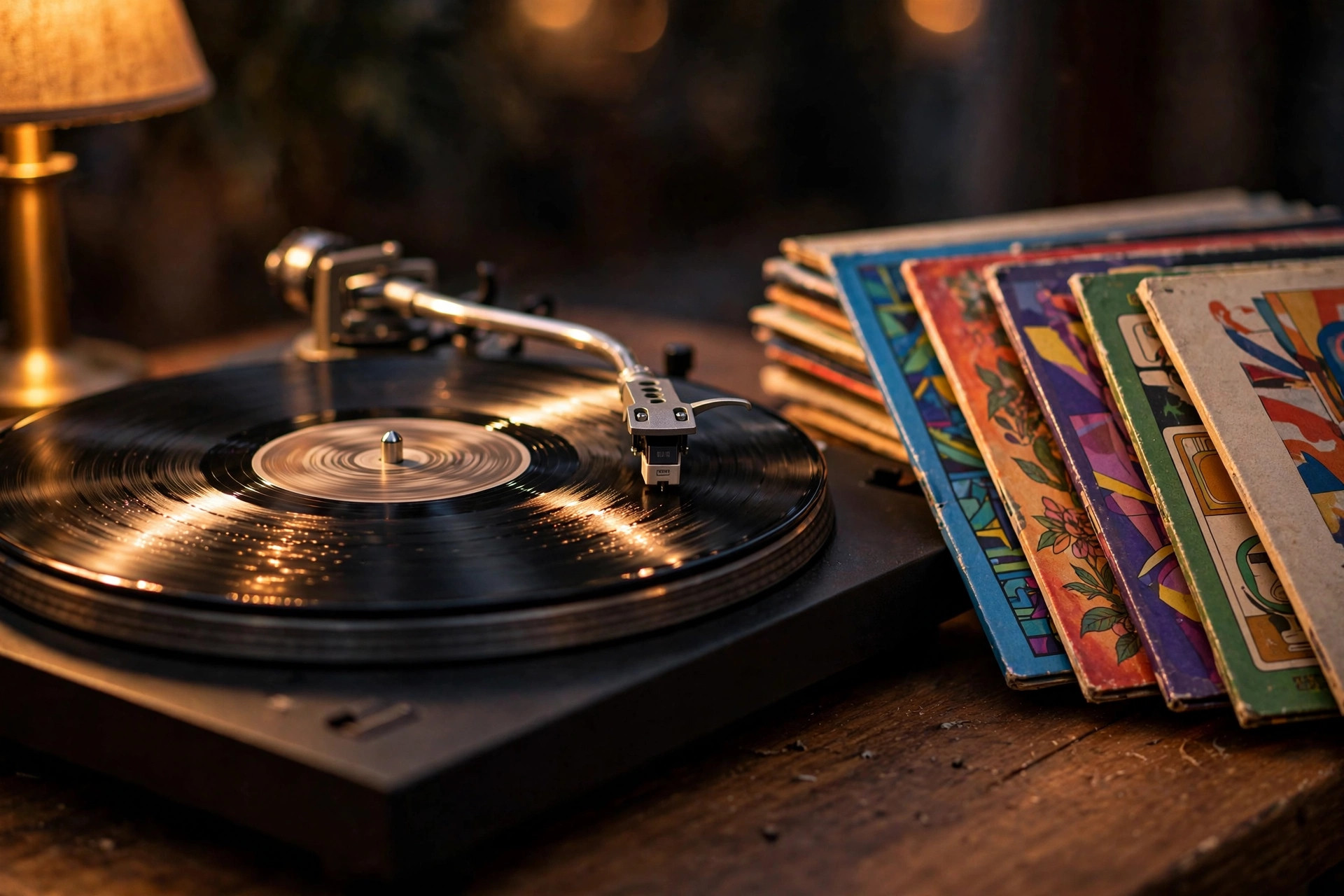
You do not need audiophile equipment to enjoy vinyl — you need a decent turntable, stable support and speakers that suit your room. If you are starting from scratch, an entry-level belt-drive turntable from an established brand will serve you beautifully for years. Look for adjustable tracking force and a replaceable cartridge; these are the marks of a deck that respects your records. Avoid the ultra-cheap all-in-one suitcase players if you can — they look charming but their heavy tracking can wear records faster.
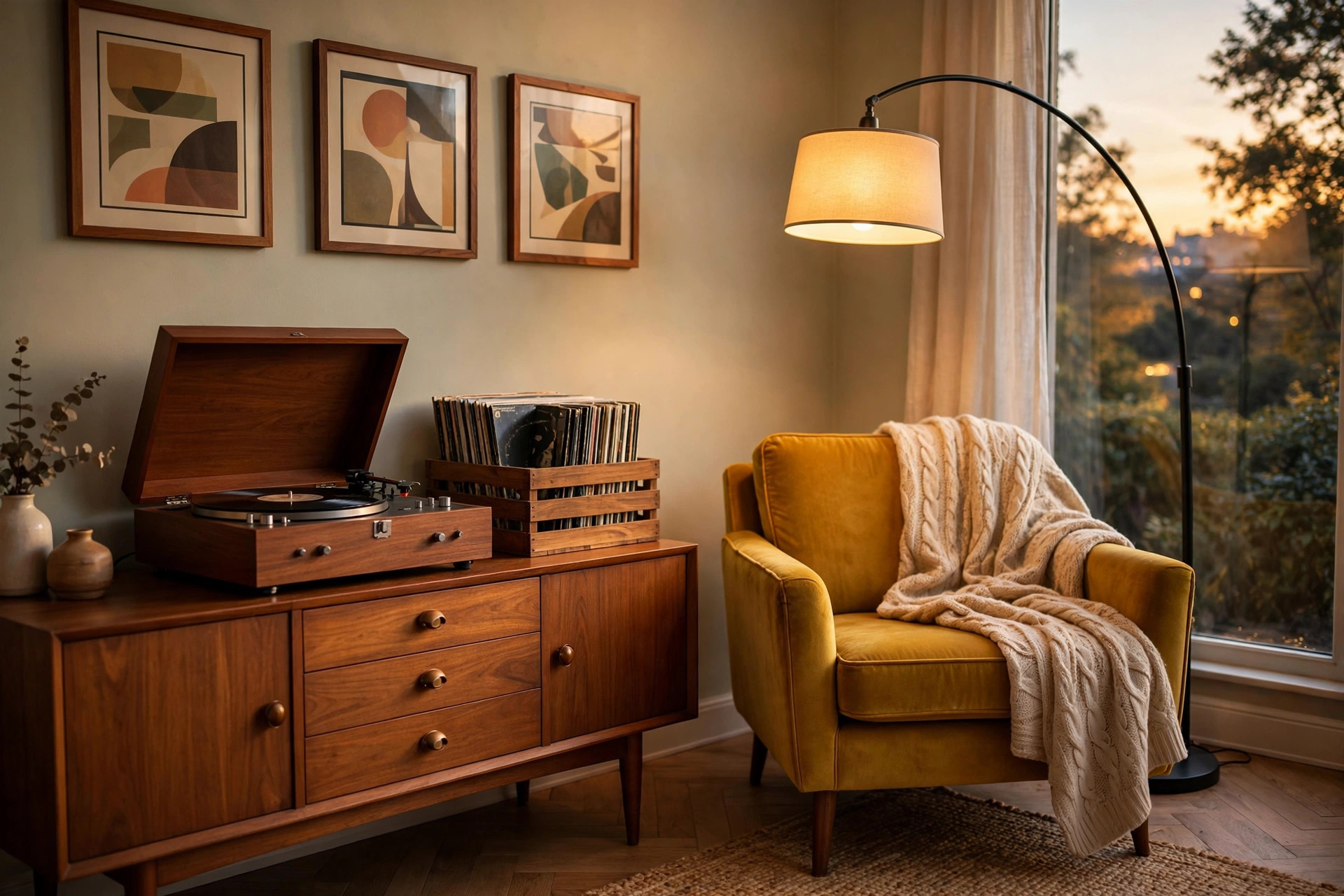
What the turntable sits on matters as much as the turntable itself. A solid sideboard, a dedicated record console or even a sturdy vintage cabinet all work, provided the surface is level and does not wobble. Mid-century sideboards are the classic choice for a reason: the right height, the right width, storage for records below, and they look magnificent. Whatever you use, keep the turntable away from speakers to avoid vibration feedback, and ensure the lid (if it has one) can open fully.
| Element | What to aim for |
|---|---|
| Turntable | Belt-drive, adjustable tracking force, replaceable cartridge |
| Surface | Solid, level, wobble-free, away from speakers |
| Speakers | Bookshelf pair at seated ear height, angled toward your chair |
| Cables | Clipped together and tucked behind the sideboard |
Speakers deserve a moment of thought. Bookshelf speakers on stands or on the same sideboard, positioned roughly at ear height when you are seated and angled slightly toward your chair, create a proper stereo image — the sense of instruments spread between the speakers that makes vinyl listening so immersive. This little triangle — you and the two speakers — is the heart of the corner’s acoustics, and getting it right costs nothing.
Cable management is the unglamorous secret of a beautiful setup. A few adhesive cable clips, a short extension lead tucked behind the sideboard and cables routed together transform a tangle into invisibility. Dust covers protect the turntable when not in use, and a carbon-fibre brush for a quick pre-play dust-off keeps records sounding their best. These small rituals — brushing the record, cueing the needle — are part of the pleasure, not chores around it.
The revival is no passing fad: Statista’s chart of RIAA data shows vinyl sales in the United States surpassed CD sales in 2022, for the first time since 1987.
Which Chair Works Best for Listening?
Choose an armchair you can sit in for hours, with good back support and arms that do not hunch your shoulders. Place it one and a half to two metres from the speakers, add a footstool and a throw, and it will win evenings over the sofa.
The chair is where you will spend the hours, so choose it like you mean it. The ideal listening chair supports long, relaxed sits: a comfortable armchair with good back support, arms at a height that does not hunch your shoulders, and upholstery you can sink into. Velvet, bouclé and worn leather all suit the mood — tactile fabrics that feel as warm as the music sounds.
Second-hand is your friend here. Armchairs are among the best-value vintage buys: solid frames from past decades, often in need of nothing more than a clean. Look for comfort first — sit in it for a proper ten minutes, not a perfunctory bounce — and check the seat height against your sideboard so reaching your records feels natural. A small footstool or ottoman elevates the experience enormously; feet up, record on, world off.
Position the chair for both sound and comfort. Ideally it sits at the point of your speaker triangle, far enough back that the sound has room to bloom — usually one and a half to two metres from the speakers in a domestic room. Angle it slightly rather than dead-on; a slight angle feels more conversational and less like an examination. Leave enough room behind or beside it for a side table — within arm’s reach for tea, within sight for the album sleeve you are admiring.
Layer the chair for autumn. A soft throw over one arm, a cushion that supports your lower back, perhaps a sheepskin draped over the seat as the weather cools. These are not just decoration; they are what make the chair the place you choose on a rainy evening over every other seat in the house. The listening corner competes with the sofa, so it has to earn its evenings — comfort is how it wins.
How Should You Light a Listening Corner?
Use at least two warm light sources at different heights, always 2700K warm white, with a dimmer for tuning the mood. Keep a small adjustable lamp on the turntable so you can cue records accurately without scratching them.
Lighting makes the corner. Harsh overhead light kills the mood stone dead; warm, low, layered light creates it. Aim for at least two light sources at different heights:
- A floor lamp with a warm bulb arcing over or beside the chair, for reading sleeve notes
- A smaller table lamp or warm fairy lights on the sideboard, for glow
The combination gives you practical light for handling records and atmospheric light for everything else.
Bulb temperature is critical — 2700K warm white, always. Cool white bulbs make wood look grey, velvet look flat and the whole corner feel like an office. Dimmable bulbs or a simple plug-in dimmer let you tune the mood from “browsing records” brightness to “side B in the dark” intimacy. Smart bulbs are a nice luxury here: one voice command to dim the corner as the needle drops is a small joy that never gets old.
Consider the light on the turntable itself. You need enough to cue a record accurately without scratching — a small adjustable lamp or even a clip light aimed at the deck solves this elegantly. Some listeners add LED strip lighting behind the sideboard for a soft halo; kept warm and dim, it looks luxurious, though purists may prefer candlelight. Speaking of which: candles are wonderful in a listening corner, but keep them well away from records and sleeves, and never leave them burning unattended near paper sleeves.
Daylight deserves a mention too. If your corner gets afternoon sun, sheer curtains diffuse it beautifully and protect your records from direct UV. And there is something magical about a Sunday afternoon listening session in natural light — dust motes in a sunbeam, the sleeve in your hands, nowhere to be. Design for the evenings, but leave room for those afternoons.
How Should You Store and Display Records?
Store records vertically, never stacked flat, in a cool dry place away from sunlight, with room to grow. Face out current favourites on a ledge or frame them, and keep brushes, sleeves and a listening log close by.
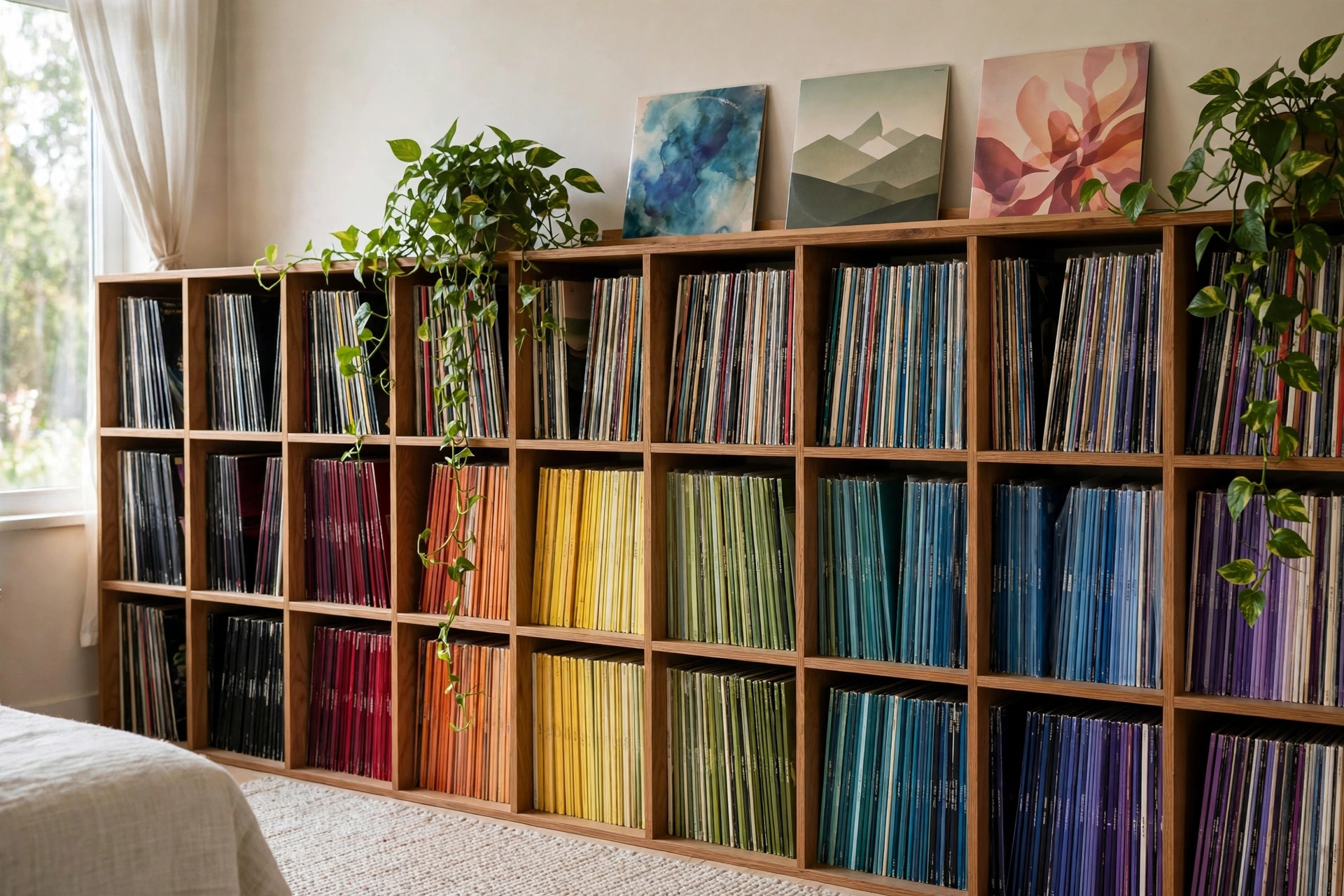
Records are both a collection and a decor element — store them well and they decorate the corner themselves. The golden rules: store vertically (never stacked flat, which warps), in a cool dry place away from direct sunlight, in inner sleeves that do not scuff. Cube shelving units are the classic solution for a reason: each cube holds records perfectly, the units are affordable, and they double as the turntable stand in many setups.
This matches official archival guidance: the US National Archives advises shelving disc recordings vertically in their sleeves and never stacking discs on top of one another.
Organisation is personal, but any system beats no system. Alphabetical by artist is the librarian’s choice; by genre then artist suits eclectic collections; by colour or mood suits the visually minded. Whichever you choose, leave expansion room — collections grow, and a shelf packed tight is a shelf that damages sleeves. Many collectors keep a “now playing” crate or a front-facing ledge for the current rotation, which doubles as ever-changing wall art.
Display is where the corner gets its personality. Album art is twelve inches of graphic design at its finest — frame favourites, lean them on picture ledges, or rotate a “record of the week” on a small easel. A grid of framed covers above the sideboard makes a stunning focal wall; single covers in simple frames let individual artworks breathe. Change the display with the seasons or your listening moods, and the corner never feels static.
Do not forget the accessories, stored beautifully. Inner and outer sleeves, a record brush, a stylus cleaner and a small notebook for a listening log all deserve a home — a lidded box or a drawer in the sideboard keeps them tidy but handy. A listening log, by the way, is a delight: date, record, a line about the evening. Years from now it will be one of your most treasured possessions, a diary written in albums.
What Are the Finishing Touches?
Walls, textiles and small rituals turn a setup into a sanctuary: framed art, a rug, a plant and your usual mug. Then protect the ritual itself — tidy up after each session so the corner is always ready to play.
With the essentials in place, the styling details turn a setup into a sanctuary. Start with the walls: framed gig posters, concert tickets, a small gallery of album art, or even a large textile hanging to soften the acoustics (soft furnishings genuinely improve sound by taming reflections). Keep the palette warm and cohesive with the rest of your home — the corner should feel like a destination within the house, not a different house.
Textiles do quiet acoustic work as well as visual work. A rug under the chair and sideboard warms the sound and the feet; heavy curtains, if there is a window, dampen echo. These are the rare decor choices that are measurably functional — a corner with soft furnishings simply sounds better than a bare one, with less harsh reflection and a warmer tone.
Add life: a trailing plant on top of the shelving, a small vase of dried grasses on the sideboard, a candle (safely placed) for evening sessions. Add ritual objects: the mug you always use, a coaster that lives on the side table, the notebook for your listening log. These personal details are what make the corner yours rather than a showroom — the difference between a styled space and a loved one.
Finally, protect the ritual. Keep the corner tidy — put each record back in its sleeve, return it to its place, brush the stylus. A corner that is ready to play is a corner you will play; a corner buried under clutter is a corner you will walk past. Five minutes of tidying after each session preserves the magic for the next one. Then, when the evening comes and the light is low, lower the needle, sink into the chair, and listen — properly, attentively, joyfully — to the whole glorious side.
A vinyl listening corner is really a promise you make to yourself: that music is worth your full attention, that evenings can be slow, that a small corner of home can hold a whole world of sound. Build it with care, fill it with records you love, and it will repay you every single night.
Leave a Reply