
There comes a moment every autumn — usually on the first properly cold morning, when you are standing in front of an open wardrobe in a towel, shivering — when you realise your closet is still dressed for July. The linen shorts are still there. The wool coat is buried behind the sundresses. Nothing goes together, nothing is quite warm enough, and getting dressed feels like a small daily defeat. The fall closet refresh exists to fix exactly this. Done well, it turns a chaotic wardrobe into a calm, organised system where every autumn morning starts easily, everything fits the season, and you actually wear the clothes you own.
The good news is that a proper seasonal refresh is not the exhausting, all-day, everything-on-the-bed ordeal it is often made out to be. Broken into calm steps and spread over a weekend — or even a few evenings — it is genuinely satisfying work. This guide will walk you through the whole process: clearing and sorting without overwhelm, storing summer clothes so they survive until spring, honestly auditing what you own, organising your autumn wardrobe by zones, and building simple habits that keep it that way all season.
Start With a Clear-Out, Not a Reorganisation
The biggest mistake people make with a seasonal refresh is trying to organise a wardrobe that still contains everything. You cannot organise clutter; you can only rearrange it. So the first step is not organising at all — it is editing. Take everything out. Yes, everything. It feels dramatic, but there is no other way to see what you actually own, and seeing it all at once is weirdly motivating.
Work in categories, not random armfuls: all tops together, all trousers together, all dresses, all knitwear, all outerwear, all shoes. As you pull each category out, sort it immediately into four piles — keep for autumn, store for summer, donate or sell, and discard. Be honest but not ruthless to the point of regret: the question is not “have I worn this in the last year” but “will I genuinely reach for this in the next six months, and does it still fit my life?” A beautiful coat you never wear because it does not suit your commute is not serving you, no matter how lovely it is.
For the donate pile, be realistic about condition. Charities want clean, wearable clothes — stained, torn, or worn-out items belong in textile recycling, not the donation bag. For the sell pile, only list things worth your time: good brands in excellent condition sell quickly; fast-fashion basics usually do not earn enough to justify the photographing and posting. Bag the discards for textile recycling straight away so they leave the house and stop whispering at you from a corner.
Store Summer Properly So It Survives Until Spring
Summer clothes stored badly come back in spring smelling musty, creased beyond rescue, or nibbled by moths. Stored well, they emerge in April looking like new. The difference is entirely in the preparation, and it takes far less effort than most people assume. The three rules are simple: clean, dry, and protected.
Clean everything before it goes away. Wash or dry-clean every summer item, even the ones that look clean — invisible body oils and food marks attract moths and set into stains over months of storage. Make sure everything is completely dry before packing; even slight dampness in a sealed box becomes mildew by spring. This is also the moment to make small repairs: sew on the loose button, fix the dropped hem, so that next summer’s you inherits no chores.
Choose the right containers. Breathable fabric storage bags or sturdy boxes with lids work best; avoid bin bags, which trap moisture and offer no protection. Fold knits and delicate items rather than hanging them — months on a hanger stretches shoulders out of shape. Add cedar blocks or lavender sachets as a natural moth deterrent, and slip a dryer sheet or scented sachet in for freshness. Label every box clearly with its contents (“summer dresses”, “linen trousers”, “swimwear”) — future you will be enormously grateful.
Store boxes somewhere cool, dry, and dark: under the bed, on top of wardrobes, in a dry loft space. Avoid damp garages and sheds, where temperature swings and moisture ruin fabric. And keep one small “transitional” box accessible rather than buried — early autumn still brings warm days, and you will want a couple of summer tops within reach for layering until the real cold arrives.
Audit Your Autumn Wardrobe Honestly
With summer packed away and the keep pile in front of you, it is time for the audit — the step that saves you money and closet space all season. Lay out your autumn clothes by category and look at them the way a shopkeeper looks at stock: what do you have too much of, what is missing, and what has quietly stopped working?
Count the workhorses first. Most autumn wardrobes run on a small set of repeated heroes: dark jeans or trousers, a few knit jumpers, layering tops, one or two good coats, ankle boots, and comfortable everyday shoes. If you own nine black jumpers and one pair of jeans that actually fits, the audit has just told you something useful. Duplicates are fine if you genuinely wear them in rotation — but five near-identical grey jumpers usually means four are just taking up space.
Check condition with fresh eyes. Hold each piece up in good light: pilling knitwear, thinning elbows, stretched necklines, tired boots with worn soles. Some things can be revived — a fabric shaver transforms pilled knitwear, a cobbler re-soles good boots for a fraction of replacement cost — but be honest about what is past saving. Wearing worn-out clothes does not save money; it just makes you feel slightly shabby every day, which is the opposite of what a refreshed wardrobe is for.
Finally, write a short shopping list — and only a short one. The audit’s real power is that it turns vague “I have nothing to wear” feelings into specific gaps: “one pair of dark straight-leg jeans”, “a warm waterproof coat”, “black ankle boots with a low heel”. A specific list prevents impulse buying and means every purchase earns its place. Aim to fill genuine gaps, not to rebuild the wardrobe from scratch.
Organise by Zones: The System That Stays Tidy
Here is where the refresh becomes a system instead of a one-time tidy. The principle is zones: group your wardrobe by how you actually get dressed, not by colour or by some idealised boutique logic. Most people reach for outfits in a predictable order — base layers, main pieces, outer layers — so organise the closet to match that flow.
A practical zone layout looks like this:
- Eye-level prime real estate: Your most-worn autumn pieces — the jumpers, tops, and trousers you reach for weekly. This zone should hold roughly the 20 per cent of your wardrobe you wear 80 per cent of the time.
- Hanging section: Coats, blazers, dresses, and anything that creases. Hang coats with room to breathe — crammed coats wrinkle each other and hide what you own.
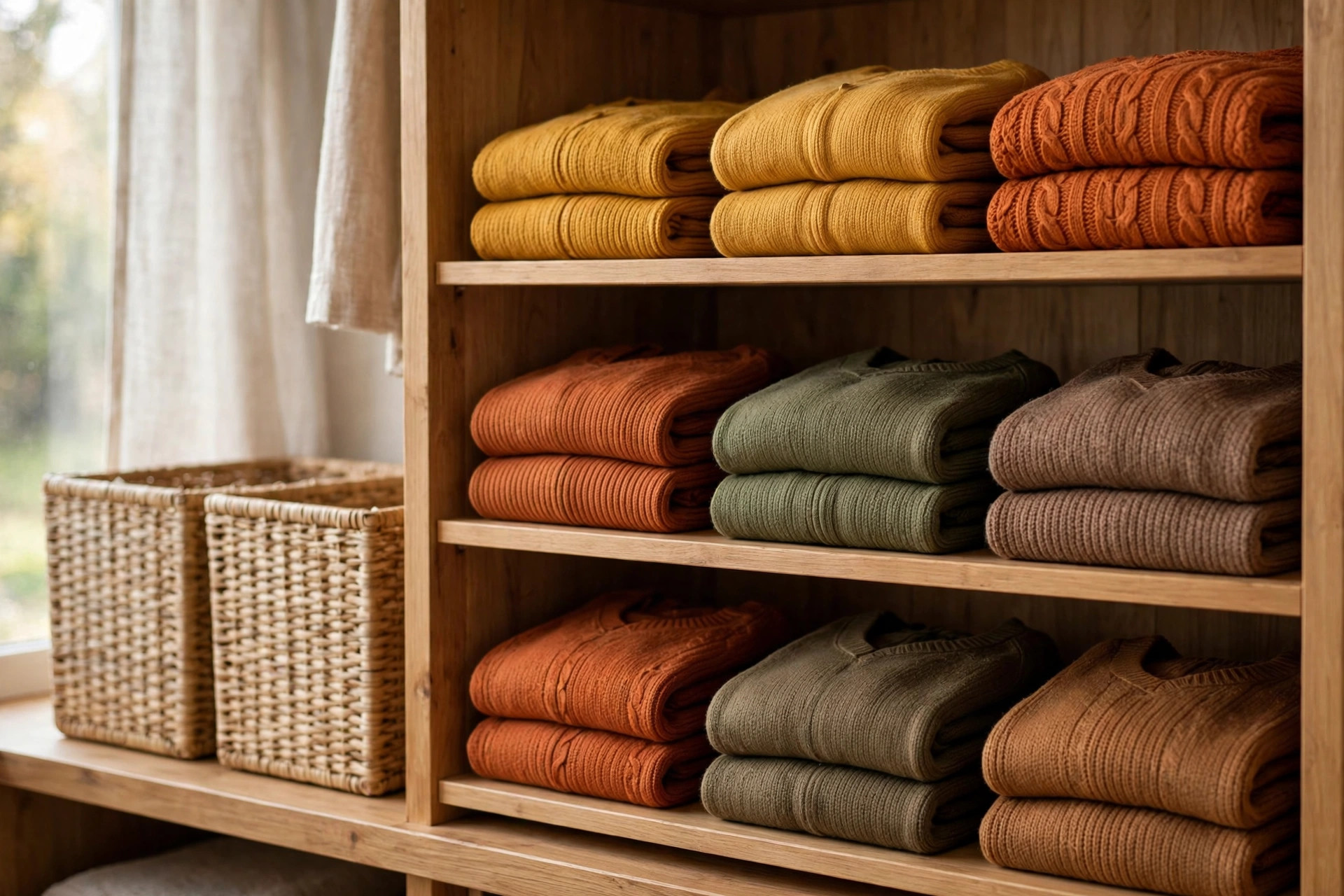
- Folded knitwear: Jumpers and cardigans folded on shelves, never hung. Folded stacks should be shallow — three or four items deep — so you can see and reach everything without toppling the pile.
- Top shelf: Occasion wear, formal pieces, and anything seasonal-but-rarely-worn, like the heavy winter coat that is still a month away.
- Bottom zone: Shoes in pairs, boots upright with boot shapers or rolled magazines inside to hold their shape.
- Drawer zone: Underlayers, scarves, hats, and gloves in drawer organisers so small items do not become a tangled drawer of mystery.
The magic of zones is maintenance: when everything has a logical home, putting laundry away takes minutes and the system survives real life. The number one cause of closet chaos is not laziness — it is a system that does not match how you actually dress. Build the zones around your real habits and tidiness largely takes care of itself.
The Hanger Upgrade (and Other Small Changes With Big Impact)
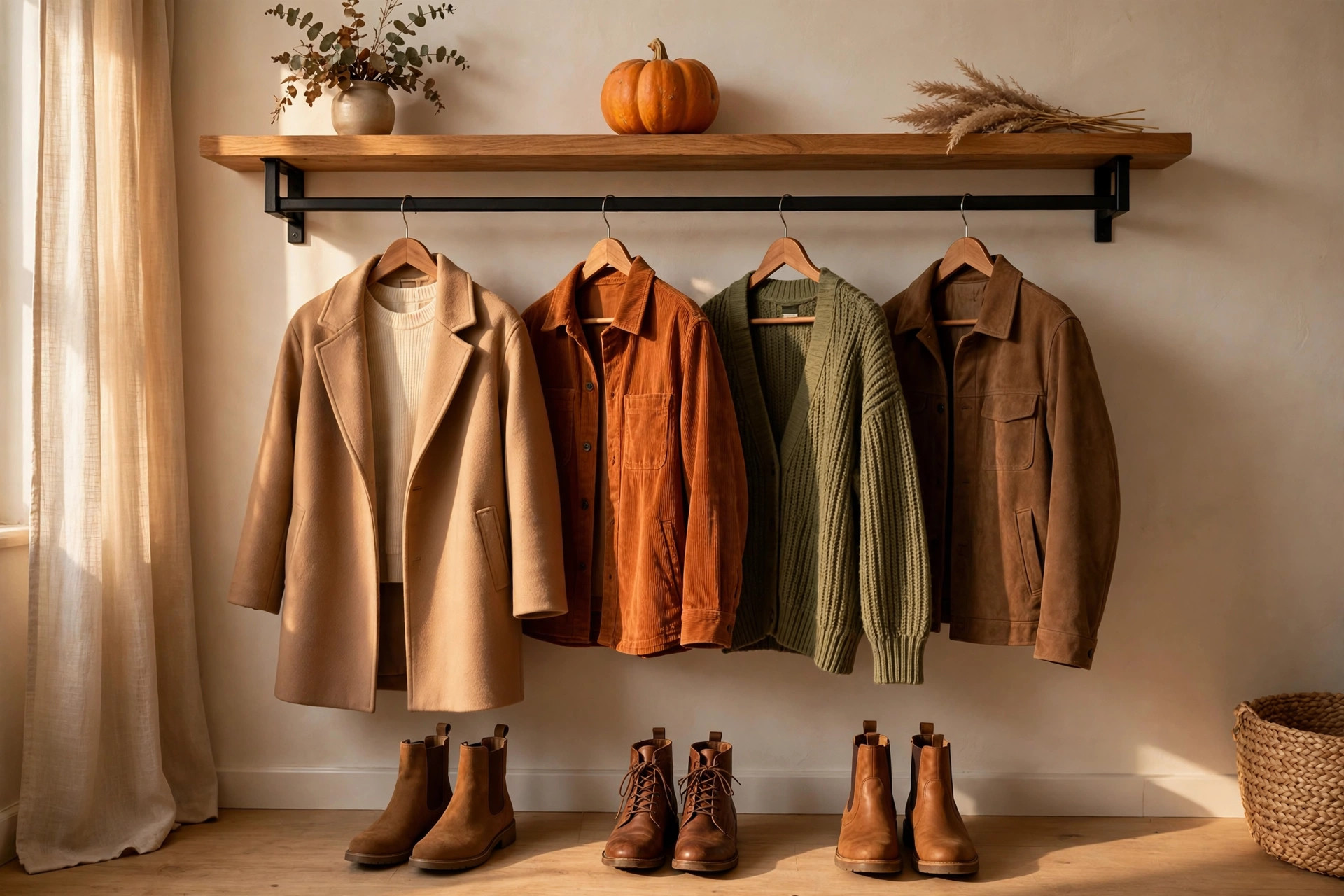
Some of the most transformative closet changes cost almost nothing. Matching hangers are the classic example: a rail of identical slim wooden or velvet hangers instantly makes a wardrobe look twice as expensive and twice as organised, and slim hangers genuinely create more hanging space. Ditch the mismatched wire and chunky plastic collection in one go — it is a small purchase with an outsized visual payoff.
Other small upgrades with big returns: shelf dividers that stop folded stacks from avalanching into each other; a hanging organiser on the closet door for scarves, belts, and sunglasses; small baskets or drawer dividers that give every accessory a compartment; boot shapers that keep tall boots standing smartly instead of slumping. None of these costs much, and together they change the whole feeling of the space.
Lighting deserves a mention too. Most closets are badly lit, which makes dark autumn clothes — navy, black, charcoal — nearly impossible to tell apart. A battery-operated motion-sensor light strip inside the wardrobe is inexpensive, installs in minutes with no wiring, and makes an astonishing difference on dark mornings. Being able to actually see your clothes is the most underrated wardrobe upgrade there is.
And consider scent. A lavender sachet, a cedar block, or a lightly scented drawer liner keeps the closet smelling fresh and discourages moths. It is a tiny touch, but opening a wardrobe that smells faintly of lavender instead of faintly of nothing makes the whole getting-dressed experience feel more cared for.
Build Easy Autumn Outfit Formulas
An organised wardrobe still fails if you stand in front of it every morning unable to decide. The fix is outfit formulas — simple, repeatable combinations you know work, so getting dressed becomes automatic rather than creative. Autumn is the perfect season for formulas because layering gives you a reliable structure: base + middle + outer + shoes.
Develop three or four personal formulas from pieces you already own. Examples to adapt:
- The everyday uniform: Dark jeans + cream or striped long-sleeve top + oversized cardigan + ankle boots. Add a scarf when it is properly cold.
- The smart-casual: Tailored trousers + fine-knit jumper + blazer + loafers. Works for offices, lunches, and anything that needs polish.
- The weekend cosy: Leggings or joggers + oversized jumper + long coat + trainers or chunky boots. Comfort that still looks intentional.
- The dressier autumn: Midi dress + tights + knee-high or ankle boots + wool coat. One dress, endless autumn mileage with different layers.
Write your formulas down — on your phone, on a card inside the wardrobe door, wherever you will see them. On the bleakest, darkest mornings, when decision-making capacity is zero, a written formula is a gift from past you to present you. Some people even photograph their favourite combinations and keep an album on their phone: a personal lookbook that makes “what do I wear” a scroll instead of a stare.
Make Room for Real Life: Laundry, Returns, and the Chair
Every wardrobe system needs to account for real life, and real life includes the chair — the one where worn-but-not-dirty clothes go to form a textile mountain. Instead of fighting the chair, give it a job: designate one hook, one basket, or one section of a shelf as the official “worn once, wearing again” spot. Clothes that have been worn but are not ready for the wash live there, visibly and contained, instead of colonising every surface.
Build laundry flow into the system. Keep a laundry basket in or right next to the closet so dirty clothes never sit on the floor “temporarily” for a week. When clean laundry comes back, put it away the same day — a basket of clean clothes living on the bed or the chair undoes a refresh faster than anything else. If same-day put-away feels impossible, try the ten-minute rule: set a timer and put away as much as you can. Ten focused minutes clears most baskets.
Handle the in-between items decisively. New purchases with tags still on: decide within the week — wear it, or return it. Items awaiting repair: keep them in one small bag or box, and set a date to deal with them; a mending pile with no deadline becomes permanent clutter. The refresh is not just about the clothes — it is about the little holding patterns that quietly undo organisation, and replacing each one with a simple rule.
Small Closets and Shared Wardrobes
Not everyone has a walk-in wardrobe, and the refresh works just as well in a small closet or a shared one — it just needs a few adaptations. In a small space, the edit matters even more: with limited room, every item must earn its place, so be slightly stricter with the keep pile. Use vertical space ruthlessly — double hanging rails (one high, one low) effectively double a small closet, and the top shelf with labelled boxes handles everything out of season.
For shared wardrobes, divide clearly. Each person gets defined zones — their own rail section, their own shelves, their own drawers — and the boundary is respected. Shared chaos usually comes from blurred boundaries, not from too little space. A simple shelf divider or a different coloured set of hangers can mark territory without any awkwardness.
If your “closet” is really a rail and some drawers in a bedroom corner, lean into it: a beautiful open rail with matching hangers and coordinated clothes is a decor feature, not a compromise. Keep the visible rail to your best, most-worn autumn pieces, store the rest in attractive boxes or a small dresser, and style the top of the dresser with a candle (flameless is safest near fabric), a small plant, and a tray for jewellery. Small-space dressing areas can be the prettiest corner of the room when they are intentional.
A seasonal refresh is not about having more clothes. It is about finally seeing — and wearing — the good ones you already own.
So pour a hot drink, put on a good playlist, and start pulling things out. Sort honestly, store summer with care, organise by the way you actually dress, and build a few outfit formulas to carry you through the dark mornings. By Sunday evening, your wardrobe will be ready for the season — and Monday morning’s getting-dressed will feel like the easiest part of the day. That is what a fall closet refresh is really for.
Leave a Reply