Last updated: October 2026
Quick answer: A fall entryway feels like a warm welcome when real life comes first: a drop zone for keys, hooks for coats, and a boot tray by the door. Once those three zones work, add a console vignette, warm light, rugs, a wreath, and a faint autumn scent.
The entryway is the handshake of your home. It is the first thing you see when you come in out of the cold, the first thing guests see when they arrive, and the space that quietly sets the emotional tone for everything beyond it. In autumn, when the days shorten and the air turns crisp, your entryway has one job above all others: it should feel like a warm welcome.
That sounds simple, but entryways are some of the hardest-working square metres in the house. They have to handle muddy boots, wet umbrellas, school bags, post, keys, and coats, all while looking inviting. The trick to a beautiful fall entryway is designing for the real life that happens there first, then layering the seasonal beauty on top of a system that actually works.
This guide walks you through it step by step, whether you have a grand hallway, a tiny flat entry, or just a corner by the front door. Every idea is practical, affordable, and chosen to make coming home in October feel like the best part of the day.
What three zones does every entryway need?
Before any seasonal decor, set up a drop zone for keys and post, a hook per person for coats and bags, and a boot tray by the door with a bench nearby. When these three zones work, the entryway already feels calmer and less cluttered.
Before a single pumpkin appears, sort out the three functional zones that keep an entryway working through autumn’s mess. If these are missing, no amount of decor will make the space feel calm.
| Zone | What it holds | How to set it up |
|---|---|---|
| Drop zone | Keys, post, sunglasses, small daily items | A small tray, lidded box, or shallow bowl on the console table |
| Coat and bag station | Coats, bags, guest coats | A row of sturdy hooks, one per person plus one spare |
| Shoe and boot area | Muddy boots, wet shoes | A boot tray by the door, plus a bench or stool for sitting |
Zone one: the drop zone. This is where keys, post, sunglasses, and the small daily flotsam land. A small tray, a lidded box, or a shallow bowl on the console table does the job. Without a designated spot, these things migrate across every surface in the house.
Zone two: the coat and bag station. Hooks are better than a coat stand for most entryways, they take up no floor space and each person gets their own. Mount a row of sturdy hooks at a height everyone can reach. Add one hook per regular household member, plus one spare for guests. In autumn, this zone earns its keep: damp coats need air circulation, so avoid cramming five coats onto two hooks.
Zone three: the shoe and boot area. Autumn means mud, rain, and leaves tracked indoors. A boot tray, a simple shallow tray with a lip, catches the worst of it and can be rinsed in seconds. Place it right by the door so shoes never travel further into the house. A small bench or stool nearby gives everyone a place to sit while pulling boots on and off, which keeps the wall behind it free of scuffs.
Once these three zones are working, your entryway already feels calmer. Now the seasonal layering begins, and because the practical bones are solid, the decor will look intentional instead of cluttered.
How do I style a fall console table?
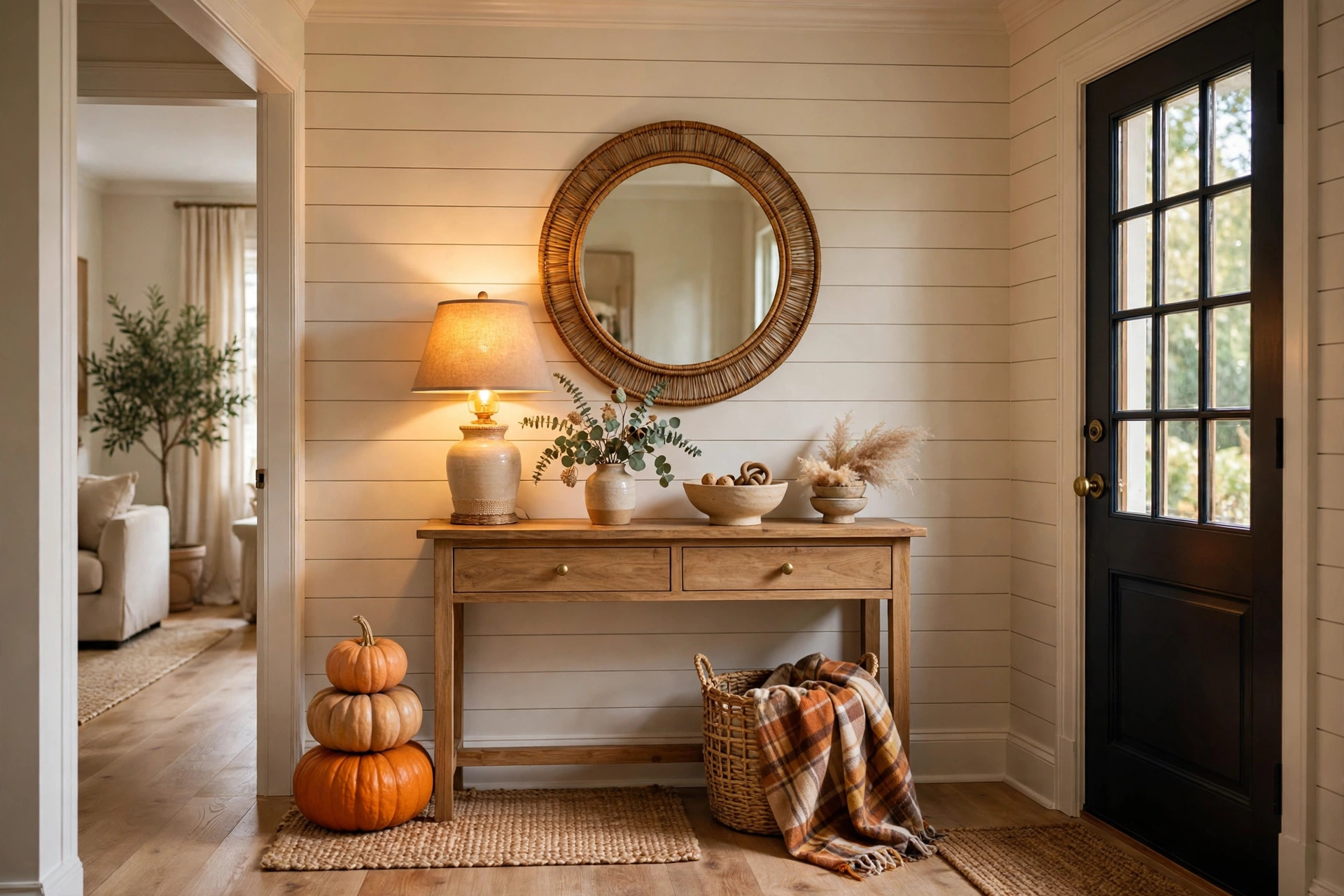
Build the console vignette in three layers: height at the back, practical pieces like a key tray and lamp in the middle, and seasonal touches at the front. Keep it edited to about five objects, so the eye has empty space to appreciate each one.

If you have room for a console table, it becomes the centrepiece of your fall entryway. This narrow surface is your chance to create the kind of welcoming vignette that makes people smile the moment they walk in.
Build the arrangement in three layers, back to front:
- At the back, something with height: a mirror (which also bounces light around a dark hallway), a piece of art in autumnal tones, or a tall vase with branches.
- In the middle, your practical pieces: the key tray, a small lamp for warm light, perhaps a candle.
- At the front, the seasonal touches: a small pumpkin, a sprig of dried foliage tucked into a bud vase, a little stack of books tied with twine.
The lamp deserves special mention. Hallways are often the darkest part of the house, and a small lamp glowing on the console table transforms the feeling of coming home on a dark October evening. Choose a warm bulb and a fabric shade. The difference between warm and cool light in a hallway is the difference between welcoming and clinical.
Keep the surface edited. A console table with five well-chosen objects looks styled; the same table with fifteen looks like a jumble sale. If you are adding seasonal pieces, remove something else to make room. The eye needs empty space to appreciate what is there.
What should I hang on entryway walls?
A mirror is the most useful hallway addition, making narrow spaces feel wider and bouncing daylight deeper into the house. Add one larger autumn artwork rather than a scatter of small frames, plus a small dried posy or mini wreath for the season.
Entryway walls are prime real estate that too many of us leave blank. A mirror is the single most useful thing you can hang in a hallway: it makes narrow spaces feel wider, bounces precious daylight deeper into the house, and gives everyone a last check before heading out into the autumn wind.
A round mirror softens a hallway full of right angles, while an arched or rectangular mirror in a brass or aged-wood frame adds the vintage warmth that suits autumn so well. Hang it at a height where the average adult sees their face comfortably, roughly 150 to 160 centimetres from the floor to the centre.
For art, autumn is the season of moody landscapes, botanical prints, and anything in rust, ochre, and olive. One larger piece makes more impact than a scatter of small frames in a narrow space. If you love a gallery wall, keep it to one wall and let the opposite wall breathe. Hallways need visual rest stops.
A simple seasonal touch on the wall costs almost nothing: hang a small dried-flower posy or a mini wreath on a hook, or lean a framed autumn print on the console table against the wall. It signals the season without requiring a full redecoration.
How do I handle muddy boots and hallway floors?
Choose a low-pile, washable runner that runs most of the hallway’s length, and layer a coarse outdoor mat with an absorbent indoor mat. Darker patterns in rust, brown, or charcoal hide October mud far better between cleans.
Hallway floors take a beating in autumn, and the right rug strategy protects them while adding warmth underfoot. A runner is the classic hallway choice for good reason: it defines the path through the space, adds colour and pattern, and catches a surprising amount of dirt.
Choose a runner you can clean easily. Low-pile, washable rugs are the practical autumn choice, look for ones you can put in the washing machine, because October mud will find them. Darker patterns in rust, brown, or charcoal hide the in-between-cleans reality far better than pale rugs.
Layer your doormats: a coarse outdoor mat for scraping boots, then an absorbent indoor mat just inside the door. This two-mat system catches dramatically more dirt and water than a single mat, and it is the kind of boring practical detail that keeps the rest of your entryway looking lovely all season.
Size matters more than you think. A runner that is too short looks apologetic; ideally it should run most of the length of the hallway, stopping a few centimetres short of each end. In a small entry, a square or round rug that fits the space generously beats a tiny mat that looks lost.
How can a tiny entryway still feel welcoming?
In a tiny entry, go vertical: one row of hooks, a narrow floating shelf, and a mirror above create a complete station in under a metre of wall. Choose one confident seasonal touch and warm light, since restraint reads as style in small spaces.
No hallway at all? Many of us open the front door straight into the living room, or have an entry that is barely a metre deep. A warm welcome is still entirely possible, it just needs to be vertical.
When floor space is scarce, use the wall. A single row of hooks, a narrow floating shelf for keys and post, and a mirror above it creates a complete entry station in less than a metre of wall. A slim bench that doubles as shoe storage underneath gives you the sit-down spot without claiming the whole floor.
Choose one seasonal moment rather than spreading decor thinly. A small wreath on the inside of the door, a single pumpkin on the shelf, or a candle on the bench, one confident touch beats five apologetic ones. In a tiny entry, restraint reads as style.
Light is even more important in small, dark entries. If there is no room for a lamp, a wall-mounted light or even a row of LED candles on the shelf creates the warm glow that says welcome home. Avoid overhead fluorescents at all costs, they are the enemy of cosiness.
How do I welcome guests before they even come in?
Start at the doorstep with a wreath, layered mats, planters of autumn colour, pumpkins, and a lantern with a warm LED candle. Keep the path clear and the porch light working, so the house feels cared for before anyone crosses the threshold.
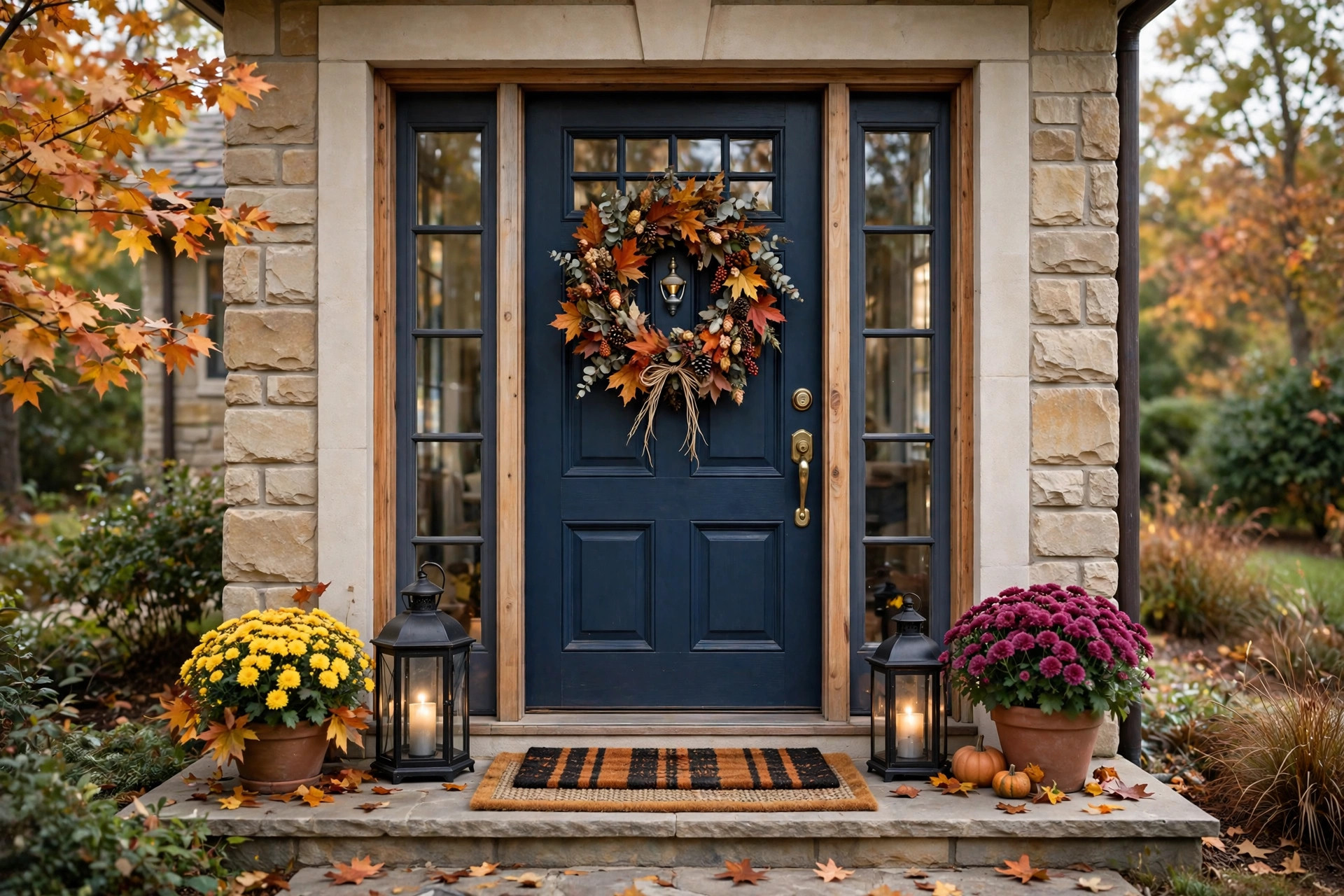
Your entryway really starts at the kerb. The doorstep is the first impression, and a few autumn touches outside make the whole house feel cared for before anyone crosses the threshold.
A wreath on the front door is the classic for a reason, it is visible, cheerful, and takes minutes to hang. Dried wreaths of wheat, eucalyptus, or preserved autumn foliage last the whole season and look better with a little weathering. If your door is a bold colour, choose a wreath with plenty of natural texture rather than competing colours.
Layer your outdoor mats: a larger patterned mat underneath, a smaller coir mat on top, slightly offset. This layered look is everywhere for good reason, it looks intentional and welcoming, and it doubles the dirt-catching.
Flank the door with planters of autumn colour. Chrysanthemums in rust, gold, and deep red are the work horses of the October doorstep, cheap, cheerful, and long-lasting. Add a couple of pumpkins or gourds at different sizes around the base of the planters, and a lantern with a warm LED candle for the dark evenings.
Keep the path clear and the lighting working. A welcoming doorstep with a burnt-out porch light sends a mixed message. Warm-white bulbs, swept steps, and a tidy mat say someone is home and glad you came.
The best entryways are the ones that work on a wet Tuesday in October, not just in photographs. Design for the muddy boots first, and the beauty will have a solid foundation to sit on. On candle safety, the U.S. Fire Administration advises keeping candles at least 12 inches from anything that burns and blowing them out when you leave a room, which is one reason LED candles suit doorstep lanterns so well.
What scents and details complete the welcome?
A faint trace of cinnamon, cedar, or baked apples greets guests before the decor registers, best delivered by a low-maintenance reed diffuser kept subtle. Finish with a folded throw, a working umbrella stand, and a dusk walk-through as a guest.
Welcome is not only visual. The smell of your entryway hits before the decor registers, a faint trace of cinnamon, cedar, or baked apples as someone walks in does more for the feeling of autumn than any number of pumpkins.
A reed diffuser on the console table is the low-maintenance choice: no flame, no fuss, steady background scent. Choose autumn notes like cedarwood, amber, clove, or fig. Avoid anything too sweet or too strong in a small space. The entryway scent should be a whisper, not an announcement.
Small details complete the picture: a folded throw over the bench for chilly arrivals, a pretty umbrella stand that actually holds umbrellas, a little dish of conkers or acorns that children can touch. These are the things guests remember, the entryway that feels considered down to the smallest object.
Finally, do a dusk walk-through. Come home one October evening, open your front door, and stand in your entryway as a guest would. Is the light warm? Is there somewhere to put your bag? Does it smell faintly of autumn? Adjust whatever feels off. The warm welcome is not a look, it is a feeling, and you are the best judge of whether your entryway delivers it.
Leave a Reply