Last updated: October 2026
Quick answer: Style fall shelves with the rule of three — one tall, one medium and one small object per vignette — plus a limited palette of three colours and a neutral, varied heights and depths, and about a third of each shelf left empty. A full restyle takes about twenty minutes.
There is no better canvas for autumn decorating than a shelf. Unlike a whole room, a shelf is small, forgiving and wonderfully changeable — you can restyle it in twenty minutes on a Sunday afternoon, and if you do not love the result, you simply try again. Floating shelves, bookshelves, built-in alcoves and even the top of a sideboard all offer the same delightful opportunity: a little stage where you can tell the story of the season.
Yet shelves are also where decorating goes wrong most often. Too many small objects create clutter, mismatched colours create chaos, and flat rows of same-height items create boredom. The difference between a shelf that looks styled and one that looks messy comes down to a few simple principles. This guide shares fall shelf decor ideas built on those principles, so you can create autumn vignettes that look effortlessly beautiful all season long.
What Is the Rule of Three for Shelf Styling?
The stylist’s favourite formula groups objects in threes: one tall for height, one medium for substance, one small for charm — a triangle the eye finds satisfying. On a long shelf repeat it two or three times with space between vignettes, leaving about a third of each shelf empty.
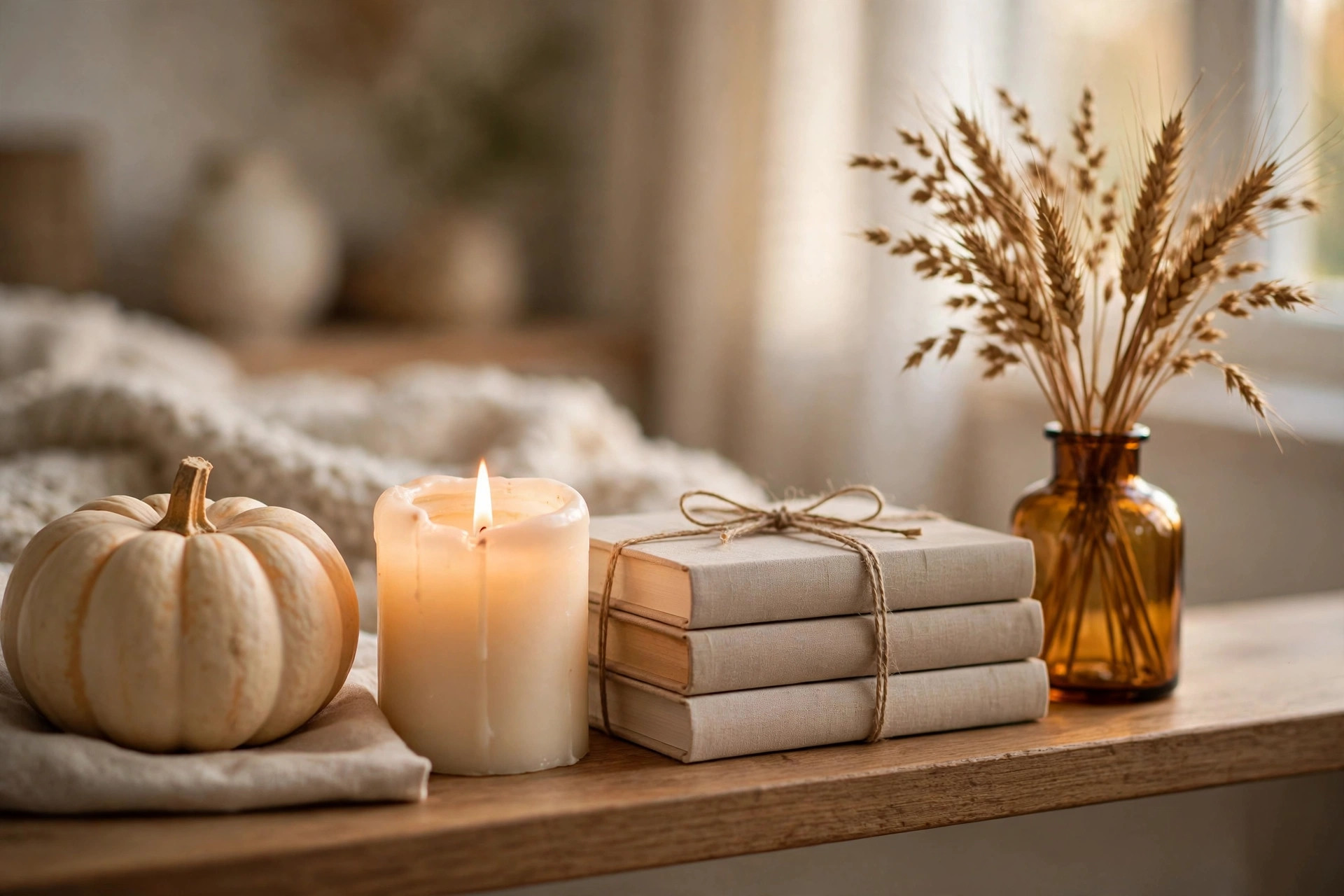
Professional stylists rely on one simple formula above all others: group objects in threes. A vignette of three items — say, a small pumpkin, a candle and a stack of books — looks naturally pleasing in a way that two or four rarely do. If you remember nothing else from this guide, remember the rule of three, because it will improve every shelf in your home instantly.
A great vignette combines three types of objects: something tall, something short and something in between. The tall item gives the grouping height and presence — a vase of wheat stems, a candlestick or a framed print. The medium item adds substance — a stack of two or three books, a small pumpkin or a lidded jar. The small item adds charm — a pinecone, a tiny candle or a sprig of dried flowers tucked alongside. Together, these three create a little triangle that your eye finds deeply satisfying.
On a long shelf, repeat this formula two or three times with space between each vignette. On a short shelf, one vignette is plenty. The space between groupings matters as much as the groupings themselves — it gives each little scene room to breathe and keeps the shelf feeling calm rather than crowded. As a rough guide, aim for about one third of each shelf to remain empty.
Once you are comfortable with threes, you can play with fives for larger shelves — but the principle stays the same. Odd numbers feel organic and relaxed; even numbers feel formal and static. Autumn decorating should feel like a walk through falling leaves, not a museum display, so let the odd numbers do their quiet magic.
How Do You Pick an Autumn Colour Story?
Before placing a single object, decide your colour story: three colours plus a neutral. Rust, amber and deep brown is the cosiest; ivory, beige and warm grey is calm and elegant; forest green, plum and black with brass is dramatic. Repeat each colour at least three times across your shelves.
Before you place a single object, decide on your colour story for the season. A limited palette is what makes a shelf look intentional rather than accidental, and autumn offers so many gorgeous directions to choose from. Pick three colours plus a neutral, and let them guide every choice you make.
The warm traditional story — rust, amber and deep brown against cream — is the cosiest option and the easiest to shop for, since every home store stocks it in autumn. The soft neutral story — ivory, beige, warm grey and natural wood — feels calm and elegant, and it lets you keep your shelf styled almost year-round with only small seasonal tweaks. The moody story — forest green, plum and black with brass accents — is dramatic and sophisticated, perfect if your home leans modern.
Your existing books and objects count toward the palette, so work with what you have. If your books are a rainbow of colours, turn them around so the pages face out — the creamy page edges create a beautiful neutral backdrop that suits any autumn story. This one trick solves the most common shelf-styling problem instantly, and it costs nothing.
Repeat each colour at least three times across your shelves so the palette feels cohesive. A rust pumpkin on the top shelf, a rust candle on the middle shelf and a rust-toned book below ties the whole unit together. When colours echo from shelf to shelf, the entire bookcase reads as one thoughtful composition rather than a stack of unrelated displays.
How Do You Layer Heights and Depths Like a Stylist?
Flat rows at one height look dull, so layer in three dimensions: build vertical height with stacks of books as pedestals, place tall items at the back, medium in the middle and one treasure at the front — and soften the lines with a plant spilling over the edge.
Flat shelves look flat when everything sits in a single row at the same height. The stylist’s secret is layering in three dimensions: varying heights vertically and placing objects at different depths from front to back. This creates the rich, collected look that makes people ask who decorated your home.
Build height with stacks. Two or three books become a pedestal that lifts a small pumpkin or candle into a more prominent position. A small wooden box or a turned-over bowl can do the same job. These little risers are invisible workhorses — they create the stepped heights that make a vignette interesting, and they let you use objects that would otherwise disappear behind taller neighbours.
Layer front to back as well. Place your tallest item at the back of the shelf, medium items in the middle, and one small treasure right at the front edge. A tiny pumpkin or a brass acorn at the front of a shelf draws the eye in and adds delightful depth. Leaning a small framed print against the back of the shelf, with objects arranged in front of it, creates a gorgeous layered scene in seconds.
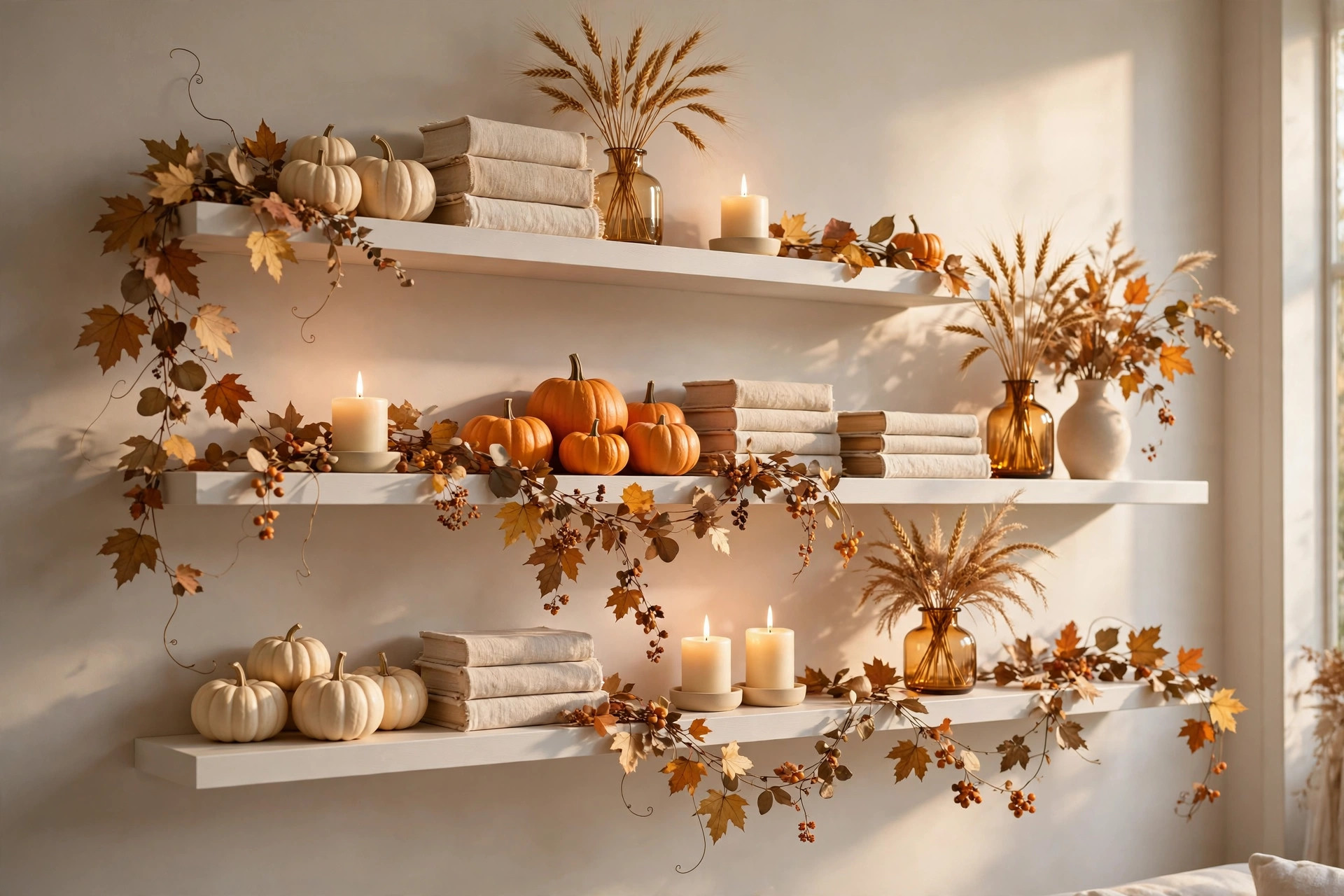
Do not forget the vertical space between shelves. A trailing plant or a garland of fall leaves spilling over the edge of an upper shelf softens the horizontal lines and connects one shelf to the next. Eucalyptus, ivy or a simple leaf garland all work beautifully — that gentle cascade of greenery is one of the prettiest things you can add to any shelving unit.
How Do You Style Different Types of Shelves?
Different shelves call for slightly different approaches: floating shelves look best restrained with one vignette and empty space; bookcases can handle abundance, mixing books with decor and baskets; alcoves work as single framed pictures with one focal point; and small ledges shine with a single mini-vignette of three items.
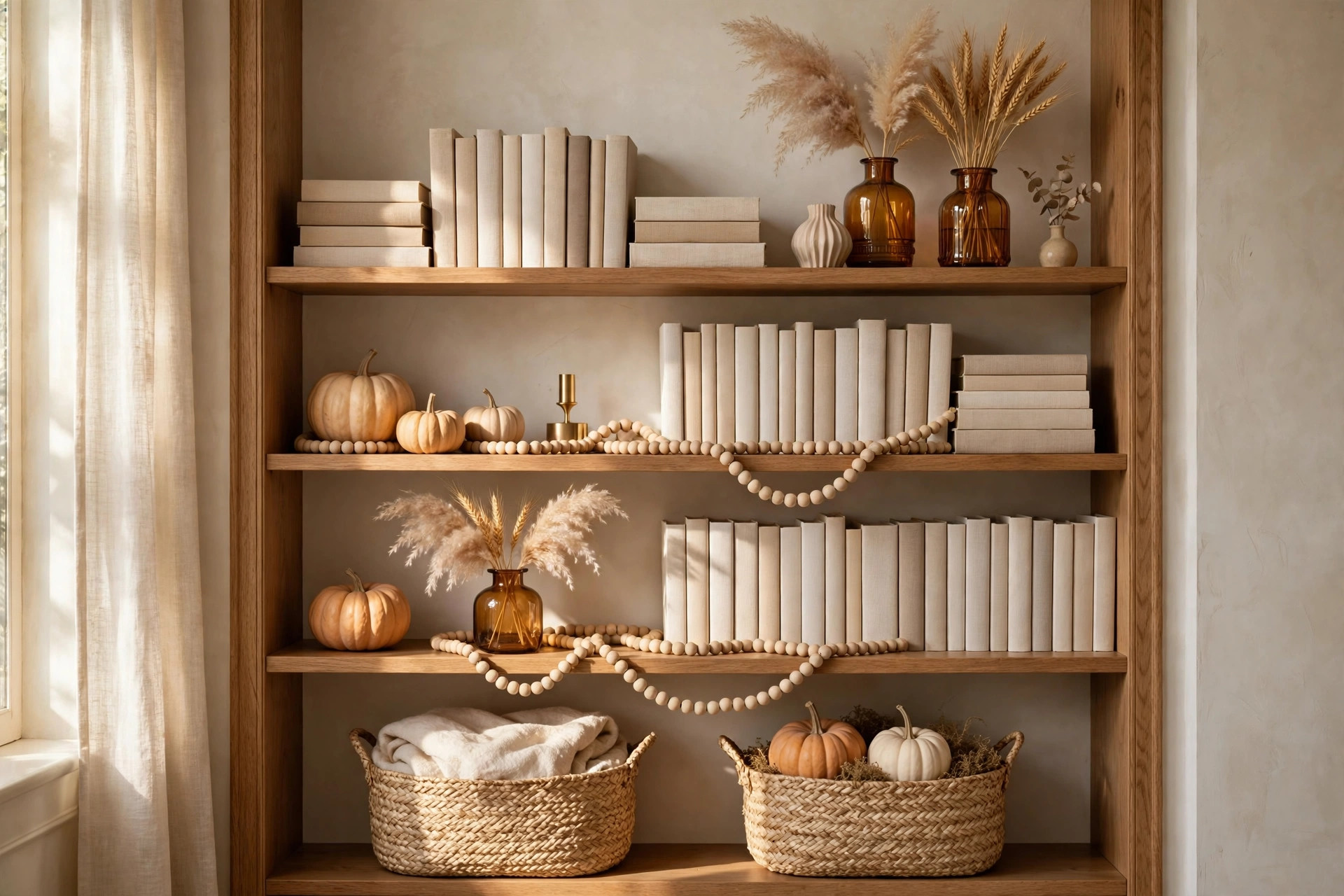
Different shelves call for slightly different approaches. Floating shelves, with their clean modern lines, look best with restrained styling — one vignette per shelf, plenty of empty space, and a consistent palette. Because floating shelves are so visible, less truly is more: three beautiful objects per shelf will look more expensive than ten crowded ones.
| Shelf type | Styling approach | Key tip |
|---|---|---|
| Floating shelves | Restrained: one vignette per shelf, consistent palette | Less is more — three beautiful objects beat ten crowded ones |
| Bookshelves and bookcases | Abundant: mix books with decor, horizontal and vertical stacks | Tuck woven baskets on lower shelves to hide clutter and add texture |
| Built-in alcoves and nooks | One framed picture: a single focal point with two or three smaller elements | A large vase of pampas grass or a lantern makes a stunning focal point |
| Small shelves and ledges | Single mini-vignettes | One candle, one tiny pumpkin and one sprig of dried flowers is all it takes |
Bookshelves and bookcases can handle more abundance. Here you can mix books with decor freely: stack books horizontally in some sections, keep them vertical in others, and tuck small autumn objects into the gaps. Baskets on the lower shelves are both beautiful and practical — they hide clutter while adding wonderful texture. Woven seagrass or rattan baskets in particular suit autumn perfectly.
Built-in alcoves and nooks deserve special attention because they are often the first thing you see when entering a room. Treat each alcove as a single framed picture: one clear focal point, supported by two or three smaller elements. A large vase of pampas grass, a glowing lantern, or a beautiful autumn wreath hung inside the alcove all make stunning focal points.
Small shelves — the narrow ledge in a hallway, the top of a sideboard, a bathroom shelf — are perfect for single mini-vignettes. One candle, one tiny pumpkin and one sprig of dried flowers is all it takes to make a small space feel seasonal. These little moments of autumn scattered through your home often bring more joy than one big display, because you discover them again and again as you move through your day.
How Do You Keep Shelves Fresh Through the Season?
Think in gentle layers, not one big makeover: a neutral, textural base (linen books, wooden beads, neutral vases, baskets, candles) that stays from September to November, with small monthly swaps — greens in September, pumpkins in October, pinecones in November — rotating retired pieces into a seasonal box.
One of the joys of shelf styling is how easily it evolves through the season. Rather than doing one big autumn makeover, think in gentle layers: a base that stays put from September to November, with small swaps that mark the season’s progress.
Your base layer should be neutral and textural — linen-covered books, wooden beads, neutral vases, woven baskets and your prettiest candles. These pieces work for early autumn, late autumn and even into winter with tiny adjustments. Invest in good base pieces once, and your seasonal decorating becomes almost effortless.
For early autumn in September, add fresh green touches: eucalyptus sprigs, green apples in a bowl, light airy textures. As October arrives, deepen the palette with pumpkins, amber glass and richer tones. By November, introduce cosier elements — pinecones, plaid textiles, deeper colours — that bridge naturally toward winter. Each swap takes minutes but makes your home feel beautifully in tune with the season.
Keep a small “seasonal box” for each transition. When you swap September’s eucalyptus for October’s pumpkins, the eucalyptus goes straight into the box, ready for next year. This simple habit means you are never starting from scratch, and your collection of seasonal pieces grows more personal and more beautiful every year.
What Are the Most Common Shelf-Styling Mistakes?
Four mistakes undermine most shelf styling: overcrowding (remove a third of the objects and see), ignoring scale (your tallest item should fill about two-thirds of the vertical space), and forgetting lighting (add fairy lights or a candle to dim shelves). Never fear breaking the rules for an object you love.
Even with the best intentions, a few common mistakes can undermine your shelf styling. The first is overcrowding — the urge to display everything you own. If your shelf feels chaotic, remove a third of the objects and see how much calmer it looks. You can always rotate pieces back in later; editing is the stylist’s most powerful tool.
The second mistake is ignoring scale. Tiny objects get lost on deep shelves, while oversized pieces overwhelm narrow ones. As a rule of thumb, your tallest object should fill roughly two-thirds of the vertical space between shelves — tall enough to feel substantial, with breathing room above. When in doubt, go slightly larger than you think; small, timid objects are the most common cause of shelves that feel unfinished.
The third mistake is forgetting about lighting. A shelf styled beautifully but left in shadow loses half its charm. If your shelves are in a dim corner, add a small picture light, a string of fairy lights, or simply a candle — just never leave a burning candle unattended, per the National Fire Protection Association. Warm light on autumn textures — glowing through amber glass, flickering across dried wheat — is pure magic, and LED fairy lights are a far more energy-efficient choice than old incandescent strings, according to the U.S. Department of Energy.
Finally, do not be afraid to break the “rules” once you know them. The formulas in this guide are starting points, not laws. If a quirky object you love does not fit the palette but makes you smile every time you see it, it belongs on your shelf. The best-decorated homes are not the ones that follow every rule — they are the ones that feel personal, warm and unmistakably yours. Style your shelves for the season, then style them for yourself.
Fall shelf styling is a small ritual with an outsized reward. Twenty minutes, a few pumpkins, a candle or two — and suddenly an ordinary corner of your home tells the story of autumn. Start with one shelf this weekend, use the rule of three, and see how quickly the rest of the house follows. Happy styling.
Leave a Reply