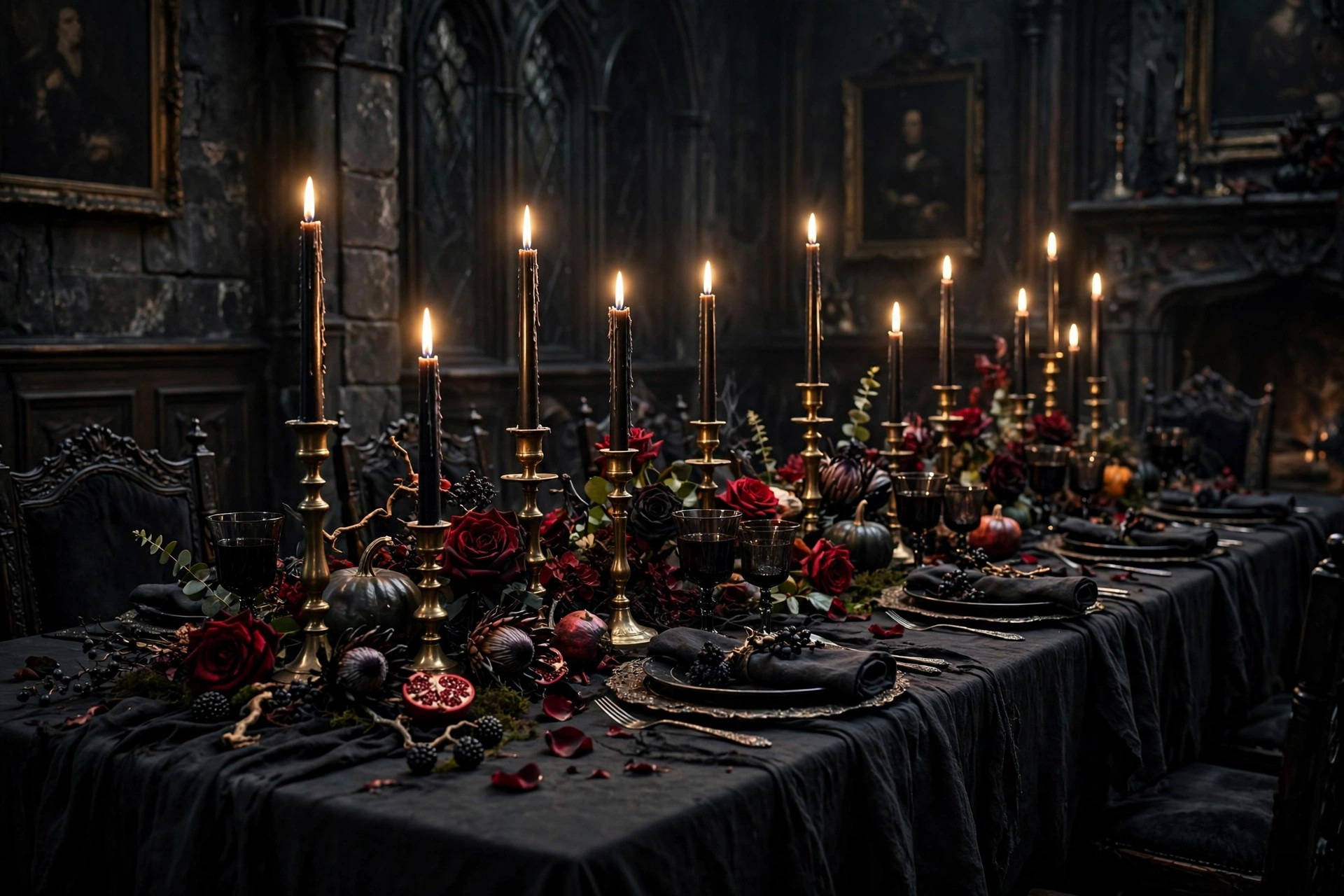
There is Halloween decorating, and then there is a gothic Halloween tablescape — the kind of dinner table that makes your guests stop in the doorway and reach for their phones before they even sit down. Think black velvet runners, tall taper candles dripping with wax, deep burgundy roses, and vintage brass candlesticks catching the candlelight. It is dramatic, it is romantic, and when it is done well, it feels far more like an elegant dinner party than a haunted house.
The gothic tablescape has become one of the most loved Halloween hosting looks of recent years, and it is easy to see why. Unlike cartoonish decorations — plastic skeletons, orange everything — the gothic style is timeless. Black, deep red, antique gold, and candlelight never look cheap, and they photograph beautifully. It works for an intimate dinner for four just as well as a full dinner party for twelve, and you can scale it from thrifted and budget-friendly to genuinely luxurious depending on what you already own.
This guide walks you through building the look from the ground up: the colour palette that keeps it moody but tasteful, the layers that give the table its richness, the candles and lighting that create the atmosphere, a centrepiece your guests will remember, place settings with real drama, and the budget-friendly tricks that make the whole thing affordable. By the end, you will have everything you need to host a Halloween dinner party that feels like a scene from a beautifully dark novel.
Setting the Mood: The Gothic Colour Palette

Every great tablescape starts with a colour story, and the gothic palette is one of the simplest to get right. Your foundation is black — black linens, black candles, black dinnerware if you have it. Black does the heavy lifting in this look: it makes everything else on the table feel more dramatic and intentional. But a table that is only black can feel flat and a little severe, so the magic comes from what you layer on top of it.
Your accent colours should stay in the deep, moody family. Burgundy, oxblood, and deep plum bring richness without breaking the spell. Antique gold and aged brass add warmth and a sense of history — this is why brass candlesticks and gold flatware work so beautifully in a gothic tablescape. Ivory and cream candles provide contrast against all that darkness and keep the table from feeling like a void. A touch of dark greenery — eucalyptus, ruscus, or even foraged branches — stops the look from feeling too one-note.
What to avoid: bright orange, neon purple, and anything that glows in the dark. Those colours belong to a different kind of Halloween party — the fun, playful one — and they will instantly cheapen a gothic table. Stick to your palette with discipline and the result will look cohesive and expensive, even if most of it came from a thrift store. If you want one rule to remember, it is this: when in doubt, choose the darker, moodier version of whatever you are considering.
The Foundation: Linens, Runners, and Layers
The secret to a tablescape that looks lush rather than sparse is layering, and it starts with your linens. Begin with a full-length tablecloth in black — a matte cotton or linen looks far more elegant than anything shiny or plastic. Over that, lay a runner down the centre of the table. This is where texture matters: a black velvet runner, a strip of dark lace, or even a length of cheesecloth in black or deep grey adds instant gothic romance. Cheesecloth is a brilliant budget trick — a few metres cost very little, and when loosely draped it creates that misty, cobweb-adjacent texture without looking like a costume-shop cobweb.
If you do not own a black tablecloth, do not rush to buy one. A dark bedsheet, a black shower curtain liner (matte, not shiny), or even black craft paper can stand in for a night. The candles and centrepiece will draw the eye, and nobody will be inspecting your tablecloth fabric up close. What matters is the overall impression of darkness and depth.
Consider layering a second, narrower runner on top of the first — perhaps deep burgundy over black, or black lace over a dark grey base. Two runners slightly offset from each other create visual richness that a single flat layer cannot. Finish the foundation with your placemats or chargers if you are using them, and step back to look at the table before adding anything else. The layered base should already feel moody and inviting on its own.
Candles, Lighting, and Atmosphere
If the gothic tablescape has a soul, it is candlelight. Nothing else creates that flickering, shadow-dancing atmosphere — not string lights, not lamps, not overhead fixtures. Plan to use far more candles than you think you need. A good rule of thumb: if you think you have enough candles, add six more. Clusters of candles at different heights look infinitely better than a few lonely singles spaced evenly apart.
Vary your candle types for the richest effect. Tall taper candles in brass or black holders give height and drama. Pillar candles of different heights create glowing clusters. Tea lights tucked into small dark glasses or vintage holders fill the gaps and add sparkle at table level. Black candles look striking, ivory candles glow beautifully, and deep red candles add a rich accent — a mix of all three is gorgeous. Battery-operated LED candles have become remarkably convincing and are worth considering if you have children, pets, or simply want to relax; place a few real candles among them and nobody will know the difference.
Lighting the room matters just as much as lighting the table. Turn off the overhead lights entirely and let the candles do the work, perhaps supplemented by a dimmed lamp in a corner of the room. If your dining room has a dimmer switch, use it. The goal is a room that feels like evening even if dinner starts at seven — deep shadows in the corners, warm pools of light on the table. This single decision does more for the gothic mood than any decoration you can buy.
- Taper candles: black or ivory, in brass or matte black holders, for height and drama.
- Pillar candles: clustered in groups of three at different heights.
- Tea lights: scattered generously to fill gaps and add low-level glow.
- LED candles: mix in for safety near edges, children, or flowing sleeves.
One practical note: keep candles away from anything flammable, including dried florals, cheesecloth runners, and long hair. Assign someone — or set a phone reminder — to check the candles every half hour during the party. Atmosphere is wonderful; a fire is not.
A Darkly Beautiful Centrepiece
The centrepiece is the heart of your tablescape, and in the gothic style it should feel abundant and slightly wild rather than neat and symmetrical. Start with your vessel: a vintage brass bowl, a black urn, an antique-looking vase, or even a hollowed-out pumpkin painted matte black. Thrift stores are full of brass and dark ceramic pieces that look made for this.
For the florals, go dark and moody. Deep red roses, black dahlias, burgundy ranunculus, and dark calla lilies are the classics. Mix in dark foliage — black-tinted eucalyptus, deep green ruscus, or branches with dark berries. If fresh dark flowers are hard to find or too expensive, dried flowers are your friend: dried roses darken beautifully, dried grasses add height, and dried lunaria (honesty) has an ethereal, moonlit quality that suits the gothic mood perfectly. A few faux black roses mixed into real greenery can also work well and cost very little.
Do not feel limited to flowers. A gothic centrepiece can include black feathers tucked among the blooms, small vintage books stacked as a base, antique keys, or a small skull tastefully placed — one, not a pile. The trick is restraint: choose two or three non-floral elements at most. And keep the centrepiece low enough that guests can see each other across the table, or use tall, narrow arrangements at the very ends of a long table where they will not block conversation. A beautiful table that prevents people talking to each other is a failed table.
Place Settings with Real Drama

Individual place settings are where the gothic tablescape becomes personal — each guest gets their own little moment of drama. Start with a charger or a dark dinner plate as the base. Black plates are ideal, but dark grey, deep brown, or even plain white plates can work if the rest of the table is dark enough; white plates actually pop beautifully against black linens. Layer a smaller salad plate on top if you like the formal, layered look.
Napkins are an easy win. Deep burgundy, black, or dark plum napkins — cloth if you have them, good-quality paper if you do not — folded simply or tied with black ribbon. Tuck a small sprig of dried flowers, a sprig of rosemary, or a single dark feather into each napkin for a personal touch that costs almost nothing. A handwritten place card on black cardstock with gold or silver pen elevates the whole setting and makes guests feel genuinely welcomed.
Flatware is the jewellery of the table. Gold flatware against black plates is the classic gothic-luxe combination, and affordable gold-tone sets are widely available. If you only own silver, that works too — silver reads as moonlit and mysterious against the dark table. Black flatware exists and looks striking, though it can be harder to find. Whatever you use, polish it; candlelight on dull flatware is a missed opportunity.
For glassware, consider dark-tinted glasses if you can find them — deep red or smoked grey wine glasses are stunning. If not, clear glasses are perfectly fine; the candlelight will make them glow. A small favour at each place — a dark chocolate, a tiny bottle of something, a handwritten note — turns the place setting into a gift and gives guests something to remember the night by.
Budget-Friendly Ways to Get the Look
A gothic Halloween tablescape looks expensive, but it absolutely does not have to be. In fact, some of the best gothic tables are built almost entirely from thrifted and foraged finds, because the style rewards age, patina, and imperfection. Here are the most effective ways to keep costs down:
- Thrift the vessels first. Brass candlesticks, dark vases, vintage bowls, and ornate frames are thrift-store staples. Go a few weeks before Halloween, when the seasonal aisle is full and the regular shelves still hold year-round treasures.
- Forage your greenery. Branches, dried grasses, seed heads, and dark berries can be gathered from gardens, parks, and roadsides for free. A bundle of bare branches spray-painted matte black makes a stunning, zero-cost centrepiece base.
- Buy candles in bulk. Packs of black or ivory taper candles and tea lights are far cheaper per candle than buying singles. You need more candles than you think, so bulk buying matters.
- Use what you own. Dark books as risers, a black scarf as a runner, existing glassware — shop your home before you shop the store. The gothic look is about mood, not matching sets.
- Spray paint is magic. A can of matte black spray paint transforms thrifted pumpkins, old candlesticks, plastic skulls, and mismatched vases into a cohesive collection. One can goes a long way.
- Go dried over fresh. Dried flowers and grasses cost less than fresh dark blooms, last for years, and suit the gothic aesthetic perfectly. Buy once, reuse every Halloween.
Set yourself a budget before you start — even a loose one — and spend it on the things that create the most atmosphere per pound: candles first, then the runner, then florals. Everything else can be borrowed, thrifted, or made. A £30 gothic table with fifty candles will always out-dramatise a £200 table with five.
Small Details That Make Guests Gasp
Once the big elements are in place, it is the small, unexpected details that take a gothic tablescape from pretty to unforgettable. Scatter a few loose rose petals — fresh or dried — down the centre of the table. Place antique-looking keys or small vintage bottles among the candles. Write a short, atmospheric quote on black cardstock and lean it against the centrepiece, or tuck tiny scrolls of poetry into napkins.
Scent is an underused tool. A subtly scented candle — smoked wood, amber, black cherry, or fig — adds an invisible layer of atmosphere. Keep it subtle; you want a whisper of scent, not a perfume counter, especially with food on the way. Music matters too: a playlist of dark classical, haunting piano, or cinematic strings playing quietly in the background completes the mood before a single guest sits down.
Consider the arrival moment. Greet guests at the door with the room already candlelit, the music already playing, and the table already glowing. First impressions are everything — if the first thing they see is the full dramatic effect, the night starts with a gasp. And do not forget to take photos early in the evening, while the candles are fresh and the table is untouched. You will want to remember this one.
A gothic Halloween tablescape is really about one thing: making an ordinary dinner feel like an occasion. The black linens, the candlelight, the dark florals — they are all just tools for telling your guests that tonight is special, that you thought about them, that this meal matters. So light the candles, pour the wine, and enjoy the most dramatic dinner party of your year. Your guests will be talking about it long after the last candle burns down.
Leave a Reply