Last updated: October 2026
Quick answer: Homemade apple cider is fresh, unfiltered apple juice made by simmering or pressing a blend of sweet and tart apples with whole spices. A stovetop batch takes about two and a half hours, the slow-cooker version needs almost no attention, and none of the five recipes calls for specialist equipment.
Few things capture autumn in a mug quite like homemade apple cider. It is sweet, gently spiced, endlessly comforting — and far easier to make than most people realise. Whether you simmer it slowly on the hob, let a slow cooker do the work while you get on with your day, or press it fresh and serve it cold, homemade cider tastes nothing like the shelf-stable cartons from the supermarket.
Before we begin, a quick note on terms: in American usage, “apple cider” usually means fresh, unfiltered apple juice — cloudy, fragrant, and full of flavour — while “apple juice” is the filtered, clear, shelf-stable version. All five recipes below start from fresh apples or fresh unfiltered cider, and each one brings its own character. Let us get simmering.
How do you choose the best apples for homemade cider?
Blending sweet and tart apple varieties gives cider depth that a single variety cannot match. Aim for roughly two parts sweet apples to one part tart, choose firm and unblemished fruit, wash it well, and allow about three to four kilograms of apples per two-litre batch.
Great cider starts with great apples — and the secret is blending varieties. A mix of sweet and tart apples gives your cider depth and balance that a single variety cannot match. Aim for roughly two parts sweet to one part tart.
- Sweet varieties to try: Gala, Fuji, Honeycrisp, Golden Delicious, or Red Delicious. These bring the honeyed, mellow sweetness that makes cider so drinkable.
- Tart varieties to try: Granny Smith, Braeburn, Jonathan, or Pink Lady. These add brightness and that mouth-watering tang that keeps cider from tasting flat.
If you are buying from a farmers’ market, ask the grower which varieties they recommend for cider — they love this question and will rarely steer you wrong. For the five recipes below, you will need roughly 3 to 4 kilograms (about 7 to 9 pounds) of apples per batch, which makes around 2 litres of finished cider. Choose firm, unblemished fruit, and give them a good wash.
What equipment do you need to make cider at home?
You do not need specialist equipment for cider-making. A large stockpot or slow cooker, a sharp knife, a fine sieve or muslin for straining, a ladle, a potato masher and clean glass bottles for storage cover almost every recipe in this guide.
- A large stockpot or a slow cooker
- A sharp knife and chopping board
- A fine-mesh sieve or a few layers of muslin (cheesecloth)
- A wooden spoon and a ladle
- A potato masher (helpful but not essential)
- Clean glass bottles or jars with lids for storing
- For the cold-pressed recipe: a juicer or a blender plus muslin for straining
Whole spices — cinnamon sticks, whole cloves, star anise — give a cleaner, more rounded flavour than ground spices, which can make cider taste muddy. Buy them whole if you can.
| Method | Total time | Hands-on time | Flavour | Best for |
|---|---|---|---|---|
| Classic stovetop | About 2.5 hours | About 30 minutes | Rich, warmly spiced | A cosy weekend project |
| Slow cooker | 8 to 9 hours | About 15 minutes | Deep, mellow | Parties and busy days |
| Cold-pressed | 30 to 45 minutes | 30 to 45 minutes | Bright, pure apple | Tasting the apples themselves |
| Orange and cranberry | About 2.5 hours | About 30 minutes | Citrusy, jewel-toned, tart | Autumn gatherings |
| Caramel | 20 minutes (plus cider) | 20 minutes | Rich, buttery, dessert-like | Cold evenings and guests |
How do you make classic hot spiced cider on the stove?
This is the simplest place to start: quartered apples simmered with cinnamon, cloves, star anise and orange for about two hours, then mashed, simmered a little longer and strained. It makes around two litres of fragrant, gently spiced cider that tastes nothing like the carton kind.

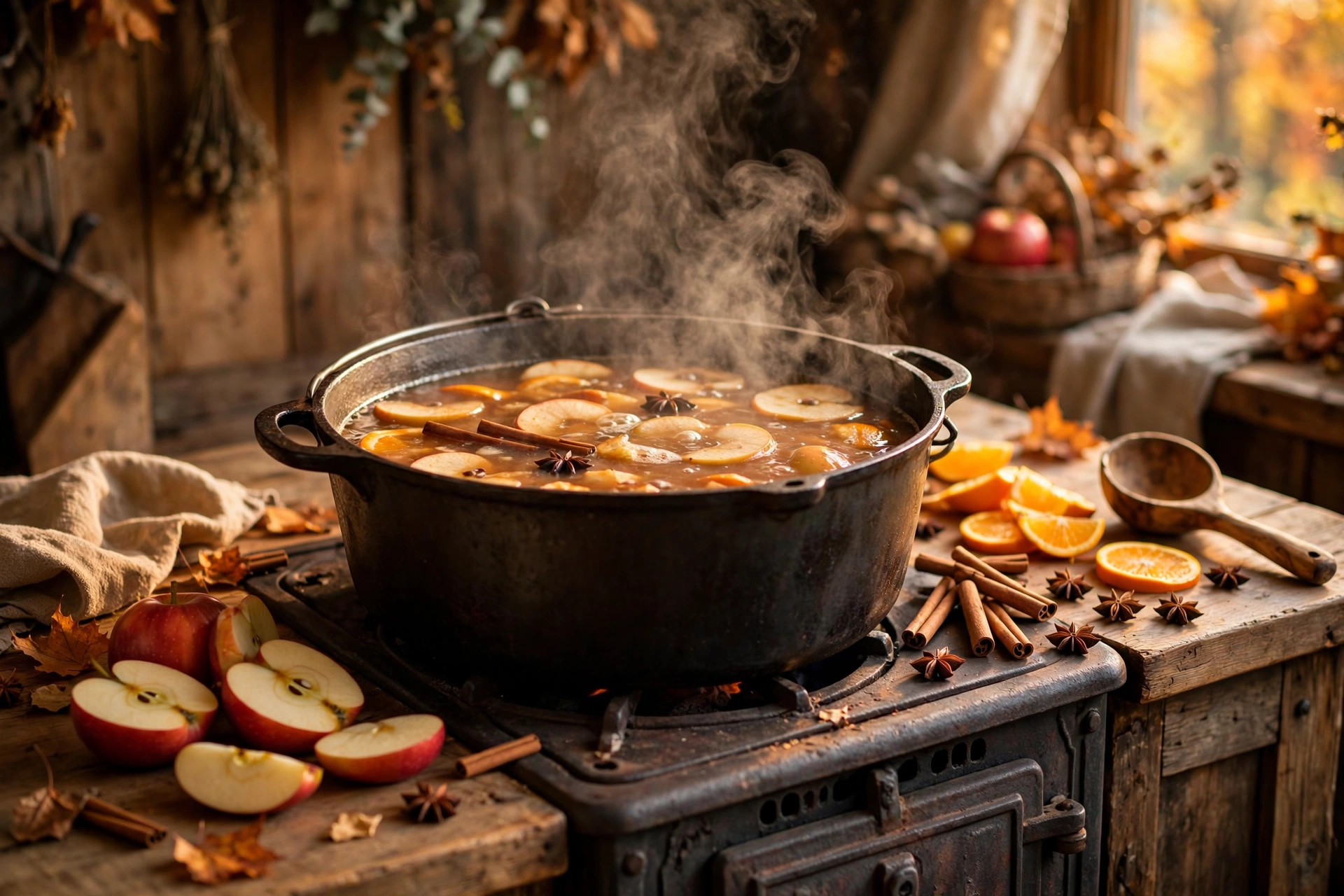
This is the one everyone pictures: a steaming pot of fragrant cider on the hob, the whole house smelling of cinnamon and cloves. It is the simplest place to start and the recipe you will return to all season.
You will need: 3 kg mixed apples (sweet and tart), 2 litres water, 3 cinnamon sticks, 1 teaspoon whole cloves, 2 star anise, 1 orange (sliced), 2 to 3 tablespoons brown sugar or honey (to taste).
Method:
- Quarter the apples (no need to peel or core — just remove any damaged bits) and place them in your largest stockpot.
- Add the water — it should just barely cover the apples. Add more if needed.
- Stir in the cinnamon sticks, cloves, star anise, and orange slices.
- Bring to a boil over high heat, then reduce to a gentle simmer. Cover and cook for 1.5 to 2 hours, until the apples are completely soft and falling apart.
- Mash the apples with a potato masher right in the pot to release every last drop of juice, then simmer uncovered for 30 more minutes.
- Strain through a fine-mesh sieve lined with muslin into a clean pot or jug, pressing the pulp firmly. Taste and stir in brown sugar or honey until it suits you.
Serve hot in mugs with a cinnamon stick for stirring. Time: about 2.5 hours, mostly hands-off. Makes: about 2 litres.
Can you make apple cider in a slow cooker?
Yes, and it is the easiest hands-off method of all. Load apples, water, spices and orange into the slow cooker in the morning, cook on low for seven to eight hours, mash, strain and sweeten. Your house will smell wonderful all day.
Perfect for busy days and gatherings: load it in the morning, and come home (or welcome guests) to a house that smells like an autumn candle in the best possible way.
You will need: 3 kg mixed apples, 2 litres water, 3 cinnamon sticks, 1 teaspoon whole cloves, 2 star anise, 1 tablespoon whole allspice berries (optional), 1 orange (sliced), brown sugar or honey to taste.
Method:
- Quarter the apples and place them in the slow cooker with the water and all the spices and orange slices.
- Cook on low for 7 to 8 hours (or on high for 3.5 to 4 hours), until the apples are completely soft.
- Mash the apples in the cooker, then cook for 1 more hour on low.
- Strain through a muslin-lined sieve, sweeten to taste, and serve.
For parties, leave the finished cider in the slow cooker on the “warm” setting with a ladle beside it — guests can help themselves all evening. Time: 8 to 9 hours, almost entirely hands-off. Makes: about 2 litres.
How do you make fresh cold-pressed cider without heat?
For pure, bright apple flavour with no spice at all, press or blend crisp apples and strain the juice through muslin. A squeeze of lemon slows browning. Serve over ice within a couple of days, because fresh unheated cider is at its best when it is very fresh.
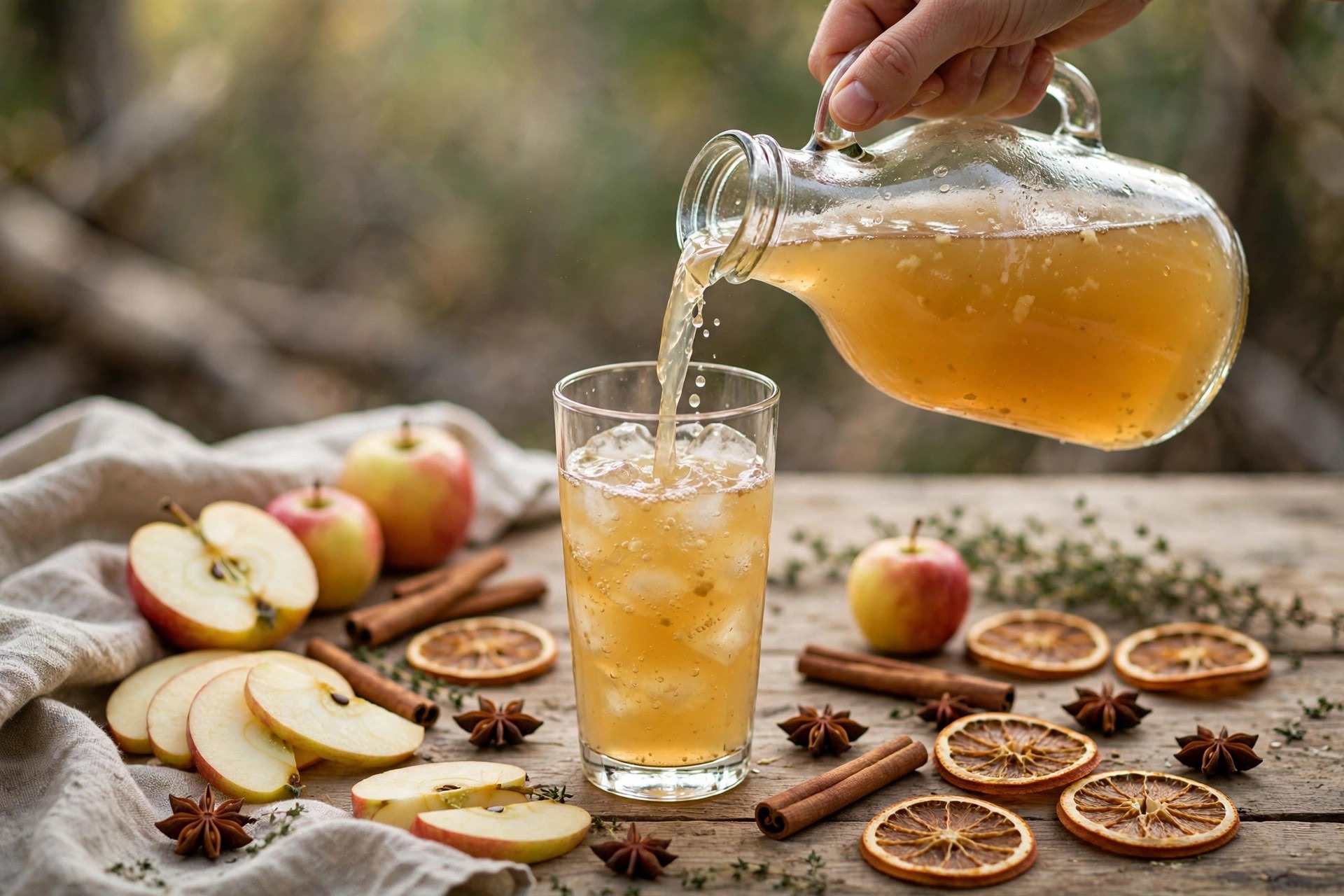
Sometimes you want cider’s pure apple flavour without any spice at all — bright, crisp, and refreshing. This is the simplest recipe here, and a wonderful way to taste the difference that fresh apples make. It is no coincidence that fresh apples juice so well: apples are roughly 85% water, according to USDA nutrition data.
You will need: 3 kg crisp, juicy apples (Honeycrisp, Gala, and Granny Smith work beautifully), a squeeze of lemon juice (to slow browning).
Method with a juicer:
- Quarter the apples and feed them through the juicer.
- Stir in a squeeze of lemon juice, chill thoroughly, and serve over ice.
Method with a blender:
- Chop the apples into small chunks and blend with just enough water to get things moving, working in batches.
- Pour the pulp into a muslin-lined sieve set over a large bowl and let it drip for 20 minutes, then gather the muslin and squeeze firmly.
- Chill and serve over ice with thin apple slices.
Fresh cold-pressed cider is best drunk within 2 to 3 days — its flavour is brightest on day one. Time: 30 to 45 minutes. Makes: about 1.5 litres.
How do you make orange and cranberry cider?
This ruby-red variation adds fresh cranberries and orange to the classic simmered method, giving a jewel-toned, citrusy cider that is just tart enough to feel festive. It looks beautiful served in a glass drinks dispenser at autumn gatherings.
This jewel-toned variation is the prettiest cider you will make all year — ruby-red, citrusy, and just tart enough to feel festive. It shines at autumn gatherings and looks beautiful in a glass drinks dispenser.
You will need: 2.5 kg mixed apples, 300 g fresh or frozen cranberries, 2 oranges (one sliced, one juiced), 2 litres water, 2 cinnamon sticks, 4 whole cloves, brown sugar or honey to taste.
Method:
- Combine the quartered apples, cranberries, water, cinnamon, cloves, and orange slices in a large stockpot.
- Bring to a boil, then simmer covered for 1.5 hours until everything is very soft.
- Mash well, simmer 30 minutes more, then strain through muslin, pressing firmly.
- Stir in the fresh orange juice and sweeten to taste — cranberries are tart, so you may want a little more sweetener than usual.
Serve hot, or chill and serve over ice with an orange twist. The colour alone will earn compliments. Time: about 2.5 hours. Makes: about 2 litres.
How do you make caramel apple cider?
The indulgent one: gently warm your homemade spiced cider, whisk in a simple caramel made from butter, brown sugar and cream with vanilla and a pinch of salt, and serve topped with whipped cream. It is dessert and a drink in one.
The indulgent one. This tastes like a toffee apple melted into a mug — rich, buttery, and utterly irresistible on a cold evening. It is a dessert and a drink in one.
You will need: 2 litres of your homemade spiced cider (the classic stovetop recipe works perfectly), 120 ml double cream, 80 g soft brown sugar, 2 tablespoons butter, 1 teaspoon vanilla extract, a pinch of sea salt, whipped cream and extra caramel sauce to serve (optional but encouraged).
Method:
- Warm the cider gently in a large pot over medium-low heat — do not boil it.
- In a separate small pan, melt the butter with the brown sugar, stirring until smooth and bubbling (about 2 minutes).
- Slowly whisk in the double cream until you have a smooth caramel, then stir in the vanilla and salt.
- Pour the caramel into the warm cider and whisk until fully combined. Taste and adjust — more caramel for decadence, a squeeze of lemon if it needs brightness.
Serve in mugs topped with whipped cream and a drizzle of caramel sauce. This one disappears fast, so consider doubling the batch. Time: 20 minutes (plus cider-making time). Makes: about 2 litres.
How long does homemade cider keep?
Cool cider completely before refrigerating it in clean, sealed glass bottles. Simmered ciders keep for seven to ten days in the fridge, while fresh cold-pressed cider is best within three days. All cider freezes well for up to three months.
Homemade cider keeps well if you treat it right. Let it cool completely, then refrigerate in clean, sealed glass bottles or jars. Food-safety wise, the U.S. Food and Drug Administration advises keeping perishable juices refrigerated at 40°F (4°C) or below — so get your cider into the fridge promptly once it has cooled.
| Cider type | In the fridge | In the freezer |
|---|---|---|
| Simmered (classic, slow-cooker, cranberry) | 7 to 10 days | Up to 3 months |
| Cold-pressed (no heat) | Up to 3 days | Up to 3 months |
| Caramel | About a week | Freezing not ideal — cream can split on thawing |
A few serving ideas to make the most of your batch:
- Reheat gently on the hob or in the slow cooker — never boil spiced cider hard, or the spices can turn bitter.
- Garnish mugs with cinnamon sticks, star anise, thin apple slices, or a twist of orange peel.
- For gatherings, serve from a glass drinks dispenser or keep it warm in the slow cooker with a ladle beside it.
- Top the caramel version with whipped cream and a drizzle of caramel sauce just before serving.
Once you have tasted real homemade cider — cloudy, fragrant, tasting of actual apples — the carton kind will never quite satisfy you again. Start with the classic stovetop recipe this weekend, and by the time the leaves are falling in earnest, you will have a house specialty worth sharing. Happy simmering.
Leave a Reply