Last updated: October 2026
Quick answer: Lace makeup recreates the pattern of lace fabric on the skin — either by pressing eyeshadow through real lace held against the eye, or by drawing the pattern freehand. Deep, dark shades like black, espresso and burgundy read best, and the stencil method is the easiest way to start.
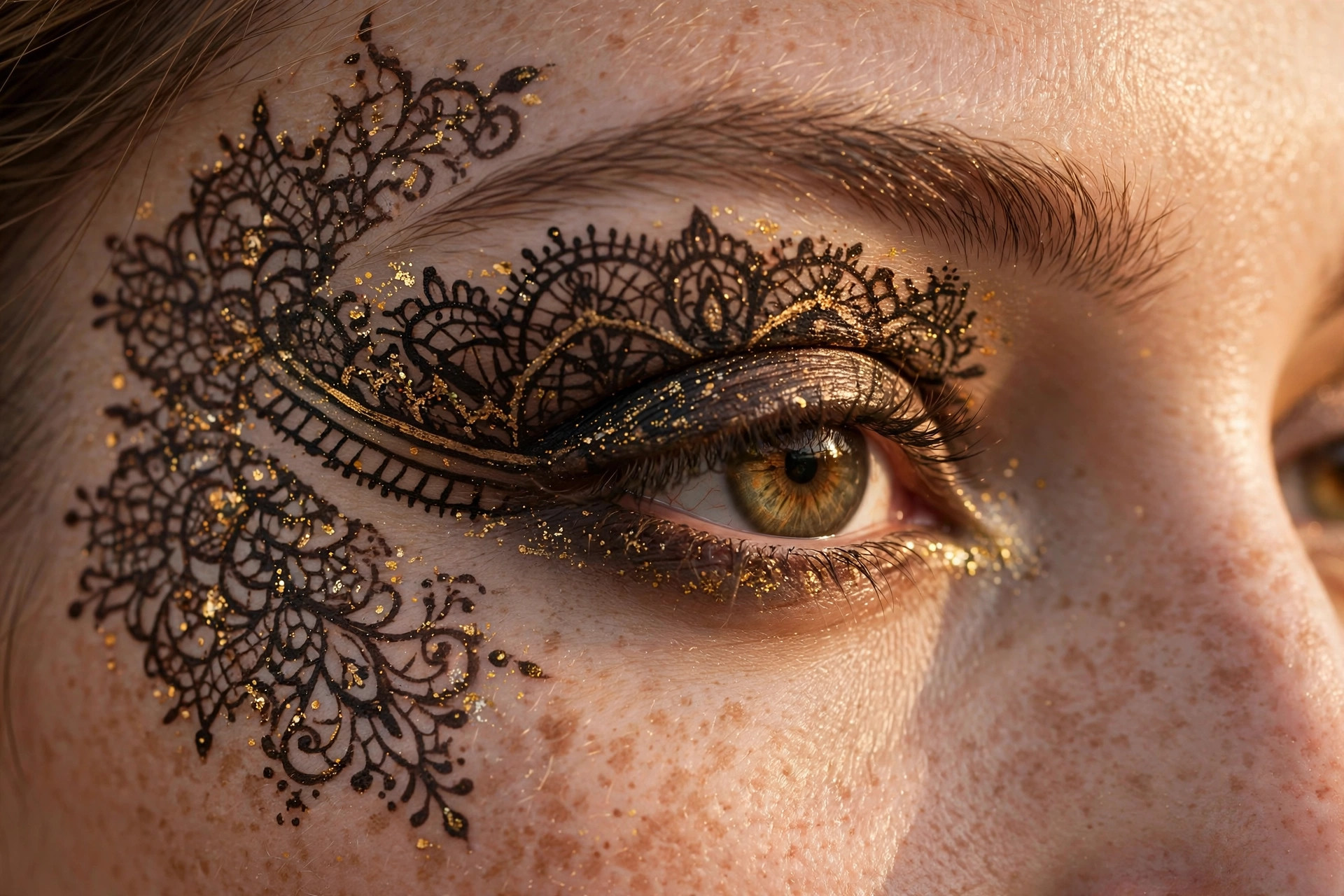
If you have scrolled beauty feeds lately, you may have stopped on the same image twice: a close-up of an eye framed by what looks like delicate black lace. It is not fabric, and it is not a filter. It is makeup — lace makeup — and it is one of the defining beauty trends of this autumn. The idea is simple but striking. Using real lace fabric as a stencil, or drawing the pattern by hand with eyeliner and shadow, you create the effect of lace lying across your eyelids and temples. The result sits somewhere between gothic romance and high fashion: dark, detailed, and surprisingly wearable once you know the tricks.
This guide explains what lace makeup is, why it is perfect for fall, and exactly how to try it yourself — from the easiest beginner method to a full evening look.
What Exactly Is Lace Makeup?
Lace makeup recreates the pattern of lace fabric on the skin, usually on the eyelid, along the outer corner, or sweeping toward the temple. The classic version uses deep, dark shades — black, espresso, oxblood or midnight navy — so the pattern reads clearly, like real black lace against skin.
The trend grew out of runway and editorial beauty, where makeup artists have pressed lace against models’ skin for years to create patterned effects for photo shoots. What changed this year is that everyday creators brought it down to bathroom-mirror level. Beauty creators on social platforms started posting tutorials using scraps of lace from craft shops and old curtains, and the looks spread fast across beauty feeds.
It helps that the trend fits the wider mood of autumn beauty. This is the season of dark romance in makeup: smoky kohl eyes, deep berry and cherry lips, moody jewel tones. Lace makeup is the most artistic expression of that mood, built on the same feeling — a little drama, a little nostalgia, and a lot of texture. And there is a pleasing lineage to it: lace itself has been made by hand in Europe since the 16th century, with needle lace and bobbin lace as the two great traditions (Encyclopaedia Britannica). Before 1800, lace threads were usually linen; after 1800, cotton became more common — a small reminder that the fabric you are stencilling with has centuries of craft behind it.
Why Is Lace Makeup Perfect for Fall?
Lace makeup suits autumn perfectly: darker shades sit naturally on the eye when the sun is not blazing, the look photographs beautifully in low warm light like candlelight, and it pairs naturally with the season’s wardrobe of turtlenecks, velvet, leather and dark florals. It also scales from subtle to dramatic.
Some trends fight the season. This one was made for it. Fall is when makeup gets richer: the light gets lower, evenings get longer, and the events on the calendar — dinner parties, weddings, Halloween, the whole holiday run-up — call for looks with more presence than a summer tinted moisturiser. Lace makeup suits fall for a few practical reasons:
- Darker shades feel natural. Deep browns and blacks that can look heavy in July look exactly right in October, when the light is lower and softer.
- It loves warm light. The look photographs beautifully in candlelight, string lights and golden-hour sunsets — exactly the light fall gives you.
- It matches the wardrobe. Turtlenecks, velvet, leather and dark florals all sit comfortably next to a lace-patterned eye.
- It scales to the occasion. A full lace mask sweeping to the temples is a statement for a night out; a small lace motif just at the outer corner is subtle enough for dinner with friends. You choose the intensity.
Which Method Should You Choose: Stencil or Freehand?
There are two routes to lace makeup: the stencil method, where you press shadow through real lace fabric for a beginner-friendly result, and the freehand method, where you draw the pattern by hand for complete control. Start with the stencil — it is faster, more forgiving and reliably pretty.
Understanding both helps you pick the right starting point. Here is how they compare:
| The Lace Stencil Method | The Freehand Method | |
|---|---|---|
| How it works | Hold real lace fabric against the skin and apply eyeshadow over it, so the pattern transfers through the open weave | Draw lace-like swirls, dots and scalloped edges directly on the skin with liquid eyeliner, gel liner or a fine brush |
| Skill level | Beginner-friendly — the fabric does the hard work of drawing the pattern | Needs practice and a steady hand |
| Result | Impressively detailed even if your hand is not steady, which is why it dominates the viral tutorials | Complete control — you can echo an actual piece of lace you own or invent your own pattern |
| Best for | First attempts and reliably pretty results | Truly spectacular editorial looks and custom designs |
If this is your first time, start with the stencil method. It is faster, more forgiving, and the results are reliably pretty. The step-by-step section later in this article walks you through it in full.
How Do You Do the Lace Stencil Method?
The lace stencil method needs only inexpensive supplies: a piece of open-weave lace, a matte dark eyeshadow, a flat dense brush, eye primer and setting spray. Hold the lace against primed lids, pat the shadow through the weave, build up slowly, then lift the lace and clean up the edges.
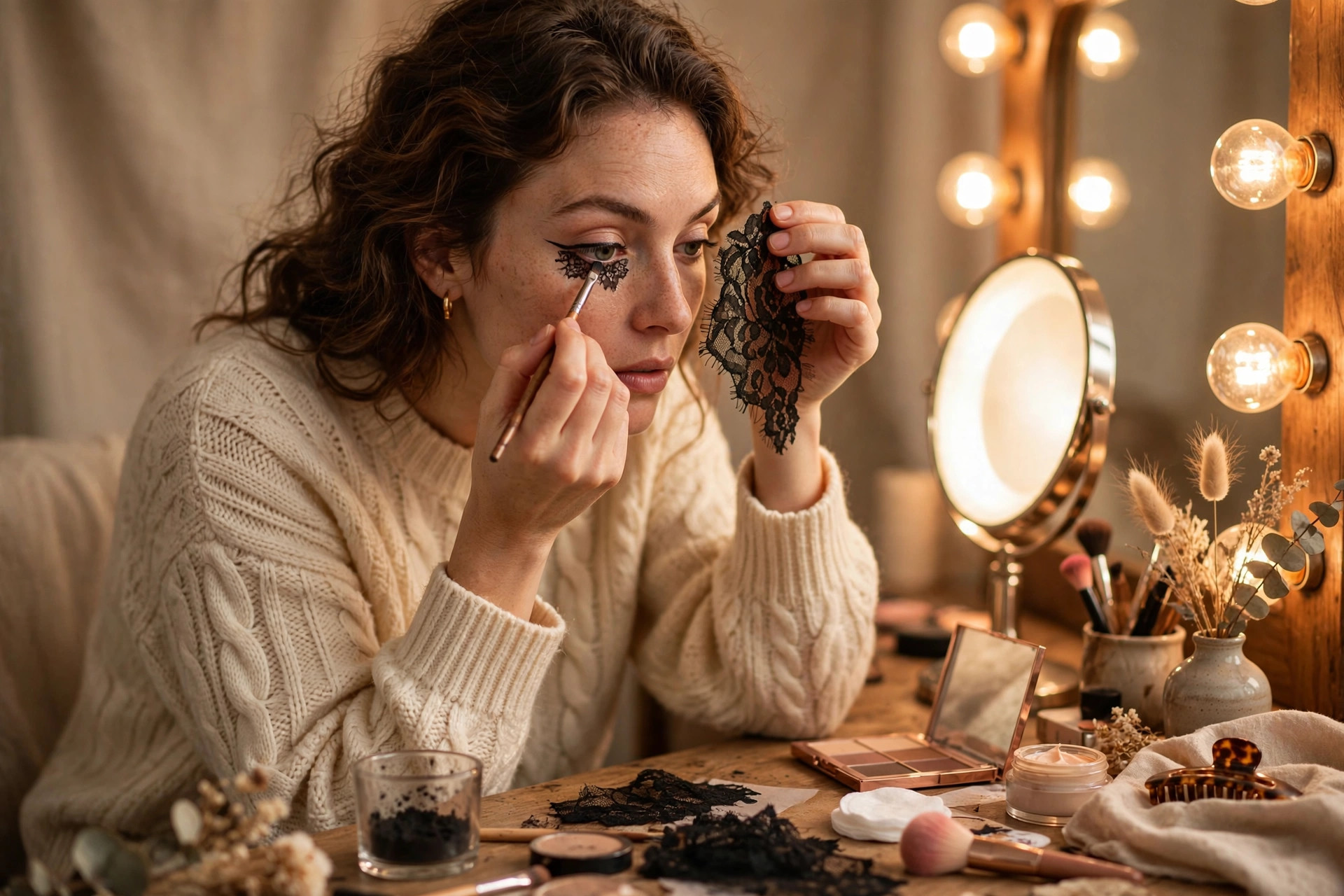
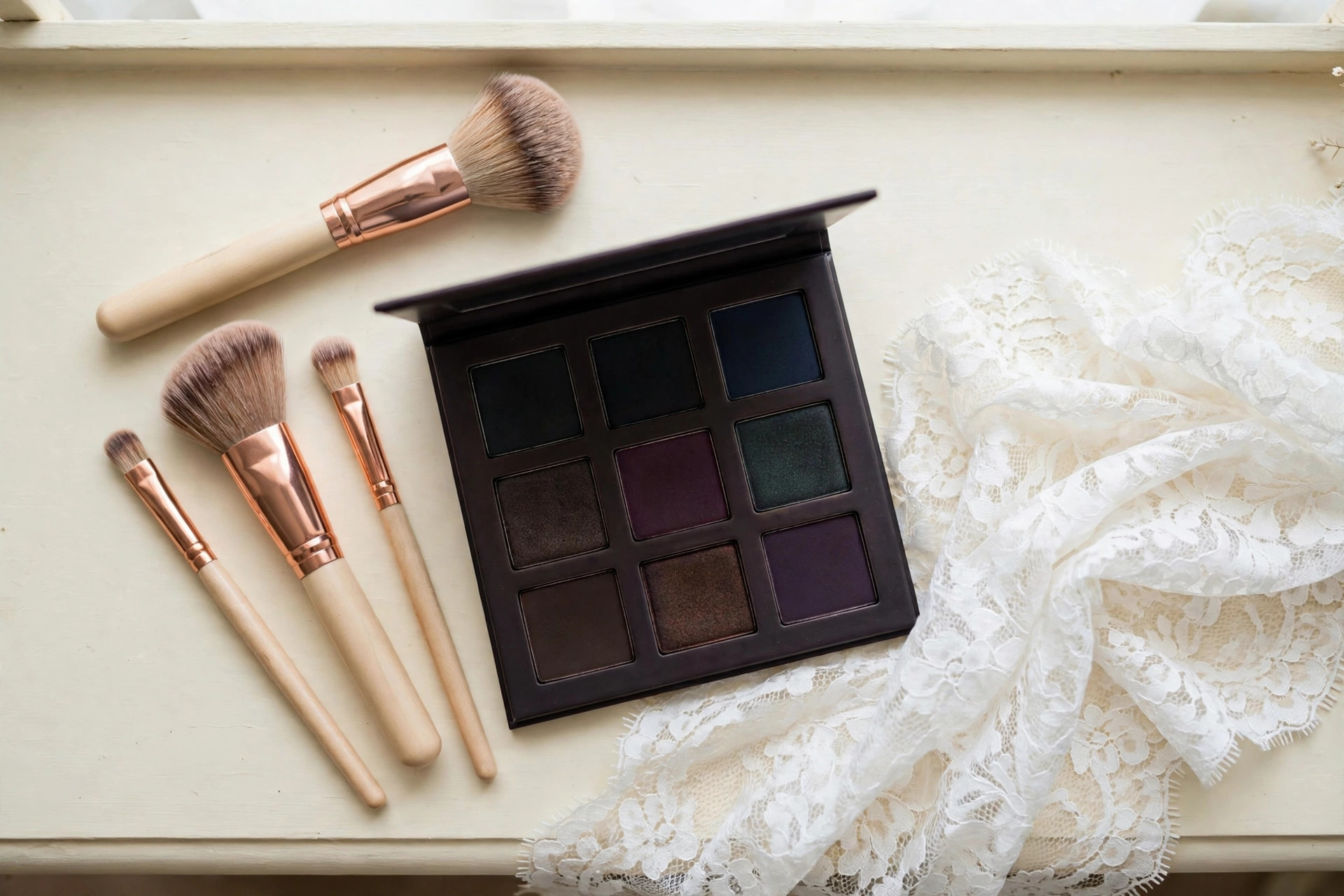
Here is everything you need, and none of it is expensive. A small piece of lace fabric with an open, clearly defined pattern — craft shops sell lace trim inexpensively, and old lace curtains or a lace top you no longer wear work just as well. Choose a pattern with distinct shapes rather than a dense blur; you want the design to read clearly. You will also need a matte dark eyeshadow (black, deep brown, or oxblood), a flat dense brush or a small makeup sponge, your usual eye primer, and a setting spray.
- Start with primed lids. Eye primer matters here more than usual because you are layering product through a stencil, and you need it to grip. Apply your normal base makeup first, but leave the eye area for the lace step.
- Position the lace. Hold the lace gently but firmly against your eyelid and temple, stretching it smooth so the pattern lies flat.
- Pat, do not sweep. Pat the eyeshadow through the lace with the flat brush. Patting keeps the pattern sharp; sweeping smudges it.
- Peek before lifting. Lift one corner of the lace and peek before removing it fully. If the pattern is too faint, lay the lace back down and add another layer. It is much easier to build up than to fix an overdone first pass.
- Clean up and set. Lift the lace straight away, clean any stray marks around the edges with a cotton bud dipped in micellar water, and mist everything with setting spray.
Expect your first try to take about twenty minutes and look slightly imperfect. That is normal. The charm of lace makeup is partly in its handmade feel — real lace has tiny irregularities too. In our experience, by the third attempt, most people can do it in ten minutes.
Can You Wear Lace Makeup in the Daytime?
Yes — soften everything for daytime. Swap black shadow for taupe, soft bronze or dusty rose, apply one sheer layer instead of two or three, and keep the pattern to the outer third of the eye. Skip heavy liner elsewhere so the lace stays the star.
The full dark-lace look is an evening look. But the technique works beautifully in softer colours for daytime, and this is the version most people will actually wear week to week:
- Go sheer and soft. Swap the black shadow for a medium taupe, soft bronze, or dusty rose, and apply it more sheerly — one light layer instead of two or three. The pattern becomes a whisper rather than a statement.
- Keep it to the outer corner. Do your normal neutral eye makeup — a wash of matte shadow, a little liner, mascara — and add the lace motif just at the outer corner, like an accent. It reads as interesting rather than dramatic, and takes about three extra minutes.
- Let the lace lead. For either daytime version, skip heavy liner elsewhere on the eye. A strong winged liner plus a lace pattern is a lot of competing detail. Let one element lead.
Which Colours Work Best for Fall Lace Makeup?
Colour choice changes the whole mood: black over a warm brown base gives classic fall drama, espresso softens it, burgundy and oxblood bring dark romance, antique gold feels festive, midnight navy adds depth, and deep plum sits in between. Whatever you choose, keep the finish matte.
- Espresso brown: softer than black, flattering on warm skin tones, and easier to wear in daylight.
- Oxblood and burgundy: the dark-romance shades of the season. Burgundy lace over a neutral lid is stunning with the season’s wine-coloured clothing.
- Antique gold: for a festive, almost jewellery-like effect. Gold lace patterning over deep brown is beautiful for evening events and the holiday season ahead.
- Midnight navy: reads as black from a distance but has more depth up close. Lovely on cool skin tones.
- Deep plum: sits between brown and burgundy; a good middle ground if black feels too harsh.
Whatever colour you choose, keep the finish matte. Shimmer and glitter blur the edges of the pattern, and sharp edges are the whole point. Save the shimmer for the inner corner of the eye, where a small highlight makes the lace pattern pop by contrast.
Step by Step: A Wearable Lace Eye Look for a Night Out
This complete evening routine takes the stencil method and builds it into a finished look in about thirty minutes: prime, lay a warm base shade, stamp the pattern from the outer corner inward, refine the edges, ground it with liner and mascara, highlight the inner corner, and set with spray.
Here is a complete routine that takes the stencil method and turns it into a finished evening look. Allow thirty minutes the first time; it gets faster.
- Prep the eye. Apply eye primer from lash line to brow bone. Set it with a translucent powder so the lace lies smoothly.
- Lay a base shade. Sweep a warm matte brown a shade or two deeper than your skin tone across the lid and into the crease. This gives the lace pattern something to sit on.
- Position the lace. Cut a piece of lace roughly 8 to 10 centimetres square. Hold it over the eye so the prettiest part of the pattern sits on the lid, with the edge extending slightly past the outer corner toward the temple.
- Stamp the pattern. Using a flat brush, pat your dark shade through the lace. Start at the outer corner where you want the most intensity, and fade toward the inner corner. Two light layers beat one heavy one.
- Remove and refine. Lift the lace, then use a small clean brush to soften any harsh edges where the pattern ends. Clean up fallout under the eye with micellar water on a cotton bud.
- Define the lashes. Tightline the upper waterline with black or dark brown liner — this grounds the look — and add two coats of mascara. False lashes are optional but lovely with this look; choose a wispy style rather than a heavy one.
- Highlight the inner corner. A dab of champagne shimmer at the inner corner opens the eye and makes the dark lace beside it look intentional rather than heavy.
- Set it. Mist with setting spray and let it dry before you touch your face. The pattern will last all evening.
Keep the rest of your makeup balanced: this is a strong eye, so pair it with a neutral lip and soft blush. A nude lip and groomed brows let the lace do the talking. If you are building a whole look around it, simple nude nails keep the attention on your eyes — our guide to classy acrylic nail designs has plenty of quiet, elegant options that will not compete with the eye makeup.
What Are the Most Common Lace Makeup Mistakes?
Most lace makeup failures come from five fixable errors: lace with too fine a pattern, pressing the brush too hard, skipping primer, extending the pattern too far down the cheek, or heavy makeup everywhere else. Light patting, good primer and balanced styling solve nearly all of them.
| Mistake | Why it happens | How to fix it |
|---|---|---|
| Choosing lace with too fine a pattern | Very delicate lace with tiny holes transfers as a grey smudge rather than a pattern | Pick lace with clear, open shapes at least a few millimetres across |
| Pressing too hard | Mashing the brush into the lace pushes shadow under the fabric and blurs the design | Light, patting motions give the sharpest result |
| Skipping primer | Without primer, the pattern fades within an hour and migrates into the crease | Primer is not optional for this look — it is the foundation |
| Going too far down the cheek | Extending the pattern far past the temple can look messy rather than artistic | Keep the main pattern on the lid and let only the edge drift toward the temple |
| Pairing it with heavy everything else | Dark lace eyes plus dark lips plus heavy contour is a lot | Balance is what makes the look chic instead of costume-like |
One more caution: if you have sensitive eyes or wear contact lenses, keep loose shadow away from the waterline and avoid getting setting spray directly in the eyes. And as with any eye product used near the eyes, stop and remove everything if you notice redness, itching, or irritation — if it persists, it is worth checking with a pharmacist or dermatologist rather than pushing through.
How Should You Style the Rest of Your Look?
Lace makeup looks best as part of a considered whole: hair pulled back or swept aside to show the temple pattern, textured romantic clothing like velvet, satin and soft knits, and simple nails that do not compete with the eyes.
- Hair: pull it back or sweep it to one side to show off the temple area where the pattern extends — a sleek low bun or a deep side part works beautifully. This is also a lovely moment for a statement hair accessory: a velvet bow or a gold clip echoes the romantic feeling of the lace. Our guide to styling ’90s hair accessories has ideas that pair surprisingly well with this trend.
- Clothing: lean into texture — velvet, lace (of course), satin, and soft knits. The look has a vintage soul, so pieces with a slightly romantic feel, like a slip skirt or a blouse with a high neckline, complement it better than sporty casual wear.
- Keep it balanced: simple nude nails and a neutral lip let the eyes do the talking.
The Bottom Line
Lace makeup earned its moment honestly: artistic enough for a night out, easy enough for a first-timer with a scrap of lace, and soft enough for daytime. Start with the stencil method, pick a dark matte shade, keep everything else simple, and let a little handmade pattern do the talking.
Leave a Reply