Last updated: October 2026
Quick answer: Military jackets are fall 2026’s heritage hero because they combine genuine history with everyday practicality. Start with an olive field jacket, dark jeans, and ankle boots, then dress the same jacket up over dresses or down with cargo trousers.
Some pieces of clothing never really leave us; they simply wait in the wings until the moment is right. The military jacket is one of them. It has marched through fashion history in one form or another for decades — the field jacket borrowed from army surplus, the naval peacoat, the cropped bomber with its brass buttons — and this autumn it has returned as one of the defining heritage trends of the season. Fall 2026 belongs to the military jacket, and honestly, it feels like a homecoming.
What makes this revival different from previous ones is the mood. This is not about camouflage prints or novelty army surplus worn ironically. The fall 2026 take is softer, more polished, and deeply rooted in heritage: beautifully cut field jackets in olive and khaki, double-breasted peacoats with gilt buttons, and cropped military blazers worn over feminine dresses. It is utility meeting elegance, structure meeting ease — a look that feels both timeless and completely current.
This guide is your complete handbook to wearing the trend well: the outfits that work hardest for real life, from everyday jeans pairings to evening looks that turn heads, plus guidance on choosing the right cut, colour, and fabric for your shape and lifestyle.
Why Is the Military Jacket Fall 2026’s Heritage Hero?
The military jacket sits at the centre of fashion’s swing toward heritage because it carries genuine history — garments descended from actual uniforms, refined over decades into civilian classics. It is warm without bulk, full of real pockets, and flattering on almost everyone.
Fashion moves in cycles, and right now the cycle has swung firmly toward heritage. After several seasons of hyper-feminine romanticism and minimalist quiet luxury, the industry has landed on something in between: classic, structured pieces with real history behind them. The military jacket sits at the very centre of that shift because it carries genuine heritage.
On the autumn runways, designers sent out field jackets in washed olive twill, peacoats with oversized brass buttons, and cropped military blazers in midnight wool. But the trend has caught fire far beyond the catwalk. It is the sort of trend that works on a school run, in an office, and on a dinner date, which is precisely why it has staying power. A military jacket does not ask you to become someone else; it simply adds polish and purpose to whoever you already are.
There is also a practical magic to the military jacket that most trends lack. It is genuinely warm without being bulky. The pockets are real pockets — deep, useful, and placed where your hands naturally fall. The fabrics, usually cotton twill, wool, or sturdy canvas, only look better with wear. And the structured shoulders do something wonderful for posture: you stand a little straighter in a military jacket, and that quiet confidence is half the look.
What Is the Everyday Field Jacket Formula?
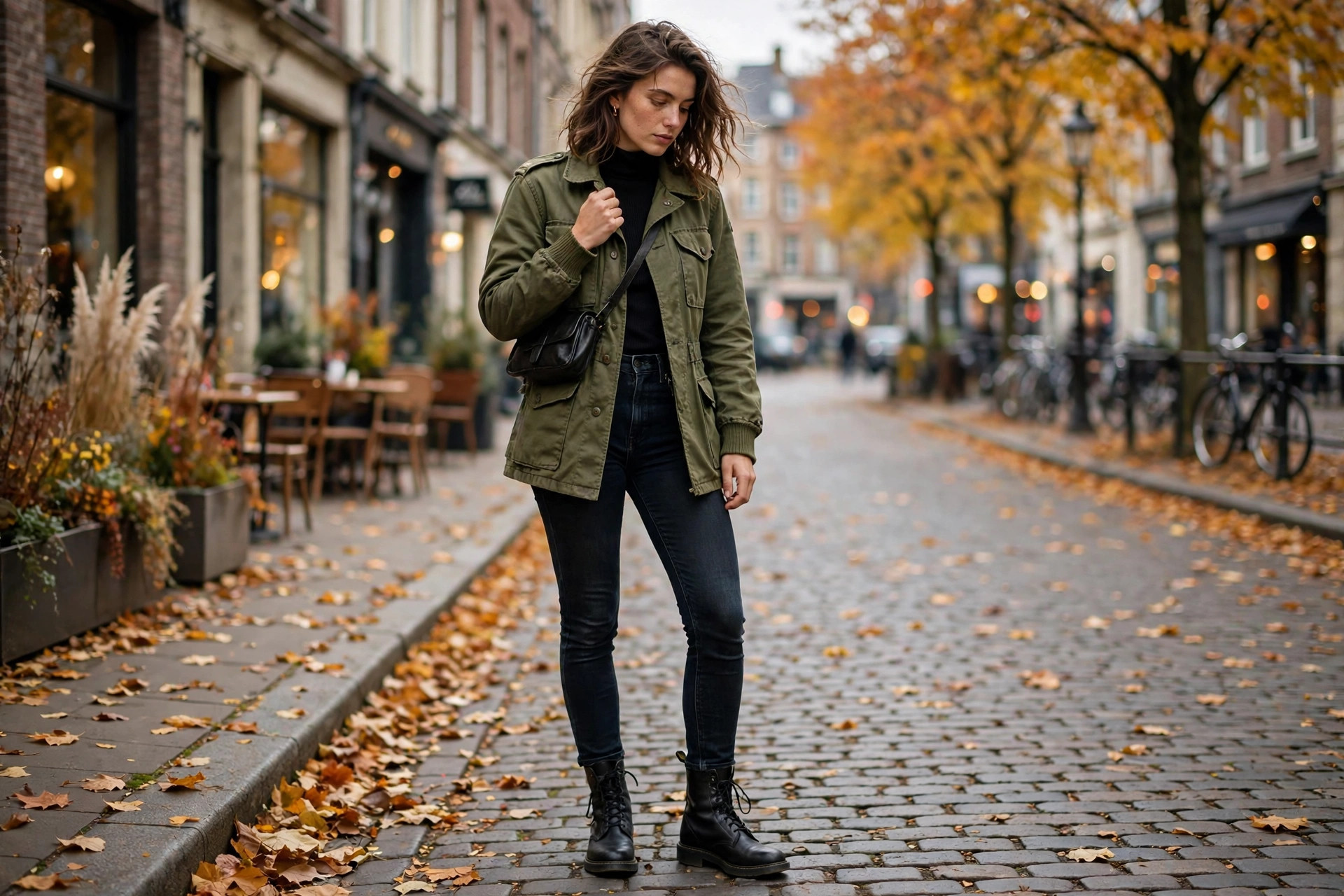
The everyday formula is simple and endlessly adaptable: an olive field jacket hitting at or just below the hip, dark straight-leg jeans, ankle boots, and a soft knit underneath. The jacket brings polish, the jeans keep it grounded, and the boots tie it to the season.
If you buy one military jacket this autumn, make it the classic olive field jacket, and if you wear one outfit on repeat, make it this. This combination is the beating heart of the trend because it balances structure and ease so perfectly.
The details are what lift it from ordinary to excellent:
- Length: choose a field jacket that hits at or just below the hip — long enough to cover a belt, short enough not to swamp your frame.
- Heritage details: flap pockets on the chest, a storm flap over the buttons or zip, epaulettes at the shoulders. These signatures separate a real military-inspired jacket from a generic green coat.
- Softness underneath: a cream cable-knit jumper, a Breton stripe top, or a plain charcoal crew neck. The contrast between something soft and cosy and the crisp structure of the jacket is the whole point.
- Footwear: suede ankle boots in tan or chocolate are the classic pairing, but chunky loafers or even clean white trainers give the look a more relaxed, contemporary edge.
This formula adapts endlessly. Swap the jeans for black cigarette trousers and you are smart enough for a casual office. Swap the knit for a silk shirt and you are ready for lunch with friends. The field jacket is that rare garment that elevates everything it touches without ever looking like it is trying too hard.
How Do I Dress a Military Jacket Up for Evenings?
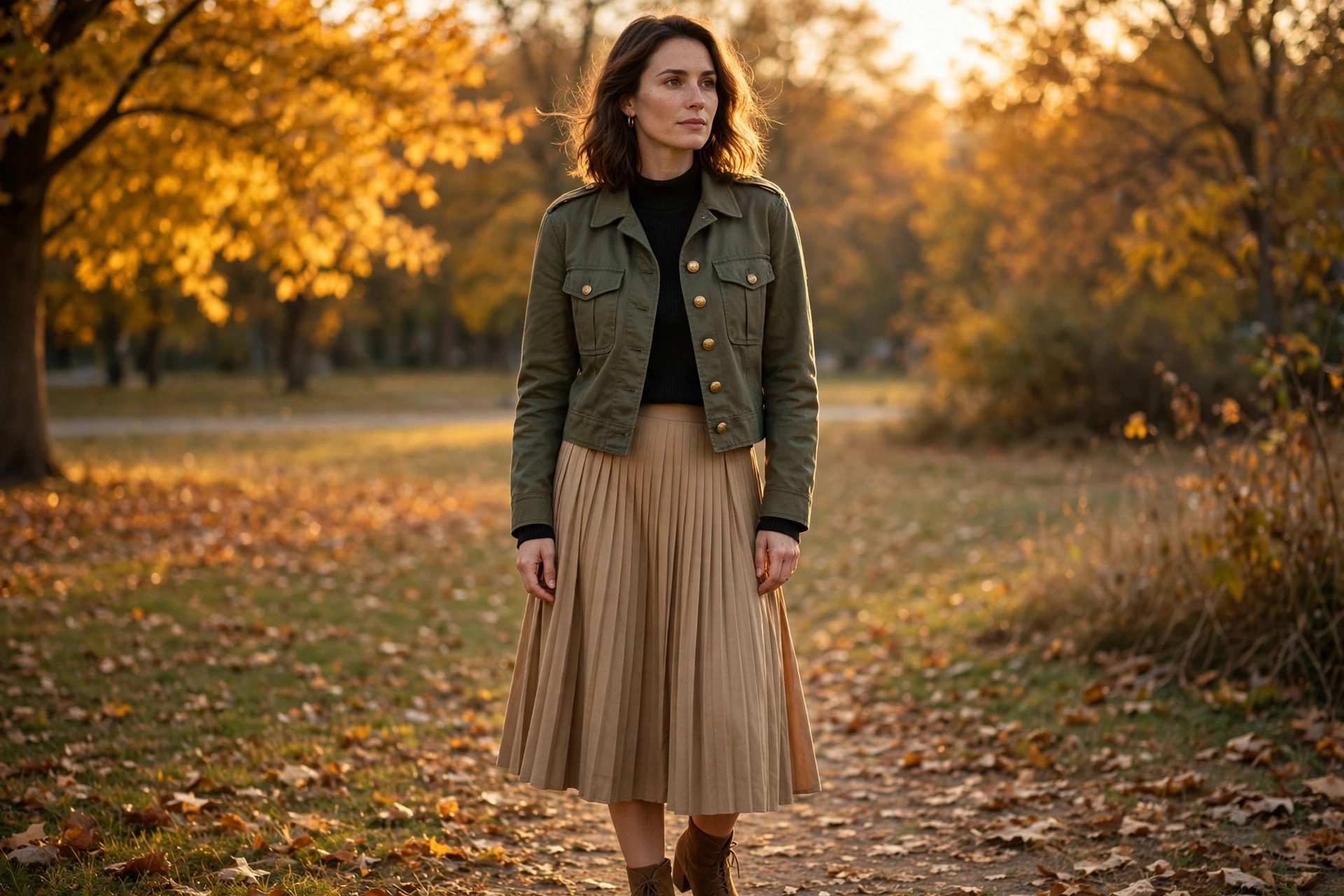
Thrown over an evening dress, a military jacket creates high-low tension that makes an outfit interesting. Match proportions — cropped jackets with long flowing dresses, longer jackets with short dresses — and let a peacoat or cropped blazer do the talking.

A black slip dress with an olive field jacket and heeled boots is one of the chicest autumn evening looks there is — relaxed, confident, and quietly striking. The trick to getting this right is proportion:
- Long, flowing dress: choose a cropped military jacket that ends at the waist, so the silhouette stays defined.
- Short dress: a longer field jacket that skims the hip works better, keeping everything balanced.
- Fitted dress: a bodycon midi or tailored slip gives you complete freedom, since the jacket becomes the statement layer over a clean canvas.
For a dressier interpretation, look to the peacoat. A double-breasted navy or black peacoat with brass buttons, worn open over a cocktail dress or a silk camisole and wide-leg trousers, reads as effortlessly elegant. The gilt buttons catch the light beautifully in the evening, and the naval heritage gives the whole look a classic, almost cinematic quality. Add a red lip and you are done — the jacket does the talking.
Do not overlook the cropped military blazer for evenings either. With its nipped waist, strong shoulders, and rows of buttons, it works like a dinner jacket with attitude. Wear it buttoned over a lace camisole and high-waisted trousers, or open over a simple black dress. It is the sort of piece that makes people ask where you got it, which is always a good sign.
How Do Cargo Trousers Fit the Utilitarian Look?
Cargo trousers are the military jacket’s natural partner this autumn — slimmer through the leg, higher in the rise, cut from softer fabrics. Let one piece star by contrasting colours, pair them with boots, and add one soft layer on top.
Heritage dressing this autumn is a head-to-toe story, and cargos have been quietly refined over the past few seasons. In fall 2026 they are genuinely elegant. Paired with a military jacket, they create a cohesive utilitarian look that feels intentional rather than costumey.
The key is to let one piece be the star. If your jacket is a classic olive field jacket, try cargos in a contrasting neutral — black, stone, or chocolate — so the outfit does not read as a uniform. If your jacket is black or navy, olive or khaki cargos bring the military story to the trousers instead. This balancing act keeps the look fashionable rather than literal, which is the difference between style and fancy dress.
Footwear matters enormously with cargos. The refined 2026 cargo, which usually tapers or sits just above the ankle, looks best with a boot that fills the gap: ankle boots, Chelsea boots, or even a sleek lace-up. Avoid trainers with this particular combination unless the whole outfit is deliberately casual — the goal is utilitarian chic, not off-duty uniform.
Finish with something soft on top to balance all that structure. A fine-knit roll neck in cream or camel, a silk scarf at the neck, or a cashmere jumper in a gentle neutral all stop the outfit feeling too severe. In our experience, the most successful military-inspired outfits always include one element of softness; it is the contrast that makes them beautiful.
Which Cut Should I Choose: Field Jacket, Bomber, or Peacoat?
The three classics each have a distinct personality: the field jacket is the casual all-rounder, the cropped bomber defines the waist and suits shorter frames, and the peacoat is the dressiest, most timeless investment. Most wardrobes can happily hold two of them.
| Cut | Best for | Watch out for |
|---|---|---|
| Field jacket | Everyday wear; suits almost everyone; most casual of the three | Petite frames should choose a version ending above the hip bone |
| Cropped military bomber | Defining the waist; dresses and high-waisted trousers; leg-lengthening on shorter frames | Works best with high-rise bottoms; low-rise leaves an awkward gap |
| Peacoat | Dressier occasions; curvier figures; the one-jacket investment | Double-breasted styles can feel broad across the bust — wear open over a dark top |
The field jacket is usually cut to the hip with four flap pockets, a pointed collar, and a slightly relaxed fit. The cropped military bomber — with its ribbed hem, strong shoulders, and often double-breasted button front — is the most fashion-forward option. The peacoat is double-breasted with wide lapels and anchor or brass buttons, traditionally in navy wool; it is the jacket you will still be wearing in twenty years. If you can only invest in one, many stylists would point you here.
What Colours, Fabrics, and Details Should I Look For?
Olive remains the signature shade, but khaki, stone, sand, navy, black, deep burgundy, and forest green all belong to the heritage palette. Judge quality by fabric body, button material, stitching, and lining — and always check the shoulder seam and freedom of movement.
Olive flatters an extraordinary range of skin tones and pairs with almost everything in an autumn wardrobe. But the heritage palette is broader than olive alone: khaki, stone, and sand are softer alternatives that feel particularly fresh in 2026; navy and black peacoats are the timeless choice; and deep burgundy or forest green military jackets are a lovely way to wear the trend with a twist.
Fabric is where quality shows. A good field jacket is cut from cotton twill or canvas with a bit of body to it — it should hold its shape, not collapse. Peacoats should be wool or a wool blend with a dense, smooth finish; hold it up to the light and you should not see through it. Quilted military-style jackets, another strong option this autumn, should have even stitching and a filling that does not bunch. These details are what make a jacket look expensive rather than cheap.
Wool itself is a natural fibre long valued for warmth, which is part of why wool and wool-blend peacoats hold up so well through autumn — a point covered in Britannica’s overview of wool. Details to look for include genuine horn or brass buttons rather than plastic, reinforced stitching at stress points, a lining that feels smooth rather than scratchy, and pockets that are actually functional. Epaulettes, storm flaps, and throat latches are the heritage signatures — they do not need to be used, but their presence is what gives the jacket its character. A drawstring or belted waist is a bonus, since it lets you adjust the silhouette to your shape.
When trying on, check the shoulders first: the seam should sit at the edge of your shoulder, not droop past it. You should be able to layer a knit underneath without the jacket pulling across the chest. And move your arms — a good military jacket is cut for movement, a legacy of its uniform origins, so you should be able to reach, drive, and carry shopping bags comfortably.
Which Accessories Complete the Look?
Accessories should echo the jacket’s tailored spirit: a scarf at the throat, a structured bag, a belt over longer jackets, considered jewellery, and a hat as the finishing touch. The mistake is wearing nothing at all, which leaves the look feeling unfinished.
- Scarves: a silk square knotted at the neck adds French polish to a field jacket, while a chunky knit scarf in cream or camel makes the whole look feel cosy and considered.
- Bags: lean structured — a leather satchel, a boxy crossbody, or a classic handbag in tan or black. Avoid anything too slouchy or sporty. Leather, made from animal skins treated by tanning (Britannica’s overview of leather), is what lets a structured bag hold its shape season after season.
- Belts: a belt worn over the jacket at the waist defines your shape and adds a styled, intentional finish, especially with longer field jackets.
- Jewellery: delicate gold pieces play beautifully against utilitarian fabric, or lean into the heritage story with a signet ring, a chunky gold chain, or vintage-style earrings. Either approach works.
- Headwear: a wool beret tucked at an angle with a peacoat, a cashmere beanie with a field jacket, or a classic baseball cap in a neutral tone for relaxed polish.
The contrast between military structure and something soft at the throat is one of the prettiest combinations in autumn dressing — do not be afraid to use hats as the exclamation mark.
How Do I Make It Work for My Shape and Lifestyle?
The military jacket trend is genuinely democratic: petite frames suit cropped cuts and defined waists, tall frames carry longer authentic cuts, curvier figures suit structured shoulders and waist shaping, and busy lives suit washable cotton twill field jackets.
- Petite: look for cropped cuts and avoid anything ending mid-thigh, which can shorten the leg line; a nipped or belted waist keeps your shape defined.
- Tall: you have the luxury of the longer, more authentic cuts — a full-length field jacket or a classic peacoat will look magnificent on you.
- Curvier figures: structure is your friend. Defined shoulders and waist shaping create a beautiful hourglass line, while sturdy fabrics skim rather than cling. Single rows of buttons suit those conscious of their bust, or wear double-breasted styles open over a dark top for a long, slimming vertical line.
- Busy, practical lives: the field jacket in washable cotton twill is your workhorse — practical, hardwearing, and smart enough for anything.
- Office and evenings: invest in the peacoat or cropped military blazer in wool; they dress up beautifully and never look underdone.
- Frequent travellers: a quilted military jacket packs flat, weighs little, and looks sharp the moment you land.
Whatever your shape and whatever your life, the military jacket meets you where you are. It is rare that a single trend is this democratic — genuinely flattering, genuinely practical, and genuinely timeless. Invest in the best quality you can afford, wear it with everything you own, and enjoy the quiet confidence that comes with getting dressed in something with real heritage behind it. Fall 2026 got this one exactly right.
Leave a Reply