
Last updated: October 2026
Quick answer: Modern Oktoberfest dressing blends traditional Bavarian inspiration with contemporary style: dirndl-inspired silhouettes or separates in cream, burgundy, forest green and navy, embroidered and lace details, braided hair, and comfortable boots. The rule is simple — nod to tradition rather than wearing a costume, and dress for a full day outdoors.
Oktoberfest season is here, and whether you are heading to Munich, a local autumn festival, or a friend’s autumn party with a Bavarian theme, the question is the same: what on earth do you wear? The traditional dirndl is beautiful, but it can feel like a costume if you get it wrong — or cost a small fortune if you get it right. The good news is that modern Oktoberfest dressing has evolved into something much more flexible and fun.
Today’s best Oktoberfest outfits blend traditional inspiration with contemporary style. Think dirndl-inspired silhouettes in modern fabrics, Bavarian colour palettes worn in everyday pieces, and thoughtful details — embroidery, braids, alpine accessories — that nod to tradition without fancy dress. This guide covers everything: how to wear a dirndl the modern way, chic alternatives if a dirndl is not for you, what to avoid, and seven complete outfit ideas for every kind of celebration.
A quick note on respect: the dirndl and lederhosen are living traditional garments with real cultural meaning in Bavaria and Austria, not costumes. Wearing them thoughtfully — well-fitted, good quality, styled with care — is appreciated. Wearing a cheap, ill-fitting “sexy” imitation is not. When in doubt, choose elegance over novelty, and you will always be welcome.
How Do You Wear a Dirndl the Modern Way?
Quick answer: The modern dirndl — blouse, bodice, full skirt and apron — comes in midi and mini lengths and fabrics from cotton to velvet. Fit is everything, especially the bodice, and the apron belongs with the garment. Styled with refined accessories and braids, it reads as fashion, not costume.

The dirndl — blouse, bodice, full skirt and apron — is the heart of Oktoberfest dressing, and the modern versions are genuinely gorgeous. Today’s dirndls come in midi and mini lengths, in fabrics from cotton to velvet to silk, in colours far beyond the traditional palette. The key to wearing one in 2026 is fit and styling: it should fit like it was made for you (the bodice in particular — a gaping or straining bodice ruins the whole effect), and the styling should feel current.
Length is the biggest modernisation. A midi dirndl (below the knee) reads elegant and contemporary; a mini dirndl reads playful and young. The traditional ankle-grazing length is beautiful but can feel costume-like outside Munich — midi is the sweet spot for most celebrations. As for the apron: yes, wear it. The apron is part of the garment, not an accessory, and a dirndl without one looks unfinished.
Here is the detail everyone asks about: the apron bow. Tradition says the bow’s position signals your relationship status — tied on the left means single, on the right means taken, in the centre means virgin (traditionally), and at the back means widowed or working as staff. Whether you treat this as fun folklore or ignore it entirely is up to you, but it is worth knowing what you are signalling. When in doubt, left is the classic choice.
Styling a dirndl for a modern feel: choose refined accessories over novelty ones. Delicate gold jewellery rather than plastic alpine kitsch. Ankle boots or elegant flats rather than costume shoes. Natural makeup with a berry lip rather than stage makeup. And hair — braids are the traditional and most beautiful choice, from a simple side braid to a braided crown. A dirndl with polished, modern styling looks like fashion; the same dirndl with a plastic alpine hat looks like a hen party.
What Can You Wear Instead of a Dirndl?
Quick answer: Not everyone wants a dirndl, and that is fine. Borrow Bavaria’s visual language instead: the cream-burgundy-forest green palette, embroidery and lace details, and full-skirt or off-shoulder silhouettes. A peasant blouse with a full midi skirt, or a velvet skirt with a cream blouse, captures the spirit in separates.
Not everyone wants to wear a dirndl, and that is completely fine — there are wonderful ways to dress for the occasion without one. The principle is to borrow the visual language of Bavarian style: the colours (cream, burgundy, forest green, navy, brown), the details (embroidery, lace, braids, alpine motifs), and the silhouettes (full skirts, fitted bodices, off-shoulder necklines).
Strong alternatives include: an off-shoulder peasant blouse in cream or white with a full midi skirt in burgundy or forest green and an embroidered sash or ribbon belt — this captures the dirndl silhouette in separates. A fit-and-flare dress in a Bavarian colour with a lace-trimmed neckline. Dark jeans with an embroidered folk-style blouse and ankle boots — relaxed but clearly in the spirit. Or a velvet midi skirt with a cream Victorian-style blouse and a ribbon choker — romantic alpine elegance without a single traditional garment.
For the most casual celebrations — a decorated autumn gathering, a friend’s garden party — dark jeans, a checked shirt or embroidered top, and boots are perfectly in keeping. The effort threshold should match the occasion: Munich’s tents deserve the full look; the local festival deserves a nod.
Which Colours and Fabrics Work Best for Oktoberfest?
Quick answer: The Bavarian palette — cream, burgundy, forest green, navy, chocolate brown with gold and red accents — is one of autumn’s most flattering. Build your outfit around two or three of these colours for a cohesive look, and let texture and one embroidered detail do the festive work.
The Bavarian palette is one of the most flattering in existence: cream and ivory, burgundy and oxblood, forest and emerald green, navy, chocolate brown, with accents of gold and red. These are rich, warm, autumnal colours that suit almost everyone and photograph beautifully against wooden festival halls and autumn leaves. Building your outfit around two or three of these colours guarantees a cohesive, festive look.
Fabrics with texture do the most work: cotton with embroidery, velvet (magnificent for evening events), lace trims, wool skirts, linen blouses. Embroidery is the signature detail — a little floral embroidery on a blouse, skirt or bag instantly signals the theme. You do not need much; one embroidered piece per outfit is plenty.
Accessories make it festive:
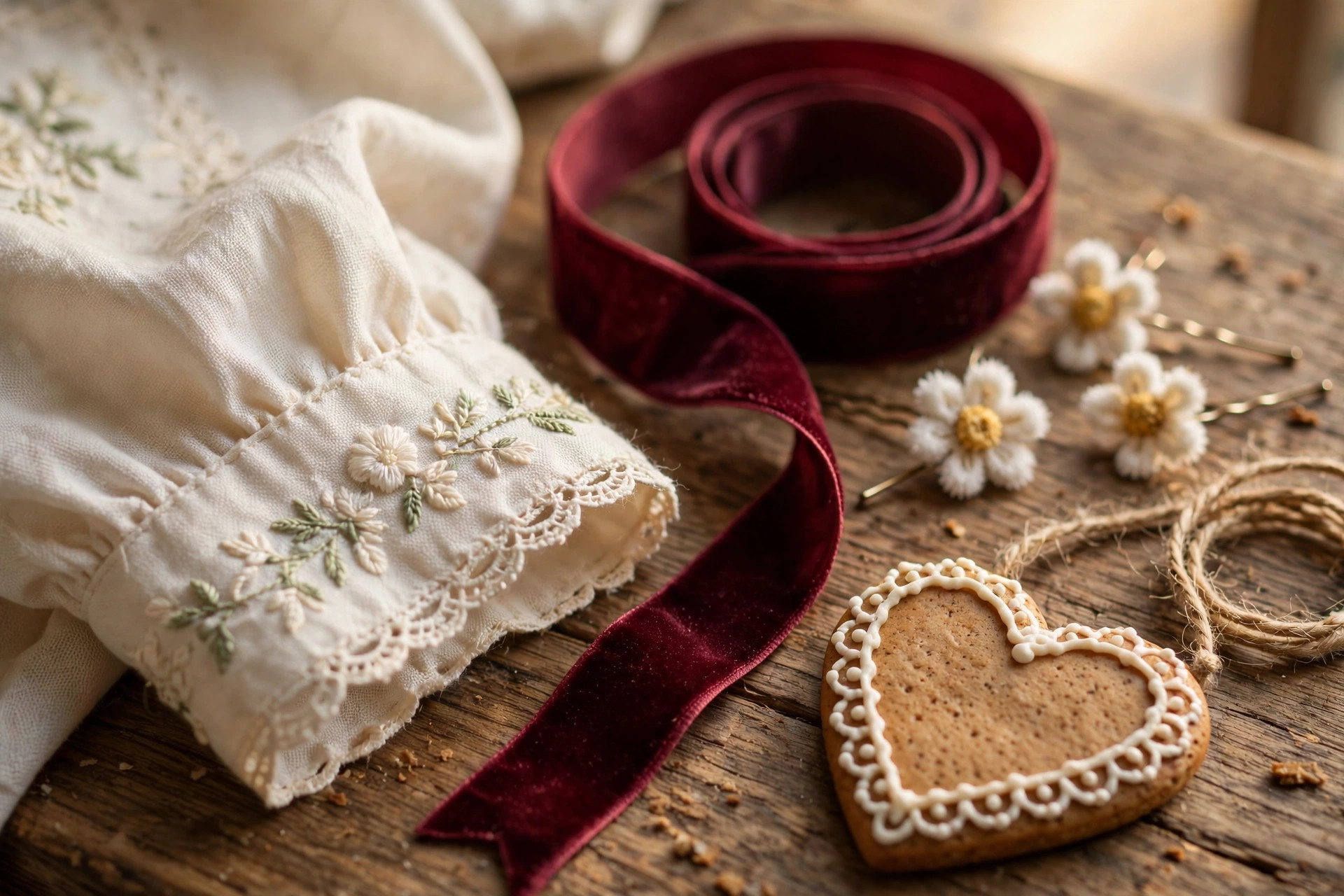
- A velvet ribbon choker or small floral hair pins — keep it delicate, not festival-giant.
- An embroidered bag or a small woven basket bag.
- A shawl or wrap for the evening — Oktoberfest nights get cold, and a beautiful wrap is both practical and pretty.
Avoid the novelty aisle: plastic alpine hats, giant foam mugs and “sexy” costume accessories cheapen the whole look instantly.
Related: velvet fall outfits
What Should You Wear on Your Feet — and What Should You Bring?
Quick answer: Oktoberfest footwear is a practical decision disguised as a style one: hours on your feet, uneven ground, crowds. Ankle boots with a low stable heel, elegant flats or sturdy Mary Janes all work. Pack a crossbody, layers for the evening chill, and essentials like plasters and a charger.
Footwear at Oktoberfest is a practical decision disguised as a style one. You will be on your feet for hours, possibly on uneven ground, in crowds. The traditional choice is the haferlschuh (a sturdy lace-up shoe), but modern equivalents work beautifully: ankle boots with a low, stable heel, elegant flats, or sturdy Mary Janes. What does not work: stilettos (cobblestones and crowds), brand-new shoes (blisters by noon), and anything with a heel you cannot stand in for six hours.
What to bring is almost as important as what to wear. A small crossbody bag — not a large tote — keeps your hands free and stays secure in crowds. Bring cash as well as cards, since some stalls and tents are cash-friendly. A portable phone charger is worth its weight in gold on a long day. Tissues, plasters, lipstick, and a hair tie cover most emergencies. And layers: a dirndl blouse leaves shoulders bare, so a wrap, cardigan or jacket for the evening is essential — late September and October nights outdoors are genuinely cold.
How Do You Do Oktoberfest Hair and Makeup?
Quick answer: The classic Oktoberfest look is fresh and rosy: glowing skin, rosy cheeks, a berry lip, and braided hair that stays put all day. Keep makeup long-wearing for the long day, and don’t skip sun protection — festival days are outdoors. A moisturiser with SPF under makeup handles it.
Oktoberfest beauty has a distinct, charming aesthetic: fresh, rosy, natural with a festive touch. The classic look is glowing skin, rosy cheeks, a berry or red lip, and braided hair. Braids are practically the official hairstyle — a milkmaid braid crown, twin Heidi braids, a braided ponytail, or simply a side braid with small flowers woven in. They are beautiful, they stay put all day, and they suit the occasion perfectly.
Makeup should be long-wearing because it is a long day: a good primer, waterproof mascara, a lip stain rather than a gloss (which will not survive the first toast of the day), and cream blush for that fresh, rosy glow. Keep the look natural rather than dramatic — the outfit is the statement. A tiny heart or flower painted on the cheek is a sweet traditional touch for the festive spirit, if that appeals to you.
One practical beauty note: festival grounds are outdoors and days are long, so sun protection matters even in autumn. A moisturiser with SPF under your makeup, or a setting spray with SPF, keeps you protected without thinking about it. The American Academy of Dermatology (AAD) advises applying a broad-spectrum, water-resistant sunscreen with an SPF of 30 or higher to all skin not covered by clothing, and reapplying every two hours when outdoors. See the AAD’s guidance on year-round sun protection. And pack blotting papers — warm tents plus dancing equals shine, and a quick blot keeps you fresh for photos.
What Are Seven Complete Modern Oktoberfest Outfits?
Quick answer: Whether you’re heading to Munich or a garden party at home, these seven outfits span the full spectrum — the classic midi dirndl, modern velvet separates, a playful mini dirndl, an evening velvet look, no-dirndl chic, a casual folk-blouse pairing, and a cosy at-home celebration look.
- The Munich classic: midi dirndl in burgundy with cream lace-trimmed blouse, embroidered apron, ankle boots, braided crown with small flowers, velvet ribbon choker.
- Modern minimal: forest-green velvet midi skirt, cream off-shoulder blouse, thin gold belt, black ankle boots, delicate gold jewellery, low braided ponytail.
- Playful and young: mini dirndl in navy with white blouse, white ankle socks, black Mary Janes, twin braids with red ribbons, small crossbody bag.
- Evening event: black velvet dirndl-style dress (fitted bodice, full midi skirt), cream silk blouse, heeled ankle boots, faux-fur-look stole, berry lip, elegant updo.
- No-dirndl chic: burgundy fit-and-flare midi dress with embroidered neckline, cream cardigan for later, tan ankle boots, woven basket bag, side braid.
- Casual autumn gathering: dark high-waisted jeans, cream embroidered folk blouse, brown ankle boots, checked scarf, hair in a relaxed braid, crossbody bag.
- Festival party at home: chocolate-brown full midi skirt, ivory Victorian blouse with lace cuffs, burgundy sash tied at the waist, ballet flats, flower pins in a low bun.
Related: fall night out outfits
What Should You Know for the Day Itself?
Quick answer: A little etiquette goes a long way: ask before sitting at reserved tables, greet with ‘Prost!’ and eye contact, pace yourself through the long day, and eat — the food is half the experience. Dress for the weather as much as the theme, and join in the spirit.
A few things worth knowing for the day itself. In Munich’s tents, tables are often reserved — do not sit at a reserved table without asking, and be ready to share tables in the free sections; that is part of the fun. The traditional greeting is “Prost!” with eye contact when you clink mugs together. Pace yourself — festival days are long, so eat well, drink plenty of water, and take breaks. Eat: the food (pretzels, roast chicken, sausages) is half the experience and keeps you going.
Dress with the weather in mind, not just the theme: layers you can add, shoes you can stand in, a bag you can keep close. And remember the spirit of the thing — Oktoberfest is joyful, communal and warm-hearted. The best-dressed person there is not necessarily the one in the most expensive dirndl; it is the one who looks comfortable, happy and ready to join in. Wear your outfit with ease, raise your mug, and enjoy every minute of it. Prost!
Leave a Reply