
Last updated: October 2026
Quick answer: Opalite makeup is a soft, iridescent look that shifts between pearly pink, lavender and soft gold as the light changes. Built on a dewy base with finely milled shimmer, it reads as healthy, luminous skin with a touch of enchantment rather than glitter.
Hold an opal up to the light and watch it shift — pink melting into lavender, a flash of gold, a whisper of blue. Now imagine that effect on cheekbones, eyelids and lips. That is opalite makeup, a soft glow look for fall, and it is every bit as lovely as it sounds. Unlike the flat highlighters of years past, opalite makeup is all about dimension: shimmer that changes with the light and your angle, giving skin a lit-from-within, almost otherworldly radiance.
The best part? In our experience, this look is far more wearable than it looks in close-up photos. Worn well, opalite makeup reads as healthy, luminous skin with a touch of enchantment — not costume glitter. In this guide, we explain exactly what opalite makeup is, which products create the effect, how to build it step by step across your base, eyes, cheeks and lips, and nine practical tips for making iridescence work in real life, from the office to autumn evenings out.
What Is Opalite Makeup, Exactly?
Opalite makeup takes its name from opal gemstones and opalite glass, and it creates a multi-dimensional shimmer in pearly pink, soft lavender, icy lilac and warm soft gold. It is finely milled, smoothly blended colour-shift — not glitter — and it suits fall beautifully, restoring glow as daylight softens.
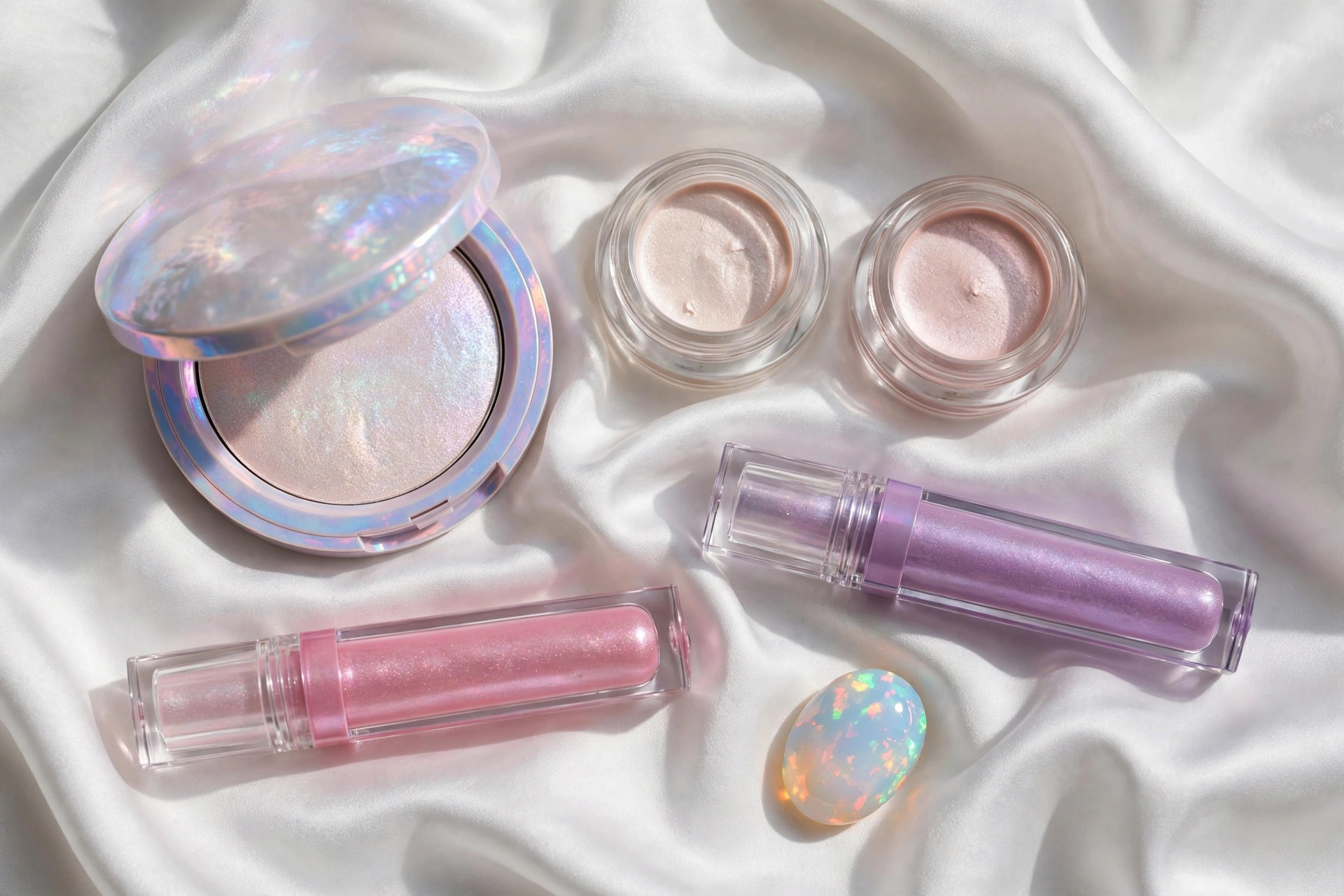
Opalite makeup takes its name and inspiration from opal gemstones — and from opalite glass, the man-made material known for its milky, colour-shifting glow. The defining characteristic is iridescence: pigments that reflect different colours depending on the angle of light. On the skin, this translates to a multi-dimensional shimmer, typically in a family of pearly pink, soft lavender, icy lilac and warm soft gold.
It is worth knowing where the inspiration comes from: opal is a hydrous silica mineral, and its famous play of colour comes from light diffracting through tiny spheres of silica arranged inside the stone, according to Britannica. Makeup borrows that same idea — light, not heavy pigment, doing the work.
Here is how opalite compares with its cousins:
| Look | What it does | How it differs from opalite |
|---|---|---|
| Glitter makeup | Individual sparkle particles | Chunkier and more obvious than smooth opalite shimmer |
| Chrome makeup | Mirror-like finish | Bolder and flatter than soft colour-shifting glow |
| Glass skin | Clear, dewy skin | About clarity without the colour shift |
| Opalite makeup | Colour-shifting luminous veil | The dreamier, more romantic sibling of glass skin |
The look suits fall beautifully. As daylight softens and evenings draw in, skin naturally loses some of its summer luminosity — opalite makeup restores that glow artificially, but in a way that looks intentional and artistic rather than sweaty or oily. It also pairs gorgeously with autumn’s deeper lip colours and cosy textures: imagine pearly lilac lids with a berry lip and a chunky knit. That contrast is the whole mood.
What Products Do You Need for an Iridescent Finish?
You do not need a whole new makeup bag for opalite makeup. Five strategic additions — an iridescent highlighter, shimmer eyeshadows, a dewy base, a glossy lip product and a radiant setting spray — are enough to build the full colour-shifting effect.
You do not need a whole new makeup bag — a few strategic additions will get you there. Here is what to look for.
- Iridescent highlighter: The hero product. Look for shades described as opal, pearl, lilac or “duochrome” — these shift between two or more colours. Cream and liquid formulas melt into skin most naturally; powders give more intensity.
- Shimmer eyeshadow palette or singles: Choose finely milled shimmers in pearl, pink, lavender and soft gold. Avoid chunky glitter for this look — the magic is in the smooth colour shift.
- Dewy base products: A luminous primer or a light layer of liquid highlighter mixed into foundation creates the glowing canvas the trend needs. Matte bases fight the effect, so save those for another day.
- Glossy lip products: Clear or pearly lip gloss, or a lip oil with a hint of shimmer, completes the light-catching story. The lips should gleam, not compete.
- Setting spray with a radiant finish: This melts everything together and adds a final veil of luminosity. Choose “dewy” or “illuminating” over “matte” formulas.
When shopping, swatch in natural light and tilt your hand — a true opalite product will visibly shift colour as the angle changes. If it just looks like plain silver shimmer from every angle, it will not deliver the signature effect.
How Do You Create a Dewy Base That Glows From Within?
Opalite makeup lives or dies on the base, so start with hydrated skin and a luminous primer, keep coverage light, and layer highlighter under and over foundation. Set only the T-zone, and keep powder away from the high points where your glow lives.
Opalite makeup lives or dies on the base. The goal is skin that looks like it is glowing from within, with the iridescence sitting on top like light on water.
- Moisturise first. Hydrated skin reflects light far better than dry skin, so this step genuinely matters.
- Prime with luminosity. Apply a luminous primer all over, or mix a drop of liquid highlighter into your foundation or tinted moisturiser.
- Keep coverage light to medium. Heavy, full-coverage matte foundation will bury the glow you are trying to build. Spot-conceal where needed rather than layering foundation everywhere.
- Layer highlighter under and over. Apply iridescent highlighter under a thin layer of foundation on the high points — cheekbones, brow bones, the bridge of the nose — then add a second, lighter layer on top for the visible gleam.
- Set only where needed. Use finely milled translucent powder on the T-zone only, and keep it away from the high points where your glow lives.
This layering is what separates a flat highlight from a truly dimensional opal effect: the foundation sheers out over the first layer, and the shimmer glows through subtly, like light beneath the surface.
A note of caution for sensitive skin: introduce new shimmer products one at a time and patch-test first, especially around the eyes. If any product causes redness, itching or irritation, discontinue use — no look is worth unhappy skin. The NHS notes that cosmetics are among the substances that can trigger allergic contact dermatitis, and that avoiding the irritant usually lets skin clear up.
How Do You Build the Opal Effect on Eyes, Cheeks and Lips?
Build the opal effect feature by feature with sheer layers and good blending: pressed duochrome shimmer on the lids, cream blush topped with highlighter on the cheeks, and a glossy tinted lip oil or sheer berry gloss on the lips.

With the base glowing, it is time to build the colour-shifting details. The principle throughout is the same: layer sheer, blend well, and let the light do the talking.
Eyes: Sweep a pearly shade across the lid as your base, then press a lavender or pink duochrome shimmer into the centre of the lid with your fingertip — fingers pick up shimmer better than brushes. Add a touch of the same shimmer to the inner corners to make eyes look brighter and more awake. Keep eyeliner soft (a smudged brown or plum) so the shimmer remains the star. Finish with mascara; false lashes are optional and can overwhelm the delicacy of the look.
Cheeks: Apply cream blush first in a soft pink or berry tone, then layer your iridescent highlighter on the tops of the cheekbones, blending upward toward the temples. The blush gives the glow something to sit on — highlighter on bare skin can look stark, but over blush it looks like a natural flush catching the light. A whisper of the same highlighter on the Cupid’s bow ties everything together.
Lips: Keep lips simple and glossy. A tinted lip oil in a rosy shade, topped with clear gloss, gives that juicy, light-catching finish. If you want more colour, a sheer berry lipstick blotted down and topped with gloss is very fall-appropriate. Avoid heavy matte liquid lipsticks here — they contradict the entire luminous story.
How Do You Make Opalite Makeup Wearable in Real Life? 9 Tips
Opalite makeup stays wearable when you start with one feature, apply sheer layers, blend past the edges and check the result in natural light. Match the intensity to the occasion, blot rather than powder midday, and let the glow be the single luminous story on your face.
- Start with one feature. New to iridescence? Begin with glowing cheekbones alone, and add eyes and lips as your confidence grows.
- Sheer is your friend. Every opalite product looks better applied in thin layers and built up. You can always add more; taking away is much harder.
- Blend past the edges. Harsh lines of highlighter look stripey in daylight. Buff the edges so the glow fades seamlessly into skin.
- Check in natural light. Bathroom lighting lies. Step near a window before you leave — iridescence that looked subtle indoors can be surprisingly vivid in daylight.
- Balance with matte elsewhere. If your skin is glowing, keep brows defined but natural and skip heavy contour. One luminous story per face.
- Blot, do not powder, midday. If shine creeps into the T-zone, press blotting papers gently rather than adding powder, which dulls the glow.
- Match intensity to occasion. Daytime calls for the sheer, lit-from-within version; evenings can handle amped-up shimmer on lids and cheekbones.
- Consider your undertones. Cool undertones glow beautifully with lilac and icy pearl; warm undertones shine in soft gold and peachy pink. When in doubt, true pearl suits everyone.
- Photograph it. Opalite makeup was partly made for the camera — the colour shift reads gorgeously in photos. Take a selfie in different lights to appreciate the full effect.
How Do You Adapt Opalite Makeup From Day to Night in Fall?
Opalite makeup transitions easily from day to night using the same products with a heavier hand. Keep daytime sheer with one wash of pearl shimmer, then deepen the eyes, intensify the cheekbones and switch to a richer berry gloss for evening.
One of the loveliest things about this look is how easily it transitions. For daytime, keep the base dewy and sheer, use a single wash of pearl shimmer on the lids, and let a glossy lip do the talking. It reads as polished and healthy — nobody will clock it as a “trend,” which is often the goal.
| Daytime | Evening | |
|---|---|---|
| Base | Dewy and sheer | Same base, slightly more coverage where needed |
| Eyes | Single wash of pearl shimmer | Smoky plum or bronze in the outer corners, more lid shimmer |
| Cheeks | Light highlighter on cheekbones | Intensified highlighter on cheekbones and collarbones |
| Lips | Glossy tinted lip oil | Richer berry gloss |
Seasonally, opalite makeup bridges the gap between summer’s dewy minimalism and winter’s festive sparkle. As fall deepens, try layering it over deeper blush tones — berry, terracotta, plum — which ground the ethereal shimmer in autumn warmth. Come party season, you can push it further with more intense lid shimmer and a touch of sparkle at the inner corners. The look scales with your calendar.
Opalite makeup is ultimately about light — catching it, playing with it, wearing it. In a season when the days grow shorter, there is something quietly joyful about carrying your own glow with you. Start sheer, build slowly, and let your skin do the shimmering.
Leave a Reply