
There is a special kind of tired that arrives with fall. The alarm goes off while it is still dark outside, the house is cold, and your to-do list is already longer than the daylight. Somewhere between getting the kids ready, answering morning emails, and remembering where you left your keys, the idea of exercising feels laughable. Who has an hour for the gym when you barely have ten minutes to drink your coffee while it is still hot?
If that sounds like your mornings, this article is for you. Here is the truth that fitness magazines rarely say out loud: you do not need an hour, a gym membership, or fancy equipment to feel the benefits of morning movement. Ten minutes — even five — of intentional, gentle exercise can wake up your body, clear the fog from your mind, and give you steadier energy through the day. Research consistently shows that short bouts of movement count, and that consistency matters far more than duration.
This is not a punishing boot camp or a transformation challenge. It is a fall energy reset: a small, kind morning routine built for real, busy women with full lives. Everything here is no-equipment, low-impact, and designed to be done in your living room, in your pyjamas if you like, before the day sweeps you away. You will find a 10-minute energising routine, a 5-minute stretch option for the days when even ten feels like too much, and practical ideas for making it stick when life gets hectic.
One important note before we begin: this is general wellness information, not medical advice. If you are pregnant, recovering from an injury or surgery, or managing a health condition, check with your doctor or a qualified health professional before starting any new exercise routine. And always listen to your body — gentle discomfort is one thing, but sharp pain is always a signal to stop.
Why Your Mornings Need a Movement Reset This Fall

Fall changes everything about mornings. The light arrives later, the air turns chilly, and our bodies respond by wanting to slow down and stay warm under the duvet. Add shorter days and busier schedules — back-to-school routines, work ramping up after summer, holiday planning creeping in — and it is no wonder so many of us feel sluggish by mid-morning.
Morning movement works against all of that, gently. When you move your body shortly after waking, several good things happen at once. Your heart rate rises a little, which increases blood flow to your brain and muscles. Your body releases endorphins, the feel-good chemicals that lift your mood and take the edge off stress. Your joints loosen up after a night of stillness, which means less of that creaky, stiff feeling when you get moving. Many women also find that a short morning workout improves their focus for hours afterwards — you start the day feeling capable rather than already behind.
There is also a quieter benefit that nobody talks about enough: keeping a small promise to yourself first thing in the morning builds self-trust. On days when everything feels chaotic, those ten minutes become proof that you can show up for yourself. That feeling carries into everything else — the difficult meeting, the patience you need with your toddler, the boundaries you set with your time.
The key word here is gentle. This is not about punishing yourself for the biscuits you ate yesterday or chasing some ideal body. It is about energy, mood, and starting the day in your own skin feeling awake and ready. Fall is the perfect season for this kind of reset, because the cosy, inward-turning energy of autumn naturally invites routines that feel grounding rather than gruelling.
The 10-Minute Morning Energy Reset
This is your core routine: ten minutes, three parts, no equipment, no jumping around your flat at dawn. Do it in the order given, because each part prepares your body for the next. Put on something comfortable, clear a small patch of floor, and if you like, play a favourite song or open a window for fresh air. Set a timer if it helps, or simply move through at your own pace — the whole thing should take about ten minutes.
Part 1: Wake up (2 minutes)
Start standing with your feet hip-width apart. Roll your shoulders slowly backwards five times, then forwards five times, letting your arms hang loose. Next, gently tilt your head from side to side, ear towards shoulder, holding each side for a few breaths — no forcing, just easing out the night’s stiffness. Finish with ten gentle marching steps in place, lifting your knees to a comfortable height and swinging your arms naturally. You should feel your breathing deepen slightly and warmth spreading through your body. That is your circulation waking up.
Part 2: Energise (6 minutes)
Now move through this simple circuit. Do each exercise for 40 seconds, rest for 20 seconds, then move to the next. One round of the circuit takes six minutes. The moves are deliberately low-impact: kind to knees, kind to neighbours downstairs, kind to your just-woken-up body.
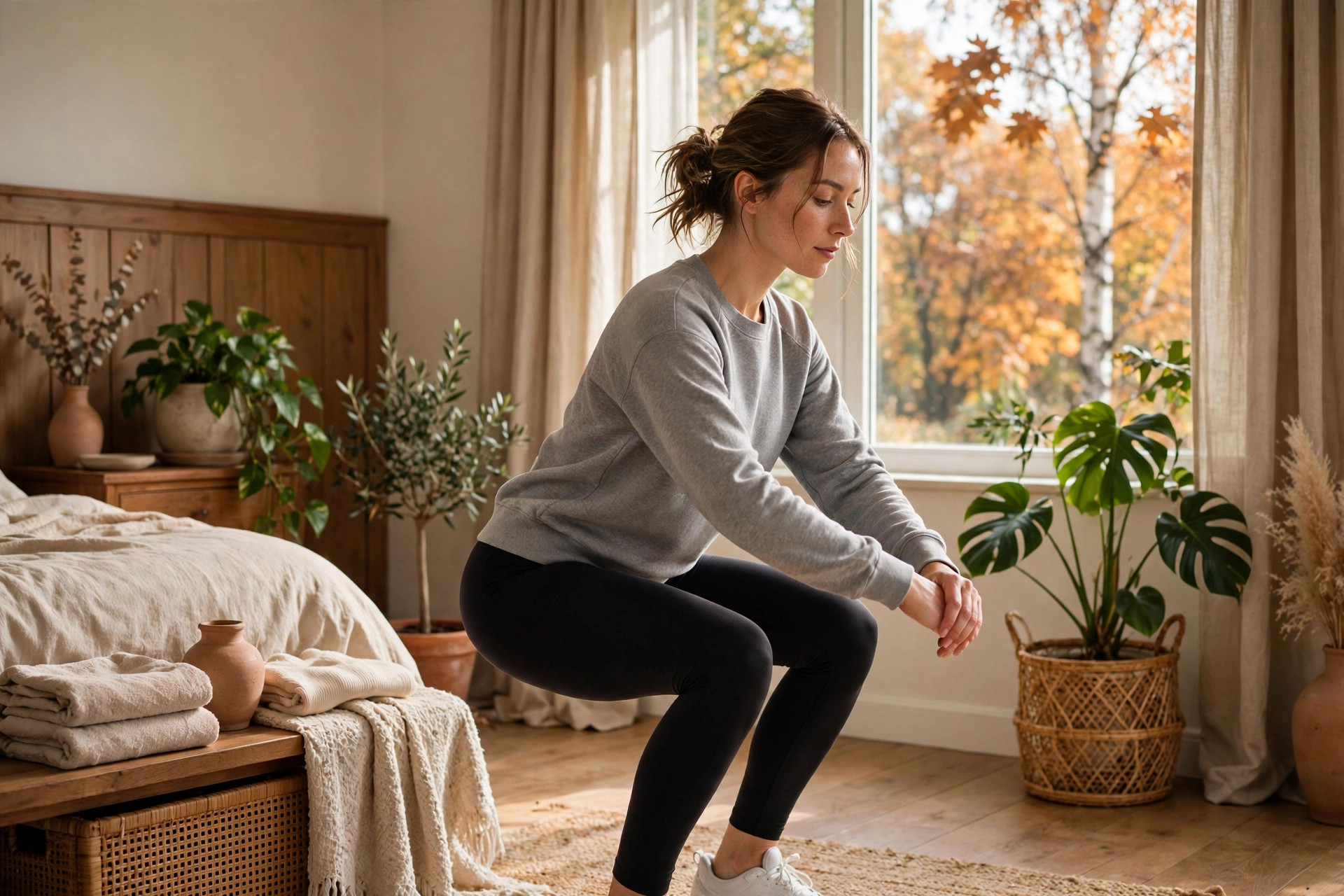
- Bodyweight squats: Stand with feet a little wider than your hips, toes pointing slightly out. Bend your knees and push your hips back as if sitting into an invisible chair, keeping your chest lifted. Go only as low as feels comfortable, then press through your heels to stand. This wakes up the biggest muscles in your body — your glutes and thighs — which is the fastest way to feel energised.
- Standing knee lifts with a twist: Lift your right knee towards your chest while rotating your torso gently so your left elbow moves towards the knee. Alternate sides in a slow, controlled rhythm. This works your core and gets your spine moving, which is wonderful after a night of lying still.
- Wall press-ups: Stand an arm’s length from a wall, place your palms flat against it at shoulder height, and bend your elbows to bring your chest towards the wall, then push back. Keep your body in one straight line from head to heels. These strengthen your arms, shoulders, and chest without any strain on your wrists.
- Standing side bends: Stand tall, raise your right arm overhead, and lean gently to the left, feeling a stretch along your right side. Hold for a breath or two, return to centre, and repeat on the other side. Alternate slowly. This opens up the ribcage and helps you breathe more deeply for the rest of the day.
- Glute bridges (on the floor): Lie on your back with knees bent and feet flat on the floor. Press through your heels to lift your hips towards the ceiling, squeeze your glutes at the top for a breath, then lower slowly. This is one of the best gentle moves for counteracting all the sitting most of us do.
- Marching with arm reaches: Finish standing: march in place while reaching one arm up towards the ceiling at a time, alternating sides. Reach tall, as if picking apples from a high branch. End with three slow, deep breaths, arms sweeping up overhead on the inhale and floating down on the exhale.
Part 3: Settle (2 minutes)
End exactly as you should start the day: calmly. Stand still, close your eyes if you like, and take five slow breaths — in through your nose, out through your mouth. Roll your shoulders once more, shake out your hands, and notice how you feel. Warmer? More awake? A little proud of yourself? Hold onto that feeling. That is the whole point.
On days when you have a little more time or energy, you can run through the energise circuit twice for a 16-minute session. On days when ten minutes feels impossible, do just Part 1 and Part 3 — four minutes of gentle movement still counts, and still changes how the morning feels.
The 5-Minute Gentle Wake-Up Stretch
Some mornings, your body does not want a workout. It wants to be coaxed, not commanded. Maybe you slept badly, or your back is achy, or you are simply running on empty. On those days, try this five-minute stretch sequence instead of skipping movement altogether. It is done entirely at a slow pace, much of it on the floor, and it feels like giving yourself a hug from the inside.
Start lying on your back with your knees bent. Hug one knee gently towards your chest and hold for five slow breaths, feeling the lower back release. Switch legs. Then hug both knees in and rock very gently from side to side, massaging your lower back against the floor. Next, drop both bent knees slowly to one side, keeping your shoulders on the floor, and turn your head the opposite way — a gentle spinal twist that feels wonderful first thing in the morning. Hold for five breaths each side.
Come up to sitting and do a slow cat-cow: on hands and knees, inhale as you let your belly drop and lift your gaze, exhale as you round your back and tuck your chin. Move with your breath for about a minute — there is no rush. Finish seated with your legs crossed: reach both arms overhead, interlace your fingers, and lean gently to each side. Take three deep breaths, and you are done. Five minutes, zero sweat, and your body will thank you with easier movement all morning.
Keep a yoga mat or a folded blanket in a visible spot — beside the bed, or rolled in the corner of the living room. The easier it is to start, the more likely you are to do it. This stretch sequence also works beautifully in the evening if mornings get away from you; the routine bends to fit your life, not the other way round.
No-Equipment Strength Moves That Actually Work
A common worry is that without weights or a gym, you cannot build real strength. That is simply not true. Your body is already a perfectly good piece of exercise equipment, and bodyweight moves — done consistently — build the functional strength that makes daily life easier: carrying shopping, lifting toddlers, climbing stairs without getting winded, and keeping good posture at a desk.
The squats, wall press-ups, and glute bridges in the 10-minute routine are genuine strength exercises, not just warm-ups. If you want to progress over the weeks of fall, here is how to make them gradually more challenging without buying a single thing. For squats, slow down: take three full seconds to lower and three to rise — your muscles will work much harder. For wall press-ups, step your feet further from the wall to increase the angle, or graduate to press-ups on a sturdy table or the edge of the sofa. For glute bridges, try lifting one foot slightly off the floor while holding the bridge, alternating sides.
Two more moves worth adding once the basics feel easy: the standing calf raise and the dead bug. Calf raises are exactly what they sound like — stand tall, rise up onto your toes slowly, pause, and lower. Do fifteen; your lower legs will feel it. The dead bug is done lying on your back: raise your arms towards the ceiling and your knees over your hips, then slowly extend your right arm overhead and your left leg out straight, hovering just above the floor, before returning and switching sides. It looks easy and is sneakily excellent for your core.
Aim to include two or three strength-focused mornings per week, alternating with the gentler stretch days. Muscles need a day to recover and rebuild — that is when they actually get stronger. And remember that strength here is a means to an end: the end is a body that carries you through your busy days with energy to spare.
How to Make It Stick When Life Is Busy
Knowing what to do is the easy part. Doing it on a rainy Tuesday when the baby was up all night and you have a 9 a.m. deadline — that is the real challenge. So let us be honest about what actually works for busy women, based on what behaviour research tells us about habits.
First, shrink the commitment until it feels almost silly. Do not promise yourself “I will exercise every morning.” Promise yourself “I will roll out my mat and do the two-minute wake-up.” That is it. On most days you will keep going once you have started, but on the hard days, two minutes still counts as keeping your promise — and keeping promises to yourself is what builds the habit.
Second, attach the routine to something you already do. This is called habit stacking, and it works because the existing habit becomes the trigger. “After I brush my teeth, I do my morning movement” is far more reliable than “I will exercise at 6:30.” Your morning already has anchors — the kettle boiling, the shower warming up, the first school-run bag packed. Tie your ten minutes to one of them.
Third, prepare the night before. Lay out your workout clothes (or just sleep in them — no judgement here), put the mat where you will see it, and fill a glass of water for the bedside. Every decision you remove from the morning is one less reason to skip. Fourth, track it simply: a tick on the calendar, a note in your phone. Watching a streak of ticks grow is quietly motivating, and if you miss a day, the rule is simple — never miss twice.
Finally, be flexible about timing. If the morning genuinely does not work — night shifts, small children, unpredictable schedules — move it. A ten-minute routine at lunchtime or in the evening still gives you the energy and mood benefits. The “morning” in morning workouts is a suggestion, not a law. The best time to move is the time you will actually do it.
Listen to Your Body First
A quick but important section, because the internet is full of “no excuses” fitness messaging that can do more harm than good. Your body is not a machine, and some days it will ask for rest instead of movement. Learning to hear the difference between “I am being lazy” and “I genuinely need rest” is one of the most valuable fitness skills there is — and it takes practice.
Move gently or rest completely if you are ill, injured, or in pain. Skip the workout if you are dizzy, short of breath in an unusual way, or experiencing chest discomfort — and seek medical advice if those symptoms are new or worrying. During your menstrual cycle, you may find that some days call for the full energising routine and others call for the gentle stretch or nothing at all; both are fine, and honouring that rhythm is smart, not weak.
If you are pregnant or recently postpartum, congratulations — and please get personalised guidance from your midwife, doctor, or a qualified postnatal fitness professional rather than following a general article. Bodies in these seasons have specific needs and deserve specific advice. The same applies if you are managing any ongoing health condition: a quick check-in with your doctor or physiotherapist before starting is always worth it.
The goal of this routine is to leave you feeling better than when you started — warmer, looser, more awake, a little brighter. If a particular move does not feel good in your body, skip it or swap it for something that does. There are no grades here. The only perfect workout is the one that respects the body doing it.
Your Fall Energy Reset Starts Tomorrow
You do not need to overhaul your life to feel more energised this fall. You need ten minutes, a small patch of floor, and the willingness to begin before you feel ready. Try the 10-minute energy reset tomorrow morning — just once. Notice how the rest of the day feels. Notice whether your afternoon slump arrives a little later, or a little softer. Notice the small, quiet pride of having done something kind for yourself before the world asked anything of you.
Then do it again the next day. And the next. Not perfectly — life will interrupt, and that is fine — but regularly enough that it becomes part of who you are: a woman who moves her body in the morning because it makes her days better. That is the real energy reset. Not a challenge, not a programme, just a small daily vote for the energetic, capable, well-rested-feeling woman you already are underneath the tiredness.
This fall, let your mornings belong to you first. Ten minutes. You have got this.
Leave a Reply