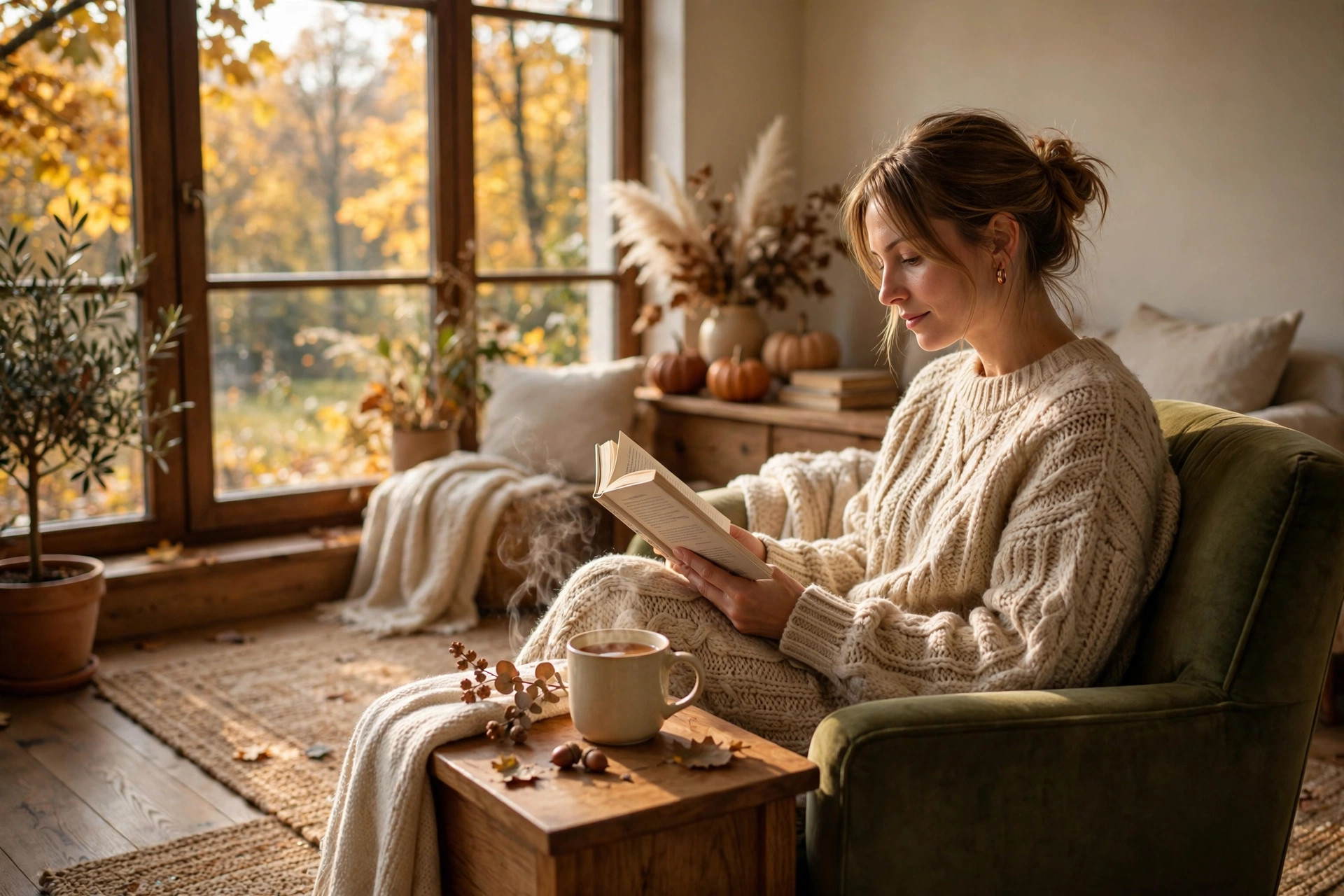
You know that feeling when October arrives and suddenly everyone is rushing? Rushing to decorate, rushing to plan, rushing to make the season “count” before it slips away. The irony is hard to miss: fall is supposed to be the season of slowing down — the trees do it, the light does it, the whole natural world exhales — and yet so many of us spend it sprinting.
Slow living offers a different way. It is not about quitting your job, moving to a cottage, or abandoning every ambition. It is much simpler and much more radical than that: it is the practice of doing ordinary things with your full attention, at a human pace, and finding them beautiful. Making tea slowly. Walking without headphones. Eating dinner at the table instead of over the sink. Small things, done on purpose.
To “romanticise” your life does not mean pretending it is perfect. It means choosing to notice the loveliness that is already there — the steam rising from your mug, the particular gold of October light, the satisfaction of a pot of soup bubbling on the stove. Fall, with all its softness and sensory richness, is the easiest season in the year to practise this. This guide will show you how, with practical ideas you can start today, whatever your life looks like.
What Slow Living Really Means (and What It Does Not)
Let us clear up a common misunderstanding first. Slow living is not laziness, and it is not a luxury reserved for people without jobs or children. At its heart, it is a philosophy that questions the idea that faster is always better. It asks: what if you did fewer things, but did them well? What if you measured a good day by how present you felt, not by how much you crossed off a list?
The slow living movement grew out of the slow food movement of the 1980s, which began as a protest against fast food and the rushing of meals. Over the decades it has widened into a gentle life philosophy: slow mornings, slow travel, slow fashion, slow technology. The common thread is intentionality — choosing quality of experience over quantity of activity, and refusing to let urgency set the tempo of your whole life.
What slow living is not: it is not about having an empty calendar. A busy mother of three can live slowly; a person with no job can live frantically. It is not about perfection or aesthetics, either — your slow living does not need to look like a magazine spread to count. And it is certainly not about judging other people’s pace. It is a personal practice, a quiet rebellion you carry out in your own kitchen, your own evenings, your own breath.
Think of it this way: fast living treats time as something to spend as quickly as possible. Slow living treats time as something to savour. Fall gives us the perfect excuse to switch from one to the other, because the season itself is slowing down all around us. The invitation is everywhere. We only have to accept it.
Why Autumn Is Made for Slowing Down
There is a reason slow living content blooms every fall. The season is practically designed for it. The light softens into golds and ambers that make even an ordinary Tuesday afternoon look cinematic. The air turns crisp, which makes warm drinks, blankets, and ovens feel like necessities rather than indulgences. Nature itself is demonstrating the art of letting go — leaves falling without resistance, gardens settling into rest, animals preparing for quiet months.
Psychologically, fall marks a natural transition point. Summer’s outward, social, high-energy months give way to a season that invites reflection and nesting. Many of us feel this shift instinctively: the urge to light candles earlier, to cook heartier food, to stay in on a Friday night without guilt. Slow living simply gives that instinct a name and a little structure, so it becomes a practice rather than a passing mood.
There is also a practical argument. The run-up to the end of the year can be genuinely overwhelming — work deadlines, school terms, holiday preparations stacking up. Building slowness into your autumn now is like laying down insulation before winter: it protects your energy for the busier weeks ahead. A slower fall is not an indulgence you cannot afford. It is preparation you cannot afford to skip.
Slow Mornings: Start the Day Softly
Mornings set the tempo for everything that follows. If you begin the day grabbing your phone, skimming bad news, and rushing through breakfast, your nervous system learns that urgency is the default — and it will stay in that gear until bedtime. Slow mornings are the single most powerful slow-living practice, and they do not require waking at dawn.
The core idea is simple: protect the first 20 to 30 minutes of your day from input. No phone, no news, no emails. Instead, do one thing at a time, slowly. Make your tea or coffee with attention — notice the sound of the kettle, the warmth of the mug in your hands. Sit by a window and watch the morning arrive. Eat breakfast sitting down, tasting it. These sound like tiny things because they are tiny things. That is the whole point.
If you have children or an early start, adapt rather than abandon. Your slow morning might be five unhurried minutes with your coffee before anyone else wakes, or a calm, phone-free school run where you notice the leaves changing along the route. One reader of ours keeps a “morning page” habit: three handwritten lines about how she wants the day to feel, written while the kettle boils. It takes ninety seconds and she swears it changes everything.
A few more ideas to try: open the curtains the moment you wake and let the daylight in; stretch for two minutes before touching your phone; play one favourite song while you get ready and actually listen to it; step outside for sixty seconds and feel the morning air. None of these require extra time — they only require presence. That is the currency of slow living.
The Kitchen as a Slow-Living Sanctuary
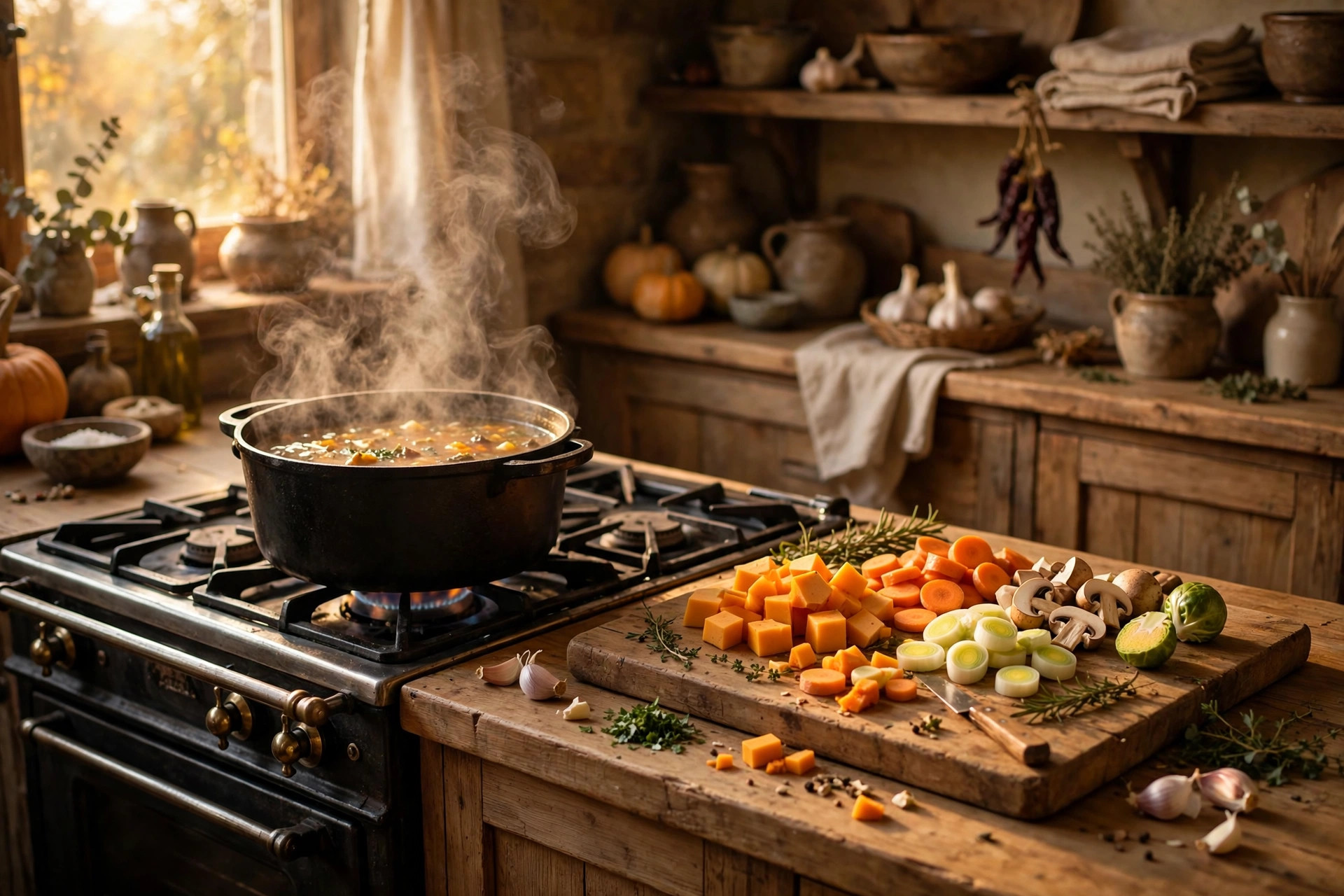
If slow living has a headquarters, it is the kitchen in October. Nowhere else does the philosophy become so deliciously concrete. Slow food — cooking from simple ingredients, without rushing — is where most people first taste what slowness feels like, and fall’s harvest gives you the finest raw materials of the year: squash, apples, root vegetables, warming spices.
You do not need to become a different cook. You only need to change how you cook, occasionally. Pick one meal a week to make slowly and properly — a soup that simmers for an hour, bread that rises while you do other things, an apple crumble assembled without hurry. Put on music or a favourite podcast, or cook in companionable silence. Chop vegetables mindfully instead of racing through. Taste as you go. Let the kitchen fill with good smells. This is not inefficient; it is the opposite of wasted time.
Baking deserves a special mention because it is slow living in edible form. Bread, in particular, cannot be rushed — the dough rises on its own schedule, and you must wait. That waiting is the practice. Sourdough, focaccia, a simple soda bread: all forgiving for beginners, all deeply satisfying. And few things romanticise a fall afternoon like the smell of baking bread drifting through a warm house.
Extend the slowness to eating, too. Set the table properly, even on a weeknight — a cloth napkin, a candle, the good glasses. Sit down together if you can, or alone with a book if that is your life right now. Eat without a screen at least sometimes. Notice flavours. Linger over the last sips of tea. A meal eaten slowly nourishes you twice: once with food, once with calm.
Cosy Evenings Without the Scroll
Here is an uncomfortable truth most of us know by heart: the hours between dinner and bed are where our time goes to disappear. We sit down “for a minute” with our phones and surface an hour later, having absorbed nothing and rested not at all. Slow living asks for those evenings back — not with rules and guilt, but with better invitations.
The trick is replacement, not removal. Willpower alone rarely beats the scroll; a lit candle, a good book, and a warm bath usually do. Build an evening menu of slow pleasures and keep it visible — on the fridge, in your journal, wherever you will see it when the phone beckons. Your menu might include: a chapter of a novel, a jigsaw puzzle worked on over several evenings, writing actual letters to friends, mending clothes by hand, a long bath with a podcast, stargazing from the garden with a blanket, or simply sitting with a cup of something warm and doing nothing at all.
Doing nothing deserves defending, by the way. We have been trained to treat unstructured time as wasted time, but rest without a purpose is where the mind untangles itself. Ten minutes of sitting by the window watching the dark come down is not laziness. It is maintenance — for your attention, your mood, your creativity. Give yourself permission regularly.
Consider a gentle digital sunset: screens off or away an hour before bed, replaced by lamplight and something analogue. You do not have to be perfect about it. Even three screen-free evenings a week will change how your weeks feel. And if you live with others, make it a shared ritual — phones in a basket by the door, the evening belonging to whoever is in the room. Some of the loveliest conversations happen in those reclaimed hours.
Letting Go of the Rush, Gently
Slowing down is simple, but it is not always easy — especially at first. Many of us feel a strange guilt when we are not being productive, as if rest needs to be earned and pleasure needs a justification. If you feel that itch of “I should be doing something” during your slow moments, know that it is normal. It is a habit of mind, and like all habits, it softens with practice.
Start by questioning the rush rather than fighting it. When you feel the familiar surge of hurry, pause and ask: hurry for what? Is there an actual deadline, or am I rushing out of habit? More often than we expect, the answer is habit — and noticing it is usually enough to loosen its grip. You can choose, in that moment, to do the next thing at a walking pace instead of a running one.
It also helps to lower the bar for what counts as slow living. You do not need a whole slow day. You need slow moments, scattered through normal days: the unhurried cup of tea, the walk where you notice five beautiful things, the meal eaten sitting down. These moments accumulate. Over weeks, they change the texture of your life far more than one perfect, Instagram-worthy slow weekend ever could.
And be patient with the people around you. Not everyone will understand why you are suddenly unavailable for frantic plans, or why dinner now takes an hour. You do not need to convert anyone. Just live at your own pace, warmly and without apology, and let the calm speak for itself. Often, it is contagious.
Your Slower, Cosier Fall Begins Now
You do not need permission to slow down, but if you have been waiting for it, consider this it. This fall, let the season teach you its oldest lesson: that letting go can be beautiful, that rest is productive in its own way, and that a life savoured slowly is a life fully lived.
Start small, start today. Light a candle at dinner. Walk the long way home and look at the leaves. Make one meal this week slowly, tasting as you go. Put the phone down for one evening and see what rises to fill the quiet. Each small slowness is a vote for the life you actually want — cosy, present, and yours.
The trees are not hurrying. Neither should you.
Leave a Reply