Last updated: October 2026
Quick answer: Choose a quiet spot with room to sit, add a comfortable cushion or chair and a soft blanket, and finish with warm low light and a scent you love. Start with five to ten minutes a day, keep it simple, and keep the corner ready so sitting down takes seconds.
Most of us have tried meditation at some point. We downloaded an app, sat on the edge of the bed, lasted about ninety seconds, and decided our brain was simply not built for it. But here is the thing nobody tells you: the problem is rarely your brain. It is your environment. Trying to meditate in the same spot where you answer emails, fold laundry, and scroll bad news is like trying to fall asleep at a bus stop. Your brain does not know it is supposed to be calm.
A meditation corner fixes that. It is a small, dedicated spot in your home whose only job is peace. When you sit there, your brain gets the message: this is where we slow down. It does not need to be big, expensive, or picture-perfect. A corner of your bedroom, a quiet spot by a window, even a cleared patch of hallway can work. With a cushion, soft light, and a few thoughtful touches, you can create a space that invites you to sit down every single day.
This guide shows you how to create your own cosy meditation corner step by step — finding the spot, choosing what to sit on, setting light, texture, scent and sound — without spending a fortune, and how to actually use it once it is built.
Why Does a Dedicated Spot Make Meditation Easier?
Meditation is a habit, and habits need cues. A dedicated corner trains your brain to associate one spot with slowing down, removes the friction of setting up each time, and signals that your peace matters enough to take up real space in your home.
Meditation is a habit, and habits need cues. A cue is a signal that tells your brain what to do next, and a dedicated corner is one of the strongest cues you can create. Every time you sit in your corner, you are training your brain to associate that spot with slowing down. After a week or two, just walking over to your corner may start to lower your shoulders. That is not magic. That is conditioning, and it works.
A corner also removes friction. If you have to clear the dining table, find a cushion, and hunt for your headphones every time you want to meditate, you will not do it. But if your corner is always ready, always inviting, sitting down takes five seconds. The easier a habit is to start, the more likely you are to keep it.
And honestly, having a beautiful little corner of your home that exists purely for your wellbeing sends a message to yourself. It says your peace matters enough to take up actual square footage. In a busy household where every surface seems to serve someone else’s needs, that matters more than you might think.
Where Should I Put My Meditation Corner?
Look for a spot that feels naturally calm: a little tucked away, with natural light or the potential for lamplight, where you can sit undisturbed. A square metre is plenty — a bedroom corner, a window spot or even a wide stair landing all work.
Look around your home for a spot that feels naturally calm. The best meditation corners share a few qualities. They are a little bit tucked away, so you feel sheltered rather than exposed. They have decent natural light, or at least the potential for soft lamplight. And they are somewhere you can sit undisturbed for ten or fifteen minutes.
Good candidates include a corner of your bedroom, a spot beside a living room window, a landing on the stairs if it is wide enough, a section of a home office you can visually separate, or even a walk-in wardrobe with the door open. If you have a garden, balcony, or porch, an outdoor corner can be wonderful in mild weather, though you will want an indoor backup for autumn and winter.
You do not need much space. A square metre is plenty. You need room to sit comfortably with your legs crossed or on a small chair, plus a little space beside you for a candle or a cup of tea. If you can stretch your arms out without hitting furniture, you have enough room.
Once you have chosen your spot, claim it. Clear it completely, even if that means relocating a pile of books or a laundry basket. A meditation corner that doubles as storage is not a meditation corner. It needs to feel like its own little world.
What Should I Sit On to Meditate Comfortably?
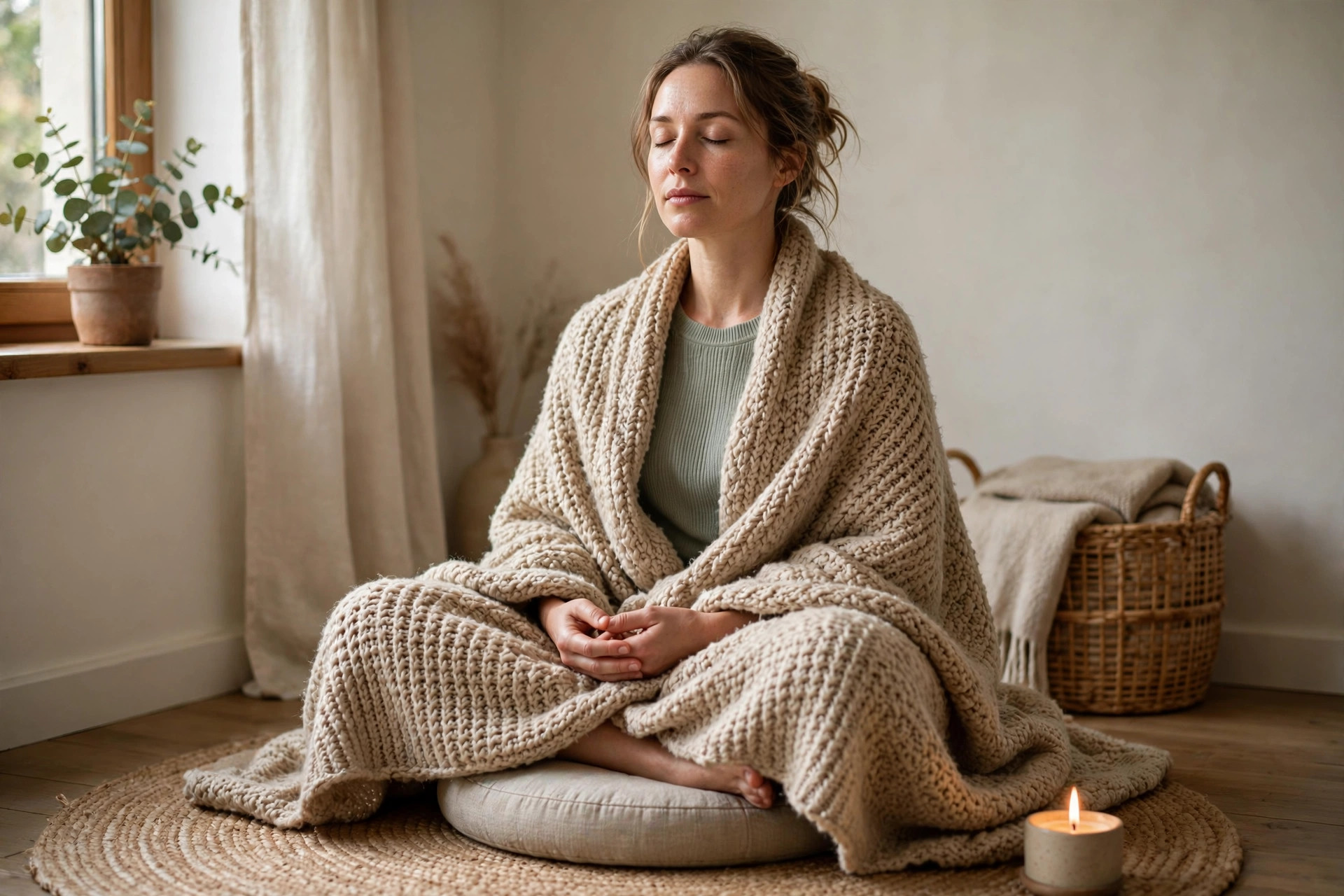
Comfort is a requirement, not a luxury: aching knees will steal your attention. A floor cushion lifts the hips above the knees, a chair works just as well if the floor does not suit you, and a soft blanket adds warmth and a held feeling.
Comfort is not a luxury in meditation. It is a requirement. If your knees ache and your back hurts, you will spend the whole session thinking about your body instead of calming your mind. So invest your main effort here.
- A floor cushion: A round floor cushion, sometimes called a zafu, is the classic choice. It lifts your hips slightly above your knees, which makes sitting cross-legged much more comfortable and helps your spine stack up naturally. If you do not have one, a firm sofa cushion or a folded blanket works just as well. Sit on the front edge so your hips tilt slightly forward.
- A chair: If sitting on the floor does not suit your body, use a chair. There is no rule that says meditation must happen on the floor. A comfortable armchair with your feet flat on the ground and your back supported is a perfectly good meditation seat. What matters is that you can sit upright and relaxed without fidgeting.
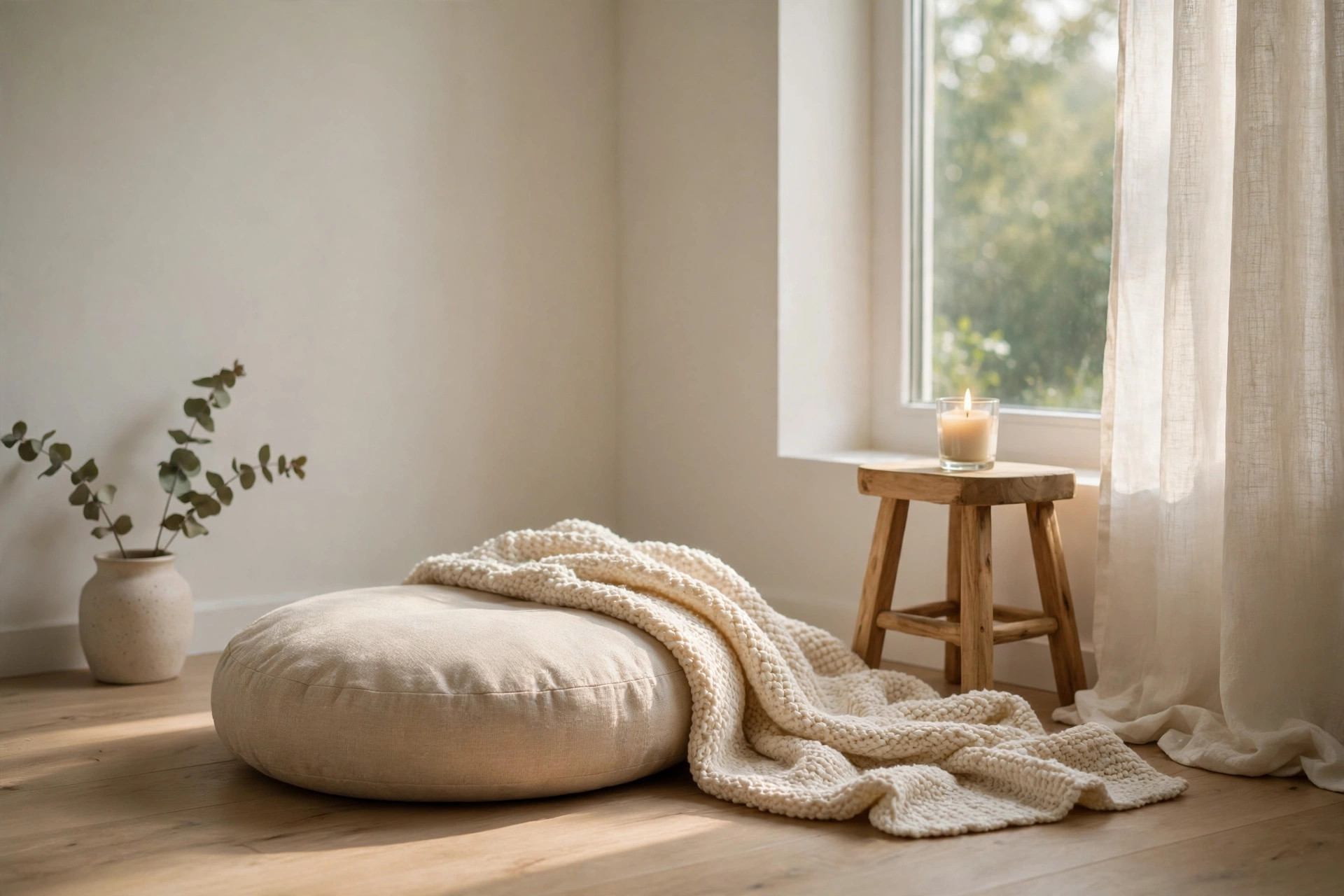
- A soft blanket: Autumn meditation corners practically demand one. A knitted throw over your shoulders or across your lap keeps you warm and adds a feeling of being held, which may help you settle. Keep the blanket folded on your cushion when you are not using it, so your corner always looks ready and inviting.
How Do I Set the Light and Texture?
Soft, warm light says rest; harsh overhead light says office. Use natural light, a warm-toned lamp or candles, and layer texture with a rug, a knitted throw and something tactile for restless hands. These details turn a corner into a nest.
Light changes everything about how a space feels. Harsh overhead lighting says “office.” Soft, warm light says “rest.” Your meditation corner should feel like the second one.
- Natural light: If your corner is near a window, you are already winning. Morning light is especially lovely for meditation, soft and golden.
- A small lamp: For darker spots, add a lamp with a warm-toned bulb. Salt lamps, paper lanterns, and simple table lamps with fabric shades all give that gentle glow. String lights can work too, especially in autumn when the early dark makes everything feel gloomier.
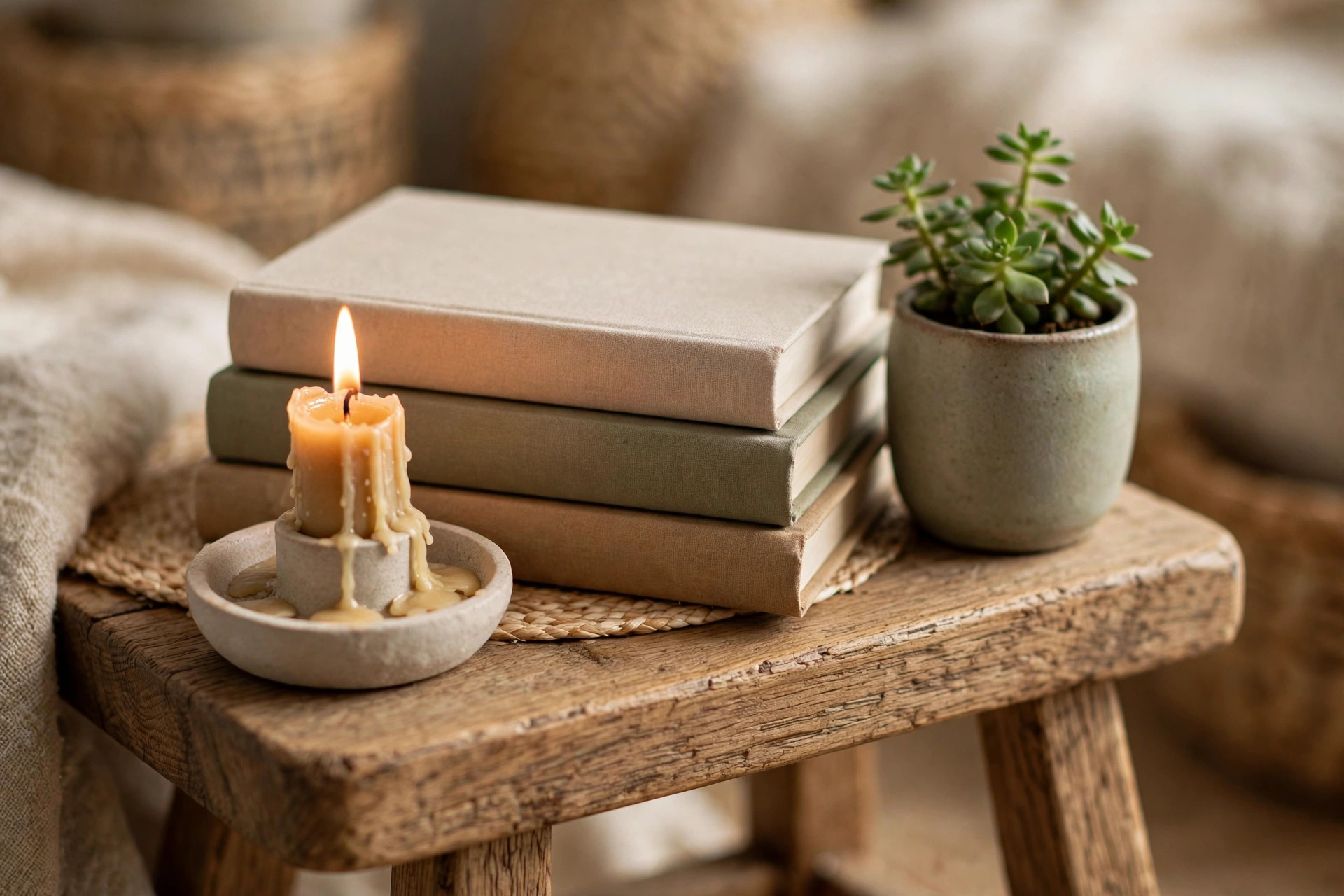
- Candles: The classic meditation corner accessory. The small, living flame gives your eyes something soft to rest on, and the ritual of lighting a candle marks the beginning of your practice beautifully. Use a proper candle holder, keep it away from fabrics, and never leave it burning unattended. If you have pets, children, or a forgetful streak, a good flameless candle gives you the same glow with none of the worry.
- Texture: Layer it. A small rug under your cushion defines the space and softens the floor. A knitted throw adds warmth. A smooth stone, a wooden bead bracelet, or a soft piece of fabric to hold can give restless hands something to do. These tactile details make the corner feel like a nest, and nests are calming.
Which Scents and Sounds Work Best?
Scent reaches the emotional brain fast, so one or two scents you love are enough: a diffuser, a scented candle or a cup of herbal tea. For sound, try gentle rain, a fireplace recording or lyric-free ambient music kept low — a texture, not entertainment.
Scent is one of the fastest routes to calm because smell connects directly to the emotional parts of your brain. You do not need a complicated aromatherapy setup. One or two scents you love are enough.
- A simple essential oil diffuser is the easiest option. In autumn, warm scents like cedarwood, vanilla, cinnamon, and frankincense feel especially cosy. In spring and summer, lighter scents like lavender, bergamot, or eucalyptus work well.
- Simpler alternatives: a scented candle, a small bowl of dried lavender, or even a cup of herbal tea beside you adds a gentle fragrance to your practice.
Sound matters too. Total silence is fine, but many beginners find it unnerving at first, because silence makes the chatter in your head louder. Soft background sound gives your mind something neutral to lean on. Try gentle rain sounds, a crackling fireplace recording, or simple ambient music without lyrics. There are countless free options online. Keep the volume low. It should be a texture, not entertainment.
You might also add one meaningful object. A photo that makes you feel loved. A shell from a favourite beach. A small plant, which adds life and something green to rest your eyes on. A card with a quote that steadies you. One or two personal objects make the corner feel like yours in a way that shop-bought decor never quite manages. Just resist the urge to fill every surface. Empty space is part of the calm.
How Do I Keep My Meditation Corner Simple and Affordable?
You do not need to buy anything to begin: a cushion you own, a blanket from the sofa, a candle and a cleared corner cost nothing. If you spend, spend on comfort — a proper floor cushion and a small rug — and skip the performance pieces.
It is easy to fall into the trap of thinking you need to buy everything before you can begin. You do not. Some of the most peaceful meditation corners in the world are a cushion on the floor and a window. Start with what you have, and add things slowly, only if you genuinely want them.
A realistic starter setup might be: a cushion you already own, a blanket from your sofa, a candle or a small lamp, and a cleared corner. That is it. Total cost: nothing. If you want to spend a little, the best value purchases are a proper floor cushion, which makes sitting comfortable enough to actually do it daily, and a small rug to define the space.
What to skip, at least at first: singing bowls you do not know how to use, expensive meditation apps with subscriptions you will forget to cancel, elaborate altar setups, and anything that makes the corner feel like a performance. Your corner is a tool, not a photoshoot. If it helps you sit down and breathe, it is perfect.
One more thing to skip: perfectionism about the corner itself. It does not need to match your decor. It does not need to be symmetrical. It does not need to impress anyone. The only person who needs to love your meditation corner is you.
How Do I Actually Use My Meditation Corner?
A simple ten-minute beginner routine: light your candle, settle in, take five slow breaths, then notice your breath and gently return your attention each time your mind wanders. Start with five to ten minutes daily, linked to an existing habit.
Building the corner is the fun part. Using it daily is the real practice. Here is a simple beginner routine that takes ten minutes and requires no experience:
- Mark the transition. Sit down in your corner and light your candle or turn on your lamp. This small ritual marks the beginning.
- Settle and breathe. Settle onto your cushion, wrap your blanket around you, and close your eyes. Take five slow breaths, breathing in through your nose and out through your mouth. Feel your body get heavier with each exhale.
- Notice the breath. Breathe normally and simply notice your breath — the air moving in and out, the small pause between breaths. When your mind wanders, and it will, dozens of times, gently bring your attention back to the breath. That bringing-back is the actual meditation. It is not a failure. It is the exercise.
- Close gently. After about eight minutes, or whenever feels right, take three deeper breaths, gently open your eyes, and sit quietly for a moment before standing up. Blow out your candle. That is a complete practice, and it counts just as much as any hour-long session.
Start with five to ten minutes a day. Morning works well for many people, before the day’s noise begins, but any consistent time is fine. Link it to something you already do, like right after you brush your teeth or right before your morning tea, so it becomes part of an existing routine. If you miss a day, just come back the next day. The corner will be waiting.
Many people find a short evening sit helps them unwind too — and the American Psychological Association notes that mindfulness meditation may help ease anxiety and depression. If you find your mind racing at night, a calm corner practice pairs beautifully with a good evening wind-down: the Sleep Foundation recommends keeping your bedroom around 65°F (about 18°C) for the best sleep. Our guide to sleeping better when the nights get longer has gentle ideas for the hours before bed.
How Do I Keep the Meditation Habit Gentle?
The biggest threat to meditation is self-criticism, not distraction: a busy mind is not a failed session. Be kind, expect wandering, and notice the quiet changes over time. If the practice ever feels overwhelming, talk to a professional — there is no shame in support.
The biggest threat to a meditation practice is not distraction. It is self-criticism. Beginners often quit because they think they are “bad at it.” But there is no such thing as being bad at meditation. A busy mind is not a failed meditation. Noticing the busy mind, again and again, is the whole training.
Be as kind to yourself in your practice as your corner is. Some days ten minutes will feel like two. Other days two minutes will feel like ten. Both are fine. The goal is not an empty mind or a blissful experience. The goal is simply to sit down, breathe, and give yourself a few minutes of quiet in a noisy world.
Over time, you may notice small changes. You might react a little less quickly when something annoys you. You might fall asleep a little more easily. You might find yourself looking forward to your corner time the way you look forward to a warm drink. These changes are quiet, but they are real, and they build.
If meditation ever brings up difficult feelings, that is normal too, and it does not mean you are doing it wrong. But if you ever feel overwhelmed, anxious, or distressed by the practice, it is wise to talk to a professional, such as a therapist or counsellor, who can guide you. Meditation is a wellness tool, not a treatment, and there is no shame in getting support.
Your Corner Is Waiting
You do not need the perfect cushion, the perfect room or the perfect moment. Find a corner this weekend, clear it, add a cushion and a blanket, light a candle, and sit down for five minutes. Autumn is the perfect season to begin.
You do not need to wait for the perfect cushion, the perfect room, or the perfect moment. Find a corner this weekend. Clear it, add a cushion and a blanket, light a candle, and sit down for five minutes. That is all it takes to begin.
Autumn is the perfect season for this. The evenings are drawing in, the world is getting quieter, and there is something deeply right about carving out a small warm space that belongs to your inner life. Build your corner, use it gently, and let it become one of your favourite places in your home.
For more ideas on making your home feel like a sanctuary, see our dreamy bedroom ideas for a cozy refresh. Your whole home can feel this calm.
Leave a Reply