Last updated: October 2026
Quick answer: Accessorise a simple outfit by starting with a small daily jewellery uniform — hoops, a pendant, a watch — then adding one statement piece, like a silk scarf or structured bag. Match accessories to your real lifestyle, keep everything else quiet, and simple basics become distinct outfits.
Jeans and a white t-shirt. On their own, perfectly fine — and perfectly forgettable. Add layered gold necklaces, a silk scarf on the bag handle, tortoiseshell sunglasses pushed into the hair, and a structured tan bag, and suddenly it’s an outfit. The clothes didn’t change. Everything around them did.
Accessories are the highest-leverage part of getting dressed. They’re cheaper than clothes, they take up almost no closet space, and one good piece can transform twenty outfits. Here’s how to use them well.
What’s the Easiest Everyday Jewellery Foundation?
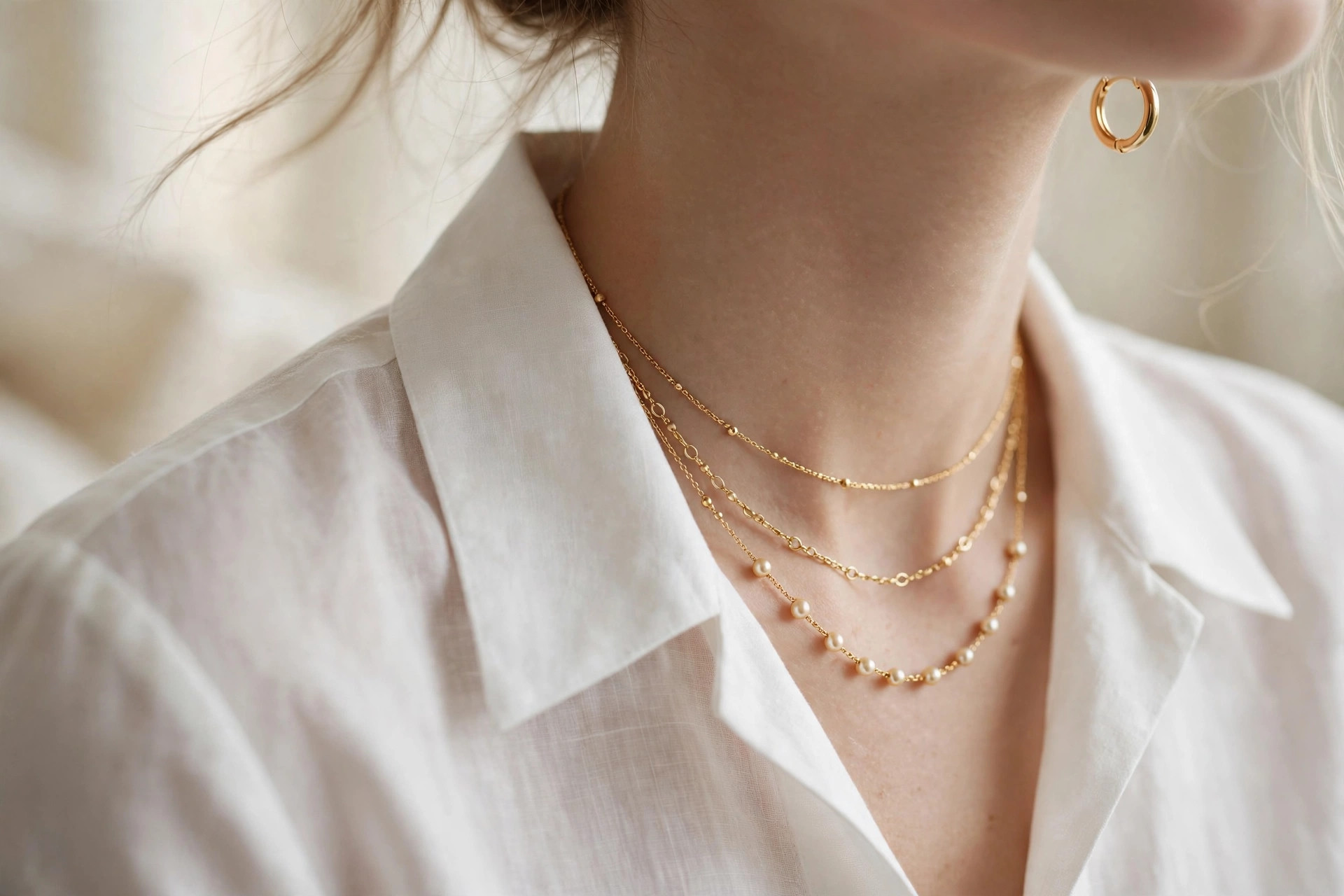
Quick answer: Build a small daily jewellery uniform — small gold hoops, a thin chain with a tiny pendant, and a watch — that you put on every morning in twenty seconds. From that base, layer necklaces of different lengths and mix textures so it looks collected, not bought as a set.
If you do nothing else, build a small daily jewelry uniform: pieces you put on every morning without thinking. For me it’s small gold hoops, a thin chain with a tiny pendant, and a simple watch. It takes twenty seconds and it means I’m never truly “undressed,” even in leggings and a sweatshirt.
From that base, learn to layer:
- Necklaces: two or three of different lengths (say 16, 18, and 20 inches) create depth that one never can. Mix textures rather than matching exactly — a fine chain with a slightly chunkier one looks collected, not purchased-as-a-set.
- Rings: stack beautifully across fingers; keep them in the same metal family so they read as intentional.
- Quality over quantity: cheap jewellery that turns your skin green or loses its plating in a month is the most expensive kind, because you replace it endlessly. A few solid, well-made basics — gold-filled or vermeil rather than plated — will outlast a drawer of fast-fashion pieces and look better every single day.
How Many Ways Can You Wear a Silk Scarf?
Quick answer: A 90cm square silk scarf does at least four jobs: knotted at the neck, tied around a ponytail, wrapped on a bag handle, or threaded through jeans loops as a belt. Start with one print you love, and aim for a slightly imperfect knot.
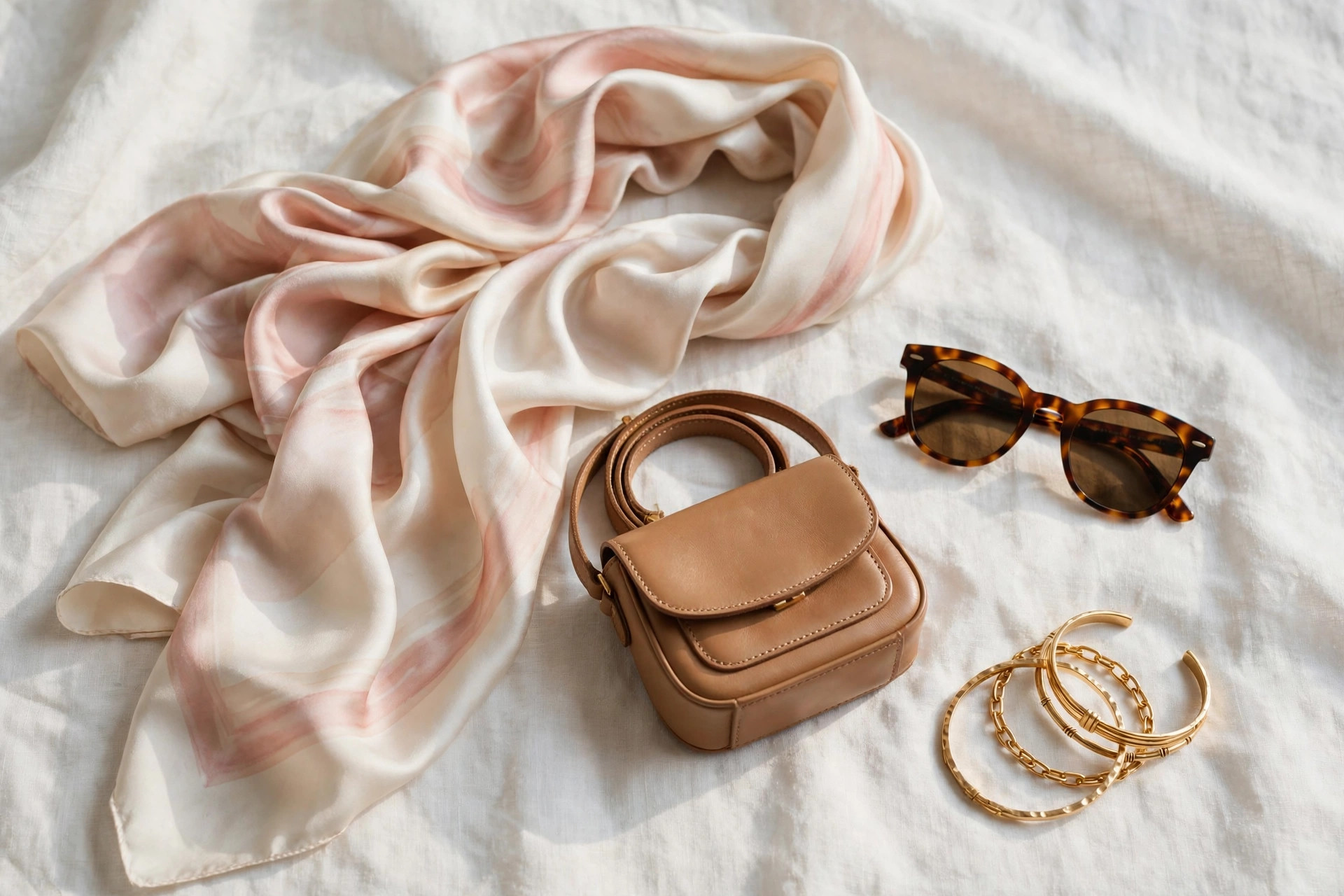
No accessory works harder than a square silk scarf. Knotted at the neck over a plain blouse, it reads Parisian. Folded into a band and tied around a ponytail, it’s playful. Wrapped around a bag handle, it makes an old handbag feel new. Tied as a belt through jeans loops, it’s unexpected in the best way.
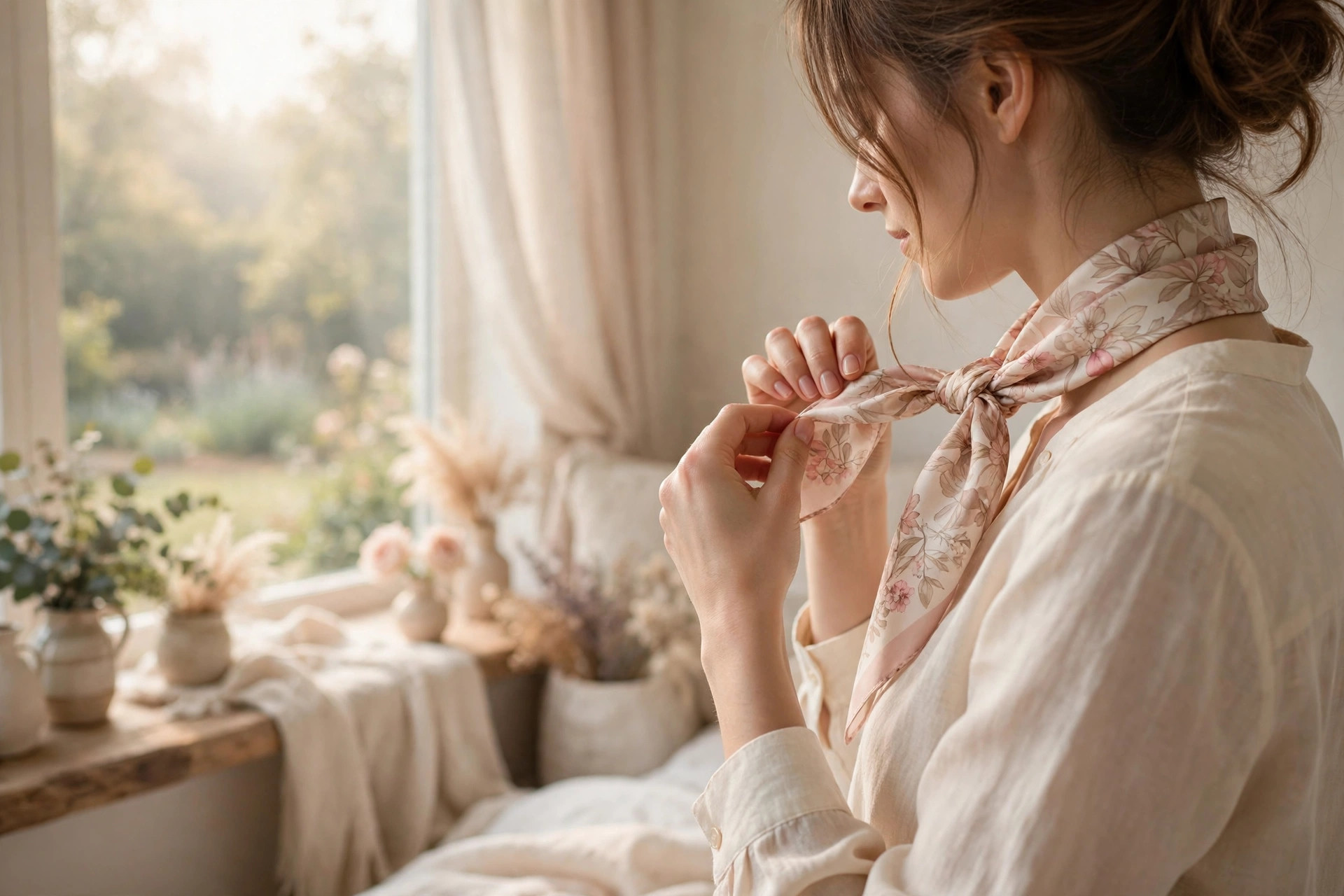
Start with one scarf in a pattern you love — a classic equestrian or floral print in colours that suit you — around 90cm square, which is the most versatile size. The neck knot is the move worth practising: fold into a triangle, roll loosely, drape around your neck, and tie once off-centre. Slightly imperfect is the goal; a too-perfect knot looks fussy.
Scarves are also the smartest souvenir and thrift find. Vintage silk scarves cost a fraction of new ones, the prints are often more beautiful, and nobody else will have yours.
How Do Bags and Belts Change an Outfit?
Quick answer: A bag sets an outfit’s whole register — the same dress reads errands with a canvas tote and lunch meeting with a structured top-handle. A slim leather belt over a blazer, dress, or trousers adds a focal point and definition in one move.
A bag changes an outfit’s entire register. The same dress with a canvas tote says errands; with a structured top-handle bag it says lunch meeting. If you invest anywhere in accessories, make it here: one medium structured bag in a neutral leather (tan, cognac, or black) will carry you through years of outfits.
Belts do the same work at the waist. A slim leather belt over a blazer, a dress, or high-rise trousers adds a focal point and definition in one move. Match your belt to your shoes for a classic pulled-together feel, or deliberately contrast — a tan belt with black trousers — for something more modern. And please, replace the flimsy belt that came with the dress; a real leather belt in the right width looks ten times better.
| Accessory | Best first investment | What it transforms |
|---|---|---|
| Handbag | One medium structured bag in tan, cognac, or black | A simple dress goes from errands to lunch meeting |
| Belt | One slim leather belt in the right width | A blazer or dress gains a waist and a focal point |
Which Small Accessories Make the Biggest Difference?
Quick answer: Sunglasses, hair accessories, a watch with character, and neat nails are the fastest personality transplants in fashion. Find a sunglasses shape that truly suits your face, use claw clips and headbands to signal intention, and remember that neatness — not polish — is the non-negotiable finisher.
Sunglasses are the fastest personality transplant in fashion. Find the shape that suits your face — try on dozens, photograph yourself, be honest — and wear them like you mean it. A great pair of sunglasses with a simple outfit reads as confidence, full stop.
Hair accessories deserve more credit than they get:
- A tortoiseshell claw clip turning a messy bun into something deliberate.
- A padded headband with an otherwise plain outfit.
- A silk scrunchie that matches your scarf.
These tiny choices signal intention, and intention is what separates “threw this on” from “styled.” Don’t forget the practical finishers: a watch with some character (even a simple one), a fragrance you love, and nails that are clean and cared for — polish optional, neatness not.
What’s the One-Statement Rule?
Quick answer: Allow one statement piece per outfit: bold earrings or a bold necklace, never both; a printed scarf or a printed bag, never both. Everything else stays quiet as the background. When one piece speaks, the whole outfit listens; when everything shouts, nothing is heard.
Here’s the rule that prevents accessory overload: one statement piece per outfit. Bold earrings or a bold necklace — not both. A printed scarf or a printed bag — not both. A dramatic cuff or dramatic rings — pick one hand, metaphorically.
The rest stays quiet and lets the star shine. This is why a jewellery uniform works so well as a base: your everyday pieces are the quiet background, and you add one interesting thing on top. When everything shouts, nothing is heard. When one thing speaks, the whole outfit listens.
How Should Your Lifestyle Shape Your Accessories?
Quick answer: Buy for the life you actually have: if you chase toddlers, choose studs, a sturdy watch, and a crossbody over dangling earrings and delicate chains. Desk workers get the most from rings and cuffs; those on their feet all day should treat comfortable shoes as the accessory that matters most.
The best accessory advice is honest about your actual life. If you chase toddlers, long dangling earrings and delicate chains are a liability — choose studs, a sturdy watch, and a crossbody you can forget about. If you work at a desk, rings and cuffs get their moment while necklaces hide under lanyards. If you’re on your feet all day, comfortable shoes are the accessory that matters, and everything else is decoration.
There’s no prize for owning the “right” accessories, only for wearing yours. A woman with three pieces she loves and wears daily always looks more polished than a woman with thirty pieces gathering dust. Buy for the life you have, not the life in the magazine.
What’s in a Perfect Accessory Capsule?
Quick answer: A genuinely versatile accessory wardrobe fits in one small box: daily jewellery, one silk scarf, one structured bag plus one casual one, two belts, face-flattering sunglasses, and three hair accessories. With just these, a closet of simple basics becomes dozens of distinct outfits.
You don’t need much. A genuinely versatile accessory wardrobe fits in one small box:
- Daily jewellery: hoops or studs, a pendant necklace, a watch, two stackable rings
- One silk scarf in a print you adore
- One structured neutral handbag, one casual tote or crossbody
- One slim leather belt and one slightly wider one
- Sunglasses that suit your face
- A claw clip, a headband, and a silk scrunchie
That’s it. With these, a closet of simple basics becomes dozens of distinct outfits. Accessories are also where personal style lives most vividly — two women in identical jeans and white tees look completely different once they’ve accessorised. If you’re still discovering yours, experimenting with accessories is the cheapest, most forgiving way to explore your personal style without committing to a whole new wardrobe.
Start tomorrow: pick your simplest outfit — the jeans-and-tee, the plain black dress — and add three accessories deliberately instead of none. Photograph it. Then remove one. The version with two is almost always the sweet spot, and now you know your own formula. Simple clothes plus thoughtful accessories will never, ever look boring.
Leave a Reply