
There’s a special kind of disappointment in catching your reflection at 4 p.m. and finding your morning face has quietly slid away — foundation patchy, concealer creased, blush nowhere to be found. I’ve been there, and the fix turned out to be simpler than I expected. Makeup longevity is about 80% preparation and layering, and only 20% the products themselves.
The principle is simple: makeup lasts on skin that’s been properly prepped, applied in thin layers, and set strategically. Here’s how to build a face that survives the whole day.
Prep: The Foundation Before the Foundation
Makeup clings best to smooth, hydrated, balanced skin. Skip prep and even the best long-wear foundation will struggle.
Start with a clean face — morning cleanse or at least a rinse removes the oil your skin produced overnight. Then moisturize, and give it two to three minutes to absorb fully. Makeup applied over still-tacky moisturizer slides around; makeup over absorbed moisturizer grips.
If your skin is oily, this is where primer earns its place. A mattifying primer on the T-zone creates a barrier between your skin’s oil and your makeup, which is the number one reason foundation breaks down by afternoon. For dry skin, a hydrating primer does the opposite job — it keeps the base from clinging to dry patches. You don’t need primer everywhere; target the zones where your makeup fails first.
One more prep note: sunscreen is non-negotiable, but let it set for five minutes before makeup. Rushing this step is a classic cause of pilling and sliding.
Thin Layers Beat Thick Ones
This is the single biggest longevity secret, and it’s free. Every layer of makeup should be thin. Thick foundation cracks, thick concealer creases, thick powder looks cakey by hour six.
Apply foundation in a thin, even layer and build coverage only where you need it — usually the center of the face, around the nose and chin. The edges of your face barely need any. Use a damp sponge or brush and press the product in rather than swiping; pressing bonds it to the skin.
Concealer goes on sparingly too, and set it immediately with a tiny amount of powder pressed in with a puff or brush. Concealer that isn’t set will crease — it’s not a flaw in the product, it’s physics.
Cream products (blush, bronzer, contour) should go on before powder, always. Powder first creates a dry surface that cream can’t blend into, and the whole thing separates within hours. The order is: liquid/cream products, then powder to set, then powder products if you use them.
Setting: Powder, Spray, or Both
Setting is what locks everything in place, and the technique matters as much as the product.
Powder: Use a light hand. Press a small amount of translucent powder into the zones that get shiny — typically the T-zone — with a puff or dense brush. Pressing (not sweeping) sets without disturbing the makeup underneath. Avoid powdering the whole face heavily; over-powdering is what makes makeup look dry and aged by evening.
Setting spray: Mist it in an X and T motion from about arm’s length away, eyes closed. The fine mist melts the powdery finish into the skin, making everything look more natural while adding hours of wear. For maximum hold, some makeup artists spray before and after powder — a light mist between layers sandwich-locks everything.
The combination is the gold standard for long days: powder where you get oily, setting spray all over. They do different jobs and they stack.
Eyes That Don’t Smudge or Crease
Eye makeup fails first because eyelids are naturally oily — every blink deposits a little oil onto the shadow and liner.
An eyeshadow primer is the fix. A thin layer across the lid (and under the lower lash line if you wear liner there) gives shadow something to grip. In a pinch, a tiny bit of concealer set with translucent powder works similarly.
For liner, set it: trace over pencil or gel liner with a matching eyeshadow to lock it in. Waterproof formulas genuinely last longer on the waterline and in heat, so save those for long days and events. And apply mascara as the final eye step — eyeshadow fallout landing on wet mascara creates a gritty mess that flakes by afternoon.
Lips That Survive Lunch
Lip color fades fastest because we talk, drink, and eat. For staying power: exfoliate lips gently first (a damp washcloth is enough), apply a thin layer of balm and let it absorb for five minutes, then line your lips fully with a lip liner — not just the edges, the whole lip. Liner is essentially long-wear lipstick in disguise; it grips far better than lipstick alone.
Apply lipstick over the liner, blot with a tissue, and apply a second light layer. This layering doubles wear time. Matte and long-wear liquid formulas last longest, but they’re drying — reserve them for days when longevity matters most and use comfortable formulas otherwise.

The 3 p.m. Rescue (Minimal Touch-Ups)
Even perfect application benefits from one midday check. But touch-ups should be light — piling more product onto tired makeup makes it worse.
Blot first, always. Pressing blotting papers (or a clean tissue in a pinch) onto shiny areas lifts oil without disturbing makeup. Only after blotting should you add anything — and usually you won’t need to. A tiny press of powder on the T-zone and a lipstick refresh is a complete touch-up kit.
What not to do: don’t reapply foundation over the day’s foundation, don’t add concealer on top of creased concealer, and don’t spray setting spray over oil (it seals the oil in). Blot, then assess. Most days, blotting alone brings your makeup back to life.
Your Long-Wear Kit
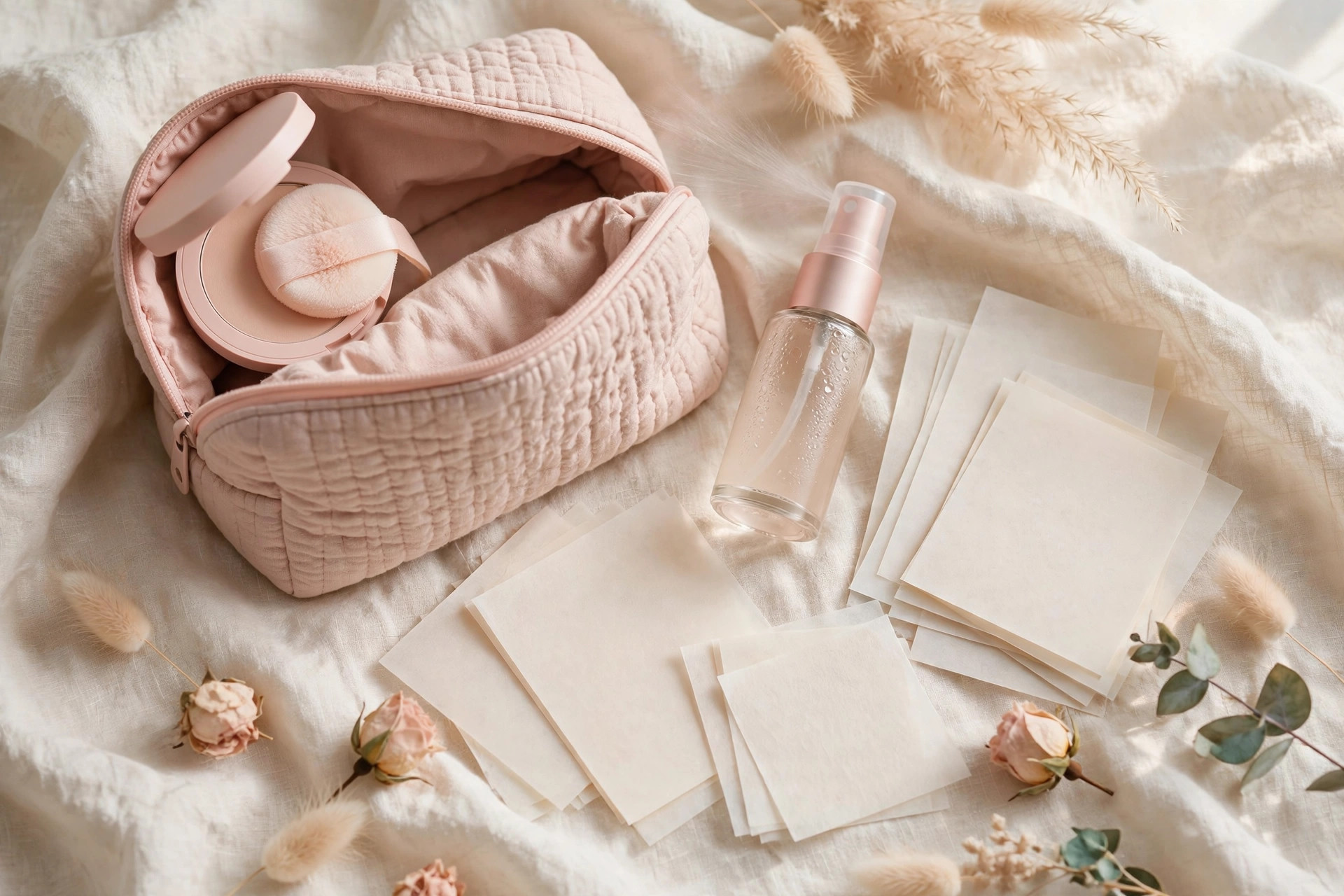
You don’t need much: a primer suited to your skin type, a translucent powder, a setting spray, blotting papers, and your lipstick for reapplication. That’s it. Longevity comes from technique, not from owning twelve setting products.
For a base routine built for staying power, start with this natural everyday foundation application — the thin-layer technique there is the same one that makes makeup last. And when you want your long-wear face to look glamorous too, this soft glam tutorial layers beautifully over the same prep.
Build it thin, set it right, and your 8 a.m. face can absolutely still be your 8 p.m. face.
Leave a Reply